



















One BLM LTVA Permit, Three Winter Bases: La Posa, Imperial Dam, and Midland
Use one winter BLM LTVA permit across La Posa, Imperial Dam, and Midland while matching each move to the route, shared services, and rig eligibility.

One BLM LTVA permit, three winter bases: La Posa, Imperial Dam, and Midland
By Romana | Information checked October 17, 2026

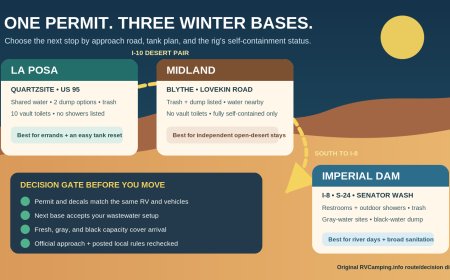
A winter Long-Term Visitor Area permit can support more than one desert base. The current Bureau of Land Management pages say the $180 long-term permit works at all designated LTVAs for the September 15-April 15 season. The short option costs $40, runs for 14 straight days, and can be renewed.[1][2][3] That makes La Posa, Imperial Dam, and Midland a workable three-stop plan without buying another LTVA permit at every move.
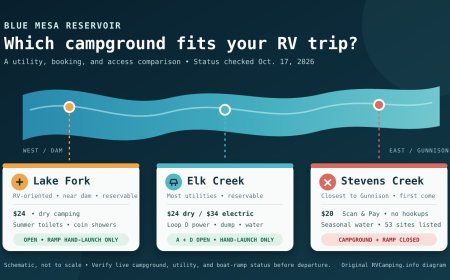
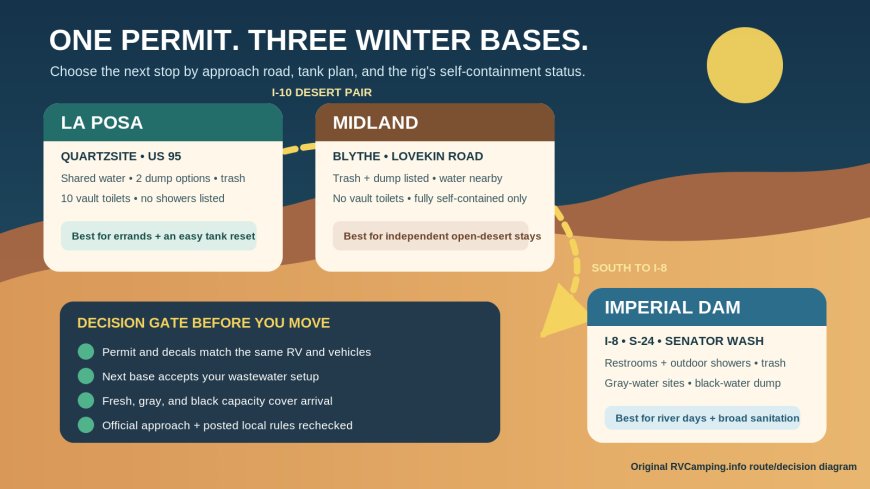
The permit is the shared part. The camping experience is not. La Posa has the easiest Quartzsite access and a strong set of shared tank services. Imperial Dam adds outdoor showers and puts the lower Colorado River at the center of the stay. Midland is the spare, open-desert option north of Blythe, where every camping unit must qualify as self-contained even though BLM lists trash and a dump station.[1][2][3]
The quick routing decision
| If the trip needs... | Start with... | Why |
|---|---|---|
| Quartzsite errands, events, or an I-10 staging base | La Posa | Four camping sections sit about two miles south of Quartzsite along US 95, with shared water, dump, toilet, and trash facilities.[1] |
| Boating, fishing, or a longer Yuma-area stay | Imperial Dam | The approach runs north from I-8 on S-24, then onto Senator Wash Road; BLM lists the broadest onsite sanitation package of these three.[2] |
| Open desert near Blythe with fewer built facilities | Midland | The entrance is eight miles north of Blythe on the Lovekin Road/Midland-Rice Road approach, but the rig must be fully self-contained.[3] |
| A simple west-to-east I-10 progression | Midland, then La Posa | Midland sits north of Blythe; La Posa is reached from Quartzsite. Add Imperial Dam only if the lower Colorado/Yuma leg earns the southward detour.[1][2][3] |
| An I-8 arrival from Southern California | Imperial Dam first | Its official approach begins from I-8. La Posa and Midland fit better as later northbound or I-10 bases.[1][2][3] |
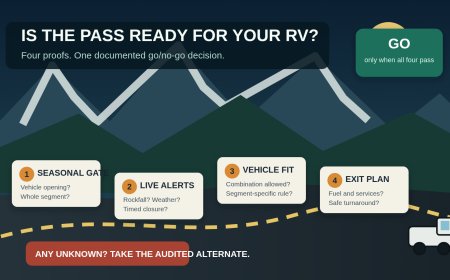
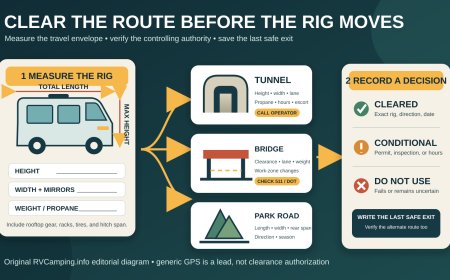
This is a planning sequence, not turn-by-turn navigation. Road work, closures, weather, and rig restrictions can change the sensible line. Recheck the BLM directions and a current large-vehicle route before departure.
What one permit actually covers
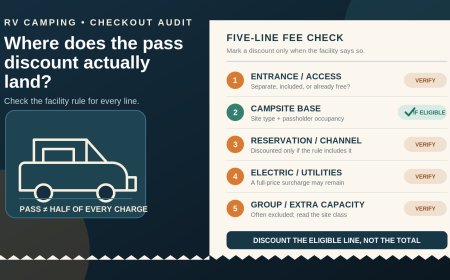
BLM's current location pages agree on the winter price and portability: $180 for the full season or any portion of it, and $40 for a 14-day visit. Both permit types are represented as valid across the designated LTVA system.[1][2][3] America the Beautiful, Senior, Access, and other interagency pass discounts do not reduce Midland's LTVA charge.[3]
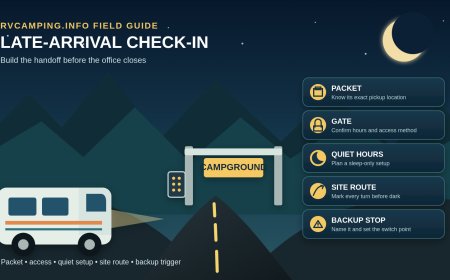
A receipt is not necessarily the last step. BLM's LTVA map page says an online payment through Recreation.gov must be exchanged for the permit and decals at the Yuma Field Office, La Posa, or Imperial Dam. It also says permits are available at host entrance stations or through the listed field offices, but not by mail.[5] Midland's page says its permits can be purchased from the Palm Springs-South Coast Field Office or from the onsite host.[3] If Midland will be the first stop, settle the pickup method before leaving pavement and do not assume an online confirmation alone is the display credential.
The decals travel with the permitted setup. BLM requires the decal on each transportation vehicle and a visible permit on every camping unit; the rules allow no more than two secondary vehicles.[4] A multi-base itinerary should therefore keep the permit materials with the same listed RV and vehicles rather than treating the permit as a shareable campsite pass. It cannot be transferred.[4]
La Posa: the Quartzsite service base
La Posa is the easiest of the three to fold into an I-10 trip through Quartzsite. BLM directs arrivals off I-10 at Quartzsite, then south on US 95 to the North, South, West, and Tyson Wash sections. The entrances begin about two miles south of town.[1] The supplementary rules narrow that further: use only the lawful US 95 access roads. Do not make a shortcut through a berm, ditch, or fence.[4]
Its shared facilities are substantial for an open-desert camping area: ten accessible vault toilets, eight water faucets, trash service, a dry dump, and a dump station supplied with water.[1] Those are common-use facilities, not utilities at the campsite. The BLM listing does not advertise electric, water, or sewer connections at individual camping spots, and it does not list showers.[1]
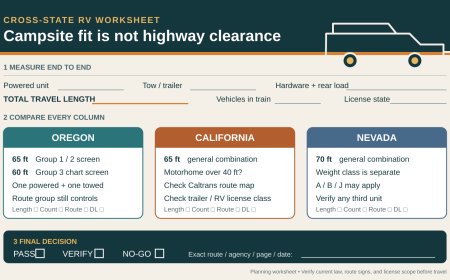
La Posa is the forgiving choice for an RV with modest tank capacity because water and both dump options are already in the LTVA. It also works for a non-self-contained camping unit only within the rule's 500-foot toilet radius. Away from that radius, the unit must meet BLM's self-contained definition: a permanently installed wastewater tank holding at least 10 gallons. Portable toilets and portable waste totes do not satisfy that definition.[4]
Pick the camping surface with the rulebook in mind. Overnight camping in a desert wash is prohibited at La Posa, even if the wash appears level and dry.[4] The legal-access and no-wash rules are good reasons to arrive with enough daylight to evaluate a spot rather than improvising after dark.
Imperial Dam: the river-and-shower base
Imperial Dam is the strongest fit when lower Colorado River recreation matters more than proximity to Quartzsite. BLM sends arriving traffic from I-8 onto S-24 for about 22 miles, followed by roughly two miles on Senator Wash Road.[2] That long approach should be treated as part of the moving day: fuel, food, water, and arrival light are easier to manage before the final leg.
BLM lists two restroom buildings with outdoor showers, trash service, gray-water disposal sites, and a black-water dump with water.[2] As at La Posa, a facility list is not a promise of hookups at each camping spot. Plan for dry camping and shared service runs.
Imperial Dam also allows a non-self-contained unit only when it is camped within 500 feet of a restroom. Elsewhere, the same permanently installed 10-gallon wastewater-tank test applies.[4] The restroom exception can matter to a basic van or pickup camper, but it does not make a portable holding system self-contained. Choose the correct zone rather than stretching the definition.
The no-wash camping rule applies here too.[4] Imperial Dam's water recreation and outdoor showers make it attractive for a longer stay, yet those extras do not change the need to carry drinking water, monitor tank capacity, and confirm that seasonal facilities are operating when you arrive.
Midland: the self-contained Blythe base
Midland is different by design. BLM describes it as open-desert dispersed camping with minimal services, eight miles north of Blythe. From I-10, take the Lovekin Road exit north; after the railroad crossing, the road becomes Midland-Rice Road and the signed LTVA is on the right.[3]
Every Midland camper must be self-contained for wastewater. There is no 500-foot restroom exception because BLM says vault toilets are not provided. The agency's rule requires a permanent wastewater tank of at least 10 gallons and rejects portable toilets, portable waste tanks, and undersized fixed tanks as substitutes.[3][4]
Minimal does not mean zero service. Midland's facilities table marks trash and a dump station as available, places water nearby rather than onsite, and leaves the restroom field blank.[3] Its water notes point travelers to sources in or near Blythe and Ehrenberg, while warning that water formerly available at Blythe's Miller Park is no longer offered.[3] Treat those business and municipal details as leads to confirm, not guaranteed supply. Arrive with enough potable water to cover a closure or changed policy.
Midland works best for a rig that can remain independent between service runs. It is a poor match for a portable-toilet van, a tiny fixed tank below BLM's threshold, or anyone counting on a restroom beside camp. The rules also prohibit camping within two miles outside Midland's boundary, so moving just past the sign is not a legal overflow strategy.[3]
Service differences that change the route
| Service or rule | La Posa | Imperial Dam | Midland |
|---|---|---|---|
| Campsite hookups | None listed | None listed | None listed |
| Water listing | Eight faucets; dump station with water | Black-water dump with water | Water listed nearby; verify before relying on a named source |
| Waste service | Dry dump plus dump with water | Gray-water sites plus black-water dump | Dump station listed |
| Restrooms | Ten accessible vault toilets | Two restroom facilities | No vault toilets listed |
| Showers | Not listed | Outdoor showers | Not listed |
| Non-self-contained camping | Only within 500 feet of a toilet | Only within 500 feet of a restroom | Not allowed |
| Arrival anchor | Quartzsite / US 95 | I-8 / S-24 / Senator Wash Road | Blythe / Lovekin Road |
A service-rich stop can reset the trip. For example, a self-contained rig could use Midland for the quietest open-desert stretch, then move to La Posa or Imperial Dam when it needs easier access to water and sanitation. That is a better use of permit portability than moving on a fixed weekly schedule.
Build the route around the limiting system. Small freshwater capacity favors shorter Midland stays. Limited gray or black capacity favors the places with the simplest dump routine. A basic van that fails the self-contained definition should remove Midland entirely and target the marked toilet-radius zones at La Posa or Imperial Dam.[3][4]
Rules that follow you between bases
Moving does not reset the system-wide rules. BLM's quiet period starts at 10 at night and ends at 6 the next morning, based on the applicable state time zone, unless a sign says otherwise. Generator or other motorized noise can still be judged unreasonable outside those hours.[4]
Keep at least 15 feet between dwelling units. Do not leave the campsite unoccupied for more than five days unless a BLM officer approves it in advance. Pets must stay leashed. Keep motorized travel to established routes, and never release wastewater onto the ground.[4]
Posted local rules win when they differ from the general supplement.[4] Photograph the entrance board at each base. A saved copy gives everyone in the RV the same reference and catches a local restriction that a system-wide brochure cannot.
Do not carry winter assumptions into summer
The one-permit strategy applies to the September 15-April 15 LTVA season. La Posa and Imperial Dam list a different April 16-September 14 fee structure: $15 per vehicle for overnight use, $10 for day use, or a $75 annual vehicle option, plus a 14-days-in-28 limit.[1][2]
Midland's off-season policy is different. Its page says camping is free from April 16 through September 14 under the usual 14-day limit, and that the host and services are absent then.[3] In other words, the three-base winter plan does not roll unchanged into late spring. Rebuild the fee, water, waste, and heat plan for the actual travel dates.
A practical three-base sequence
For an eastbound RV entering on I-10, Midland can be the first low-service test. Arrive full of potable water, verify the dump station before counting on it, and leave while the tanks still have margin. Continue to La Posa for Quartzsite errands and a simpler water-and-waste reset. Imperial Dam then becomes an optional southbound destination rather than an automatic third move.
For an I-8 arrival, reverse the logic. Use Imperial Dam first if river access and showers justify the S-24 approach. Move north only when Quartzsite or Blythe has a purpose. La Posa is the better northern service hub; Midland is the deliberate minimalist stay.
Before every move, check five items:
- the same RV and vehicles remain correctly covered and display the permit;
- the next unit's self-containment rule fits the camping unit;
- onboard water and tank margin cover the arrival plus a service outage;
- the official approach is loaded into the route, with an offline backup; and
- current alerts and the entrance board do not add a restriction.
One permit removes repeat winter permit purchases. It does not remove routing, tank, or eligibility decisions. Use La Posa for Quartzsite access and shared service depth, Imperial Dam for the river corridor and outdoor showers, and Midland when a fully self-contained rig is ready for a leaner Blythe-area base.
Sources
- La Posa Long Term Visitor Area - Bureau of Land Management - Current facilities, directions, seasonal fees, permit portability, and stay limits. Retrieved October 17, 2026.
- Imperial Dam Long Term Visitor Area - Bureau of Land Management - Current facilities, approach directions, seasonal fees, permit portability, and stay limits. Retrieved October 17, 2026.
- Midland Long Term Visitor Area - Bureau of Land Management - Self-containment, facilities, water leads, directions, permit sales, and seasonal operations. Retrieved October 17, 2026.
- Long Term Visitor Area Supplementary Rules - Bureau of Land Management - Permit display, spacing, sanitation, self-containment, access, and site-specific restrictions. Retrieved October 17, 2026.
- Long-Term Visitor Area Map - Bureau of Land Management - Permit purchase and online-voucher exchange locations. Retrieved October 17, 2026.
What's Your Reaction?