




















Who can ride where in a motorhome? Make a travel-seat map before departure
Map factory-designated motorhome travel seats, parked-use beds and sofas, swivel positions, seat belts, and child-restraint compatibility before departure.

Who can ride where in a motorhome? Make a travel-seat map before departure
A motorhome can have a dozen places to sit at camp and only four places meant for people while it is moving. A made-up bed, side bench, swivel cab chair, dinette cushion, or sofa may look comfortable. Appearance does not establish that it is a travel seat, and a loose belt does not establish that a child restraint will work there.
The useful question is not, "How many people can sleep here?" It is, "Which exact seating positions did the manufacturer designate for travel, and what restraint hardware and instructions apply at each one?" Make that map while parked, using the manuals and labels for the motorhome in front of you. Do not infer it from a similar floorplan, a rental listing, or the number of beds.
Start with the factory count, then inspect every position
Find the occupant-and-cargo label, certification label, motorhome owner's manual, chassis manual, floorplan-specific supplement, and any child-restraint instructions supplied with the vehicle. Record the VIN, model year, floorplan, and any seating changes made since delivery. Winnebago's Solis manual says its occupant-and-cargo label includes the number of seat-belt positions, while also warning that its manual is general and some pictured equipment may be optional or unavailable on a given model.[3]
Use the label count as a cross-check, not as a treasure hunt for that many buckles. Map each physical position separately:
| What you find | Put on the map | Do not assume |
|---|---|---|
| Cab seat | Facing direction for travel, lock position, belt type, air-bag instructions | A swivel can remain turned toward the living area |
| Forward- or rear-facing coach seat | Manufacturer designation, belt type, anchor labels, head restraint, occupancy limits | Every belted coach seat accepts every child restraint |
| Side-facing sofa or bench | Exact manual language and belt provision | A belt makes side-facing child-restraint use acceptable |
| Dinette seat | Which individual positions are belted and designated | The whole dinette is one travel row |
| Bed, bunk, or converted sofa | Mark "not a travel seat" unless the exact manual expressly says otherwise | Sleeping capacity equals travel capacity |
| Loose or aftermarket chair | Installer and vehicle-maker documentation | Furniture fasteners create an approved seating position |
Jayco's 2026 Class B manual says not to carry more people than there are seat belts, and says only belted seats may be occupied in motion. It expressly excludes beds and unbelted seats during travel.[1] Winnebago similarly says only belted seats should be occupied while moving and that sleeping facilities are not for use then.[3]
That first pass produces two groups: confirmed travel positions and everything else. Keep uncertain positions in a third group marked "not cleared." An unreadable label or a belt that disappears into cabinetry is a reason to ask the manufacturer or dealer, not a reason to promote the seat yourself.
A seat belt is necessary, but it does not answer every question
For each confirmed travel position, record whether it has a lap-only belt or a lap-and-shoulder belt, where the buckle and belt emerge, whether the belt locks as the manuals require, and whether the seat has a usable head restraint. Photograph the hardware without removing trim. Check webbing, buckles, retractors, and seat mounting for damage or modifications.
Jayco's broad Class B manual notes that some booth dinettes and sofa types have two-point lap belts. It also tells readers to consult the chassis guide and supplied component information because equipment varies.[1] That variation matters. A position suitable for a belted adult is not automatically suitable for a booster, and an apparent anchor is not automatically a child-restraint anchor.
Do not count a loose belt twice, route two people through one belt, or assume a belt left from removed furniture still defines a usable seat. Jayco says never to use one belt for more than one occupant.[1] If a previous owner changed the sofa, dinette, swivel base, pedestal, belt, or floor structure, obtain documentation from the vehicle maker and installer before relying on that position.
Put swivels in travel mode
Swivel cab seats are living-room furniture only after parking. Before driving, return them to the orientation and lock position specified by the exact motorhome and chassis manuals. Jayco requires its driver and front-passenger seats to be locked forward while the motorhome is moving.[1] The Solis manual describes its cab swivels as extra living-area seating while parked, then requires them to be locked and forward-facing in motion.[3]
Add a hands-on check to the departure card: rotate each swivel to travel position, listen or feel for the latch, then try to move it without operating the release. Also restore the seatback and slide position required by the manuals. A chair that looks forward but has not latched is not ready.
The same caution applies to any rotating coach seat. "Swivel" describes a feature, not its approved travel orientation. If the manual does not clearly name the travel position, get the answer for the VIN and installed seat.
Child restraints need a position-by-position compatibility check
Start with the child's current age, size, and restraint instructions. NHTSA advises choosing a restraint that fits both the child and the vehicle, reading both manuals, and keeping children in the back seat through age 12. Its installation guidance says to use either the vehicle seat belt or lower anchors to secure the seat, not both, unless the child-restraint and vehicle instructions permit a different arrangement. For a forward-facing restraint, NHTSA recommends using a tether when both manufacturers allow it.[2]
Now test the proposed motorhome position on paper before test-fitting anything:
- Does the motorhome maker identify it as a travel seating position?
- Does the motorhome or chassis manual permit the required rear-facing or forward-facing orientation there?
- Does the child-restraint manual permit that vehicle-seat orientation and belt type?
- Are the required lower anchors and tether anchor explicitly identified for that position, if that installation method is planned?
- Can the restraint be installed within both manufacturers' limits without borrowing an anchor, routing around furniture, or interfering with another occupant?
- If it is a booster, does the position provide the belt geometry, head support, and seating orientation required by the booster and vehicle manuals?
Jayco says child restraints in the motorhome should face the front or rear, never the side. Its manual directs users to the restraint manufacturer's information and to marked child-seat anchors, but the section is labeled "if equipped." It also warns against putting child restraints or boosters in the front seats.[1] Those statements belong to the Jayco manual's covered vehicles. They are not proof that another motorhome has the same anchors or approved positions.
Never treat a cargo tie-down, furniture bracket, bed latch, or unmarked metal loop as a tether anchor. NHTSA notes that tether anchors in larger vehicles can be on the seatback, floor, ceiling, or elsewhere, which is exactly why location by appearance is unreliable.[2] Match the symbol and the vehicle manual.
If the motorhome manual, chassis manual, and child-restraint manual do not resolve the installation, stop. Contact the motorhome maker with the VIN and floorplan, the chassis maker if the cab position is involved, and the child-restraint manufacturer with the restraint model. A certified child passenger safety technician can help with a hands-on check, but manufacturer restrictions still control.
Beds, aisles, and side benches stay out of the count
A passenger should not ride in a bed because it is low, padded, or surrounded by walls. Jayco specifically says not to occupy beds in motion.[1] Winnebago says sleeping facilities are not to be used while moving.[3] Mark every bed, bunk, pop-top, and converted sleeping surface as a parked-use area unless the exact vehicle documentation clearly identifies a separate travel seating position there.
Treat the aisle, bathroom, floor, and standing room the same way: they are not travel positions. Do not let anyone move around to cook, use the toilet, retrieve gear, or tend to a child while the motorhome is underway. Pull over in a safe place first.
Side-facing positions deserve an explicit note rather than a guess. Jayco's child-restraint section prohibits installing a child restraint so its occupant faces the side.[1] For adults, use only positions the exact motorhome maker designates and follow its belt instructions. Do not turn that product-specific answer into a claim about all motorhomes.
Make one card that the whole group can use
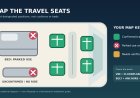
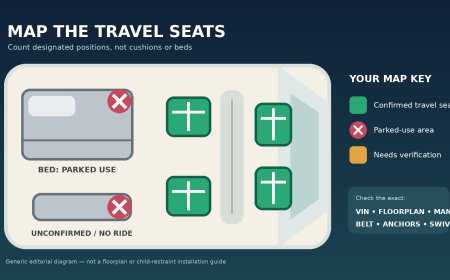
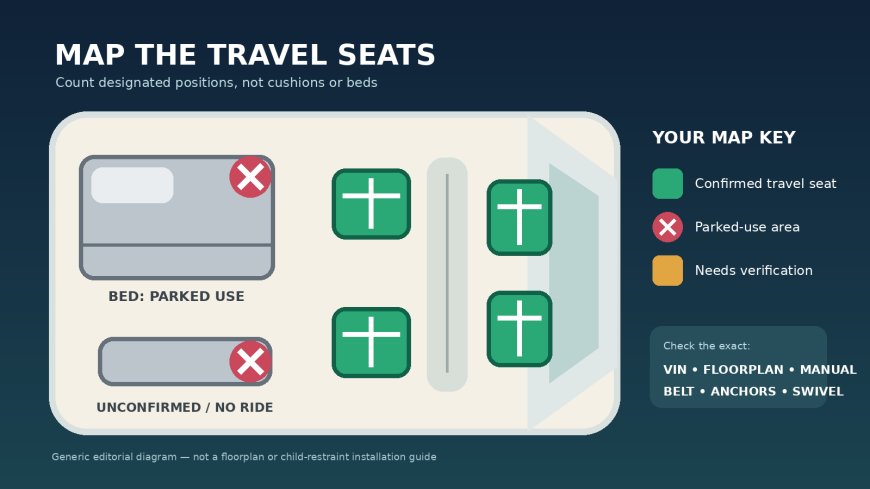
Draw a top-down outline of the actual motorhome. Number every seat-shaped surface, then give each one a status:
- Green: factory-designated travel position, with its required orientation and restraint identified.
- Amber: travel position confirmed, but child-restraint compatibility or another use remains unresolved.
- Gray: parked-use furniture, bed, aisle, or unbelted area; nobody rides there.
Beside the drawing, list occupant name, assigned position, belt type, child-restraint model if used, installation method, tether location, air-bag restriction, swivel-lock check, and the manual pages that support the decision. Keep the card with offline copies of the manuals.
Rebuild the map after a furniture, belt, swivel-base, or floor modification; after a collision; when changing child restraints; or when the passenger roster changes. Inspect the actual belts and seat locks before each departure. If the number of confirmed positions does not fit the group, change the vehicle or use another passenger vehicle. Beds and spare cushions do not supply the missing seats.
The map is complete when each rider has one manufacturer-designated position and every restraint question is answered for that position. Everything else remains camp furniture until the documentation says otherwise.
Sources
What's Your Reaction?