





RV overnight stops at truck stops: a parking plan that respects the lot
Confirm permission at the exact truck stop, arrive safely, keep slides and awnings in, clear fuel lanes, control idling and leave on time.

RV overnight stops at truck stops: a parking plan that respects the lot
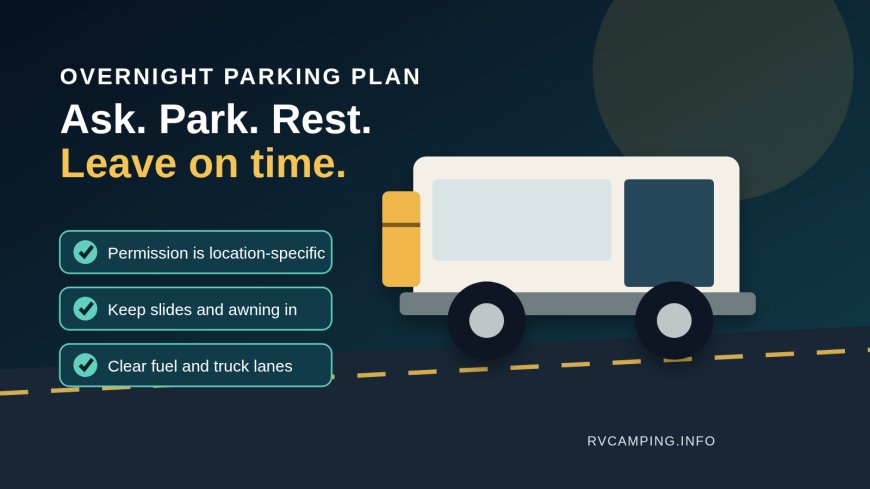
**Short answer:** An RV may stay overnight only when that specific travel center permits it and applicable local rules allow it. Confirm the exact location, ask where RVs belong, park without creating a campsite, keep fuel lanes and truck circulation clear, and be ready to leave when staff, signs, safety or changing conditions say the stop is over.
A travel-center logo is not permission. Neither is a listing that says "RV friendly." Permission can differ by store, parking zone, date and vehicle. Pilot advertises RV overnight spaces as part of its RV services, while its own location pages separate public parking, paid Prime Parking and eligible vehicle types.[1][3] Love's location pages likewise list amenities store by store; its Salina, Utah page identifies overnight parking, RV-friendly parking and specific pull-through and back-in RV counts.[2]
That is the useful rule: verify the place, not the brand.
Parking for rest is not setting up camp
Treat a free overnight stop as permission to occupy one assigned parking space for a short travel break. It is not an invitation to turn the surrounding pavement into a campsite.
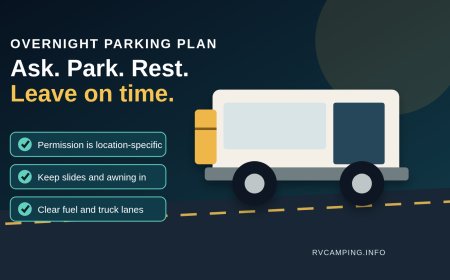
Unless staff has directed you to a marked RV hookup or RV Stop site, keep the rig in travel mode:
- slides in;
- awning in;
- chairs, mats, grills and tables stowed;
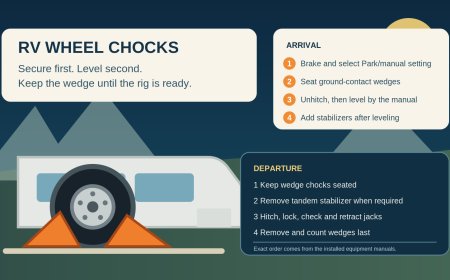
- no stabilizers or jacks unless staff expressly permits them and the surface can take the load;
- no vehicle or trailer spread across adjacent spaces;
- no gray-water discharge, sewer hose or utility connection;
- pets leashed and waste collected immediately.
This distinction matters because local codes can regulate overnight RV use as more than ordinary parking. Rapid City's code allows temporary overnight RV parking only in specified approved facilities, limits a stay to 24 hours, and prohibits hookups, generators and wastewater dumping at those sites.[8] Moab's municipal code is stricter: it prohibits using a vehicle on public or private property for human habitation or overnight camping.[9] Those examples do not create a national rule. They show why a store employee's "yes" and a travel app pin are not the end of the check.
A three-part permission check
Use all three layers before committing to the stop.
1. Check the exact location page or operator app
Look for "overnight parking," "RV parking," "RV Stop," a reservable RV space, or another explicit designation. Do not substitute "truck parking," "public parking" or "RV services" for permission to sleep there. A dump station and propane sales do not prove that overnight stays are allowed.
The differences can be concrete. Love's Salina page lists 37 pull-through and 44 back-in RV spaces, along with overnight parking.[2] Pilot's Hesperia, California page shows public parking and paid Prime Parking, and its reservation display lists truck, bobtail and RV eligibility.[3] Pilot says Prime Parking reservations require the arriving driver to find the reserved spot, print a hang tag inside and display it in the window.[4] If you reserve a space, follow the location's current confirmation and signage rather than assuming every reservation program works the same way.
2. Call the store
Ask a short, location-specific set of questions:
- "May this RV stay overnight tonight?"
- "Where should I park an RV of this length?"
- "Is that free parking, a paid reservation or an RV hookup site?"
- "What time must I leave?"
- "May I run a generator, extend a slide or remain hitched?"
Give the total combined length, not just the motorhome or trailer length. Note the employee's answer and the time of the call. A phone confirmation is useful, but signs, barriers and on-duty staff control when you arrive.
3. Read the lot when you get there
A location page can be current and the lot can still be closed, restriped, full or operating under a temporary restriction. Stop before entering any tight lane. Read signs at the driveway and at the parking row. If the approved RV area is not obvious, park briefly in a safe customer space and ask inside. Do not make a truck driver wait while you study the lot from a diesel island.
Arrive before the lot becomes a puzzle
Late-night truck parking is scarce. FHWA calls truck-parking shortages a national safety concern and says a lack of designated space can push commercial drivers onto shoulders, ramps and vacant lots.[6] That makes an occupied truck space more consequential than an ordinary empty rectangle.
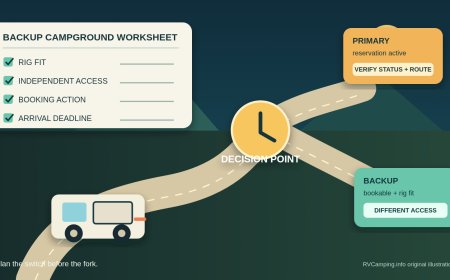
Build the stop into the route while alternatives remain open. Recheck the location page and call on the day of travel. Aim to arrive before the overnight rush, with enough fuel and alertness to move to a backup if the approved RV area is full. Save two alternatives that are genuinely compatible with your height, length and turning radius.
The federal RV-friendly signing experiment used demanding physical criteria: hard-surface access, wide lanes, adequate swing radius, long marked spaces and at least 14 feet of canopy clearance at qualifying fuel facilities.[7] That program was an experiment, not a promise that every travel center meets those dimensions. Measure your own rig and obey the posted clearance.
On approach:
- slow down early and use the driveway intended for your vehicle;
- watch for one-way arrows, curbs, bollards and pedestrians;
- assume a tractor may move, swing wide or back at any moment;
- avoid blind-side backing when another approved space is available;
- use a spotter outside the RV when visibility is poor, with a stop signal agreed in advance;
- leave immediately if the only option is a ramp, shoulder, fire lane, striped access aisle or unmarked circulation lane.
FHWA identifies shoulders, exit ramps and vacant lots as unsafe substitutes for authorized parking.[6] Fatigue does not turn them into legal or safe spaces. If you are too tired to continue, ask staff or local authorities for the nearest lawful option rather than improvising at the edge of the property.
Keep the fuel lane a fuel lane
Choose the lane that fits the rig and fuel type. Confirm canopy height, pump access and nozzle compatibility before committing. If the location has a signed RV fuel lane, use it unless staff directs otherwise. A commercial diesel lane may be appropriate for some diesel motorhomes, but it is still a high-throughput work area for professional drivers.
At the pump, finish the transaction and move forward to the designated pull-up area or a legal parking space before going inside for food, a shower or shopping. Do not leave the RV at the nozzle after fueling. Do not stop beyond the island if your trailer blocks a cross-lane, scale approach or another driver's turning path. If a passenger goes inside, the driver should stay ready to move until the combination is fully clear of the lane.
Never use a fuel island, scale queue, truck-service approach or fire lane as overflow overnight parking. Pilot's reservation system exists specifically to identify and hold eligible parking spaces; a fuel lane is not one of them.[4]
Pick a space that still works at 4 a.m.
The quietest-looking corner can become a delivery path or snowplow route. Use only the row staff assigns or the signs designate. Keep the full combination inside the lines and preserve the adjacent truck's ability to swing out.
Before shutting down, walk the perimeter with a flashlight. Check that the hitch, rear overhang, steps and mirrors do not project into a travel lane. Look up for lamps, branches and power lines. Identify two walking routes to the store that do not cut between idling or backing trucks. Lock doors, secure bikes and portable gear, and keep the ignition key accessible.
A pull-through space is often the cleanest choice because it removes a backing move at departure. Do not nose into a back-in space if that puts the exit into active traffic or leaves no room for the tow vehicle. Never unhitch unless the site is explicitly designed for RV occupancy and the operator permits it.
Noise, generators and idling
A working truck stop is noisy. Refrigeration units, air brakes and diesel engines may run through the night. Do not demand campground quiet from drivers using a facility built around freight.
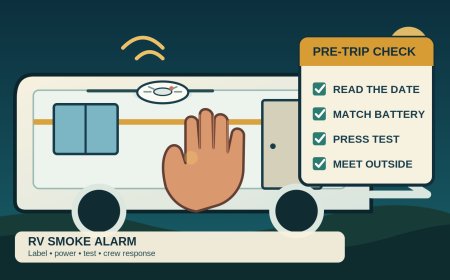
Your RV should add as little noise and exhaust as possible. Shut down the propulsion engine after parking. Do not run a generator unless the location and local rules allow it. If permitted, keep exhaust away from doors, windows, neighboring vehicles and buildings; use a functioning carbon-monoxide alarm inside the RV; and stop if wind or a new neighbor changes the exhaust path.
Idling law is not uniform. California's Air Resources Board says its rule generally limits the primary engine of covered diesel commercial vehicles over 10,000 pounds GVWR to five minutes, with listed exceptions.[5] The rule's vehicle definitions and exceptions matter, so do not turn that example into a nationwide RV rule. Check the state and municipality for the actual stop, then follow any stricter property instruction.
Even where your RV is outside a commercial-vehicle idling rule, extended engine idling beside sleeping occupants is poor lot behavior. Use the least intrusive legal way to manage temperature. If safe heat or cooling requires equipment the operator prohibits, choose a campground or hookup site instead.
Slides and awnings stay in unless the site is built for them
A slide can look clear at midnight and block a neighboring vehicle's mirror path before dawn. An awning is worse: it adds a low, hard-to-see projection in a dark working lot. Keep both retracted in ordinary parking.
The exception is an assigned RV hookup or paid RV site whose markings provide usable width and whose rules allow deployment. Even there, confirm clearance on both sides and above. Do not open a slide into another space, sidewalk, landscape strip or truck circulation area. Retract everything before sleep if an early emergency departure would otherwise require a slow teardown.
If someone must sleep in a bed that cannot be used with the slide in, an ordinary parking space is the wrong overnight option. Reserve a site designed for the RV instead of borrowing width from the lot.
When to leave
Set a departure time when permission is granted, not after breakfast. Leave by the stated checkout or time limit, and earlier if the operator asks.
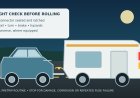
Break camp is the wrong phrase here because nothing should have been deployed. The departure check is short:
- occupants and pets aboard;
- generator and engine-area accessories off;
- slides, steps, awning, roof vents and windows secured;
- leveling equipment fully retracted;
- no trash, fluid or loose gear left behind;
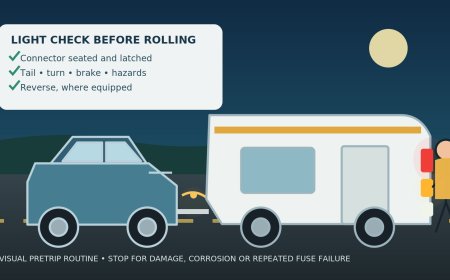
- lights, hitch, tires and tow connections checked;
- route out observed before moving.
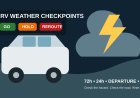
Leave immediately if staff revokes permission, police or code enforcement directs you to move, the assigned zone closes, severe weather makes the lot unsafe, exhaust enters the RV, a confrontation develops, or the only way to remain is to block traffic. Also leave when your reserved period ends. An empty neighboring space is not an extension.
If you wake too fatigued to drive safely, do not simply overstay. Contact the desk before the deadline. Ask whether you can purchase another authorized space or move to a lawful alternative. A courteous request gives the operator options; silence turns an approved rest stop into unauthorized parking.
The one-minute plan
Before the exit, be able to answer six questions:
- Did this exact location approve this RV tonight?
- Which marked space or zone did staff assign?
- What is the leave-by time?
- Are generators, slides or hookups allowed here?
- Can the rig enter, park and exit without blocking fuel or truck circulation?
- Where is the lawful backup?
If one answer is missing, keep researching or choose the backup. A travel center can be a useful overnight pause, but only when the operator, the local rules and the physical lot all say yes.
Sources
- Pilot RV Services
- Love's Travel Stop #581, Salina, Utah
- Pilot Travel Center #381, Hesperia, California
- Pilot Prime Parking
- California Air Resources Board diesel commercial vehicle idling ATCM
- Federal Highway Administration: Truck Parking
- Federal Highway Administration RV-Friendly symbol experiment
- Rapid City Municipal Code 17.50.225
- Moab Municipal Code 10.04.230
What's Your Reaction?