




Lassen Volcanic RV Campgrounds: Exact Rig Fit for 2026
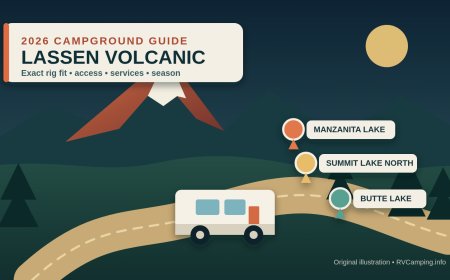
Manzanita Lake is the practical default, Summit Lake North fits summer stays, Butte Lake favors gravel-ready dry campers, and Southwest is first-come self-contained parking.


Lassen Volcanic RV campgrounds: exact rig fit for 2026
By Romana | Updated September 19, 2026
Manzanita Lake is the safest all-around RV choice inside Lassen Volcanic National Park. It has paved pads, the park's only dump station, and the broadest set of seasonal services. Butte Lake is unusually friendly to long rigs once you reach the campground, but getting there requires six miles on a rough gravel road. Summit Lake North puts campers in the middle of the park highway, though its short season had already ended by September 19. Southwest is the no-reservation fallback for self-contained rigs, not a conventional campsite.[1][2][4][5][6][7]
Short answer: Start with Manzanita Lake for service and easier access. Choose Summit Lake North for a summer trip in a measured rig. Pick Butte Lake only if a remote dry camp and the gravel approach suit your setup. Use Southwest for first-come parking-lot camping in a self-contained vehicle. Summit Lake South is not an RV alternative: NPS says it cannot take RVs or trailers other than small tent trailers.[3]
2026 comparison at a glance
| Campground | Exact rig evidence | Access and 2026 season | Services at full operation | Reservation status | Best fit |
|---|---|---|---|---|---|
| Manzanita Lake | Recreation.gov's site records publish RV/trailer limits from 16 to 45 feet; 15 public sites list 45 feet | One mile from the northwest entrance; full service May 23-Oct. 7, then Loops A and B dry until snow closure | Seasonal water, flush toilets, pay showers, laundry, store and $8 dump; no hookups | Required | The default choice for most motorhomes and trailers |
| Summit Lake North | 33 public records permit RVs/trailers; published values run to 60 feet at A15, but most are 35 feet or less | On the park highway; full service June 27-Sept. 8; closed Sept. 19 | Seasonal water and flush toilets; no dump, shower, store or hookups | Required | Summer stays near the park's central trailheads |
| Butte Lake | 75 public records list a 45-foot RV/trailer maximum; most pads are pull-throughs | Six-mile rough gravel approach; Loop B dry Sept. 2-Oct. 14 on the 2026 schedule | Full-season water and flush toilets, then vault toilets only in dry season; no dump, store, shower or hookups | Required | Remote campers comfortable taking their rig over gravel |
| Southwest | Recreation.gov publishes no numeric rig limit for its RV parking product | Near the southwest entrance and visitor center; open on the Sept. 19 hours page | Visitor-center toilets, water and public Wi-Fi; no dump, shower or hookups | First come; Scan & Pay | Self-contained rigs needing an arrival-day fallback |
The lengths above are Recreation.gov equipment limits for individual inventory records, not a promise that every rig of that size will turn, level, or fit with a tow vehicle attached. NPS also says every park campground lacks RV hookups.[1][4][5][6][7]
What was open on September 19, 2026
The park's operating-hours page was updated September 16, three days before this review. On that schedule, Manzanita Lake was still in full service. Butte Lake had shifted to dry camping in Loop B. Summit Lake North was closed, while Summit Lake South remained open for dry camping through September 23 but was unsuitable for full-size RVs and trailers. Southwest was listed open. Juniper Lake remained closed while reopening work continued.[2][3][8]
Dry camping has a specific meaning here: the park shuts off drinking water and flush restrooms, then charges a lower fee. It is not merely a site without hookups.[1] At Butte Lake on September 19, arrive with a full fresh tank and enough capacity to retain wastewater. The park's only dump station is at Manzanita Lake, far from Butte Lake's remote northeast corner.[1][6]
These are dated 2026 conditions, not a reusable calendar for 2027. NPS warns that weather, roads, snow and public-safety needs can move opening or closing dates. Check the hours page, current alerts and the exact Recreation.gov inventory again before departure.[1][2][8]
Manzanita Lake: the practical default
Manzanita sits one mile inside the northwest entrance. Its paved campground roads and pads avoid the gravel-access problem at Butte Lake. In season, it is also the only in-park campground with a dump station, camper store, pay showers and laundry. Water and flush toilets are seasonal, and none of the sites has electric, water or sewer connections.[1][4]
Rig fit is site-specific. The current Recreation.gov campsite data contains 131 public records that permit an RV and trailer, with published equipment limits ranging from 16 to 45 feet. Fifteen list 45 feet: A16, A20, A22, A23, A37, A45, B04, B12, B14, B20, B40, B42, B46, C28 and C29.[4] That list is useful for searching, but the assigned site's current booking record controls.
A long driveway is not the same as a long-RV approval. Some Manzanita driveways exceed the listed equipment length, and 41 public records are marked pull-through while most are back-in. Use the equipment maximum shown for the site, then confirm that the motorhome or trailer, hitch-mounted gear, tow vehicle and slides all work within the pad and loop geometry.[4]
Manzanita also has the longest useful fall window. Full service was scheduled through October 7, followed by dry operation in Loops A and B until snow closes them.[2] A late reservation therefore needs two checks: whether the site remains open and whether water, restrooms, showers, laundry, store and dump service will still operate on the arrival date.
Summit Lake: North is the RV campground
Treat the north and south sections as different products. NPS states that Summit Lake South cannot accommodate RVs or trailers, apart from small tent trailers.[3] Recreation.gov's South records reinforce the warning: the few entries tagged for RVs or trailers carry a zero-foot value rather than a usable maximum. Do not book a South "standard" site and assume the label means a travel trailer fits.
Summit Lake North has 33 public inventory records that permit RVs and trailers. Most publish limits of 35 feet or less. Four list 35 feet, one lists 54 feet, and A15 lists 60 feet.[5] The 60-foot entry is an outlier, not a campground-wide rule. A long motorhome or fifth-wheel owner should save the A15 detail page and confirm the measurement basis before committing.
North is the better park-highway base when the dates work. From Manzanita, drive 12 miles toward the park's south side; the southwest entrance is 17.5 miles beyond the campground in the other direction. Seasonal drinking water and flush toilets are available during full operation, but there is no dump station, shower, store, cellular reception or internet listed in the NPS campground record.[3][5]
The short season is the catch. Summit Lake North was scheduled only from June 27 through September 8 in 2026. It had no fall dry-camping extension.[2] Summit Lake South stayed open later, but that did not create an RV overflow option.
Butte Lake: roomy records, rough approach
Butte Lake looks excellent on a booking screen. Of 79 public campsite records, 77 permit RVs and trailers. Seventy-five publish a 45-foot maximum, and 76 public pads are coded as pull-throughs. The surfaces are gravel.[6]
The road changes the decision. Recreation.gov describes a six-mile rough gravel approach, and NPS places the campground about a 45-minute drive from the northwest entrance and Manzanita Lake area.[6] A 45-foot site record does not answer whether your low-clearance motorhome, rear overhang, trailer suspension or belongings can tolerate the access road. Check road condition immediately before travel and slow down enough to protect tires, plumbing and hitch hardware.
Butte has no hookups, dump, showers, store, cellular service or Wi-Fi. Water and flush toilets operate during the main season; vault toilets remain when the campground goes dry.[6] In 2026, full service ended September 1 and only Loop B continued as dry camping through October 14.[2] Reservation service is online, so download the confirmation and site details before leaving reliable coverage.
Butte is the strongest choice for a larger rig only when three things are true: the exact site approves the measured RV, the approach road is acceptable on travel day, and the crew can dry camp without a nearby dump or supply store. If any of those is uncertain, Manzanita is the lower-friction choice.
Southwest: a self-contained parking option
Southwest occupies parking beside the park's main southwest visitor facility, close to the entrance. Recreation.gov describes RV spaces in the adjacent lot and restricts them to self-contained vehicles, trailers and other camping units. Tents and freestanding camping structures cannot go in the parking area. The facility has no hookups and no on-site dump; Recreation.gov points campers to Manzanita Lake, about 30 miles north, for dumping.[7]
This is first-come camping paid through Recreation.gov's Scan & Pay system. NPS advises downloading the app before arrival because connectivity can be limited.[1][7] The source pages disagree on the parking inventory: the NPS campground record describes 15 parking-lot sites, while Recreation.gov notices refer to 10 and its product record does not publish a numeric RV length. Treat availability and fit as on-site questions, not guaranteed specifications.[7]
Southwest works for a self-contained van, motorhome or trailer whose driver is comfortable assessing the marked space on arrival. It is a weak plan for a long combination, a rig that needs leveling room, or anyone who cannot risk finding the parking allocation full.
Other park campgrounds: group-only, closed or not recommended
Lost Creek is a group campground rather than an individual-site alternative. The park publishes a 40-foot RV value for its group sites, with up to 25 people and six vehicles. Its 2026 season ended September 16, so it was closed on this article's check date.[1][2]
Warner Valley had a 2026 operating window, but the NPS campground record says trailers and RVs are not recommended because access is partly gravel. It should not be presented as a peer to Manzanita, Summit North or Butte for routine RV planning.[1][2]
Juniper Lake is simpler: it was closed for all of 2026 while the park worked toward reopening. The current alert also says the campground and day-use area are closed, even though Juniper Lake Road remained open with caution around work crews.[1][2][8]
Manzanita and Butte group sites publish 40-foot RV values. Those sites require a minimum group size and are not a workaround for an individual party seeking a longer pad.[1]
How to match a rig to a site
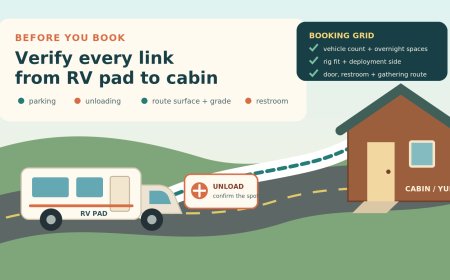
Recreation.gov's maximum-length field is a screening number. Before paying, write down the actual dimensions of the travel setup:
- Measure the RV from the foremost fixed point to the rearmost fixed point.
- Add bike racks, ladders, spare tires, cargo trays and tongue-mounted equipment.
- For a trailer, record trailer length, tow-vehicle length and connected length.
- For a motorhome, record the towed vehicle separately and whether it can be detached before entering the loop.
- Note slide depth on both sides and the side needed for the entry door or awning.
- Compare the exact site's equipment limit, driveway entry and surface, not just the campground name.
For Manzanita, also check whether the site is back-in, parallel or pull-through. For Butte, decide whether gravel access is acceptable before treating a 45-foot site as a match. For Summit North, be skeptical of the two long-site outliers until the exact record and current booking screen agree.[4][5][6]
Water, waste and power plan
None of Lassen's park campgrounds supplies shore power.[1] A reservation at Manzanita, Summit North or Butte is dry camping in the RV sense even when NPS calls the campground "full service." Here, full service means campground water and flush-restroom operation, not pedestal utilities.
Manzanita is the only location in this comparison with a park dump station. Fill and dump during posted operating hours, and do not assume late-season water will remain on. Summit North and Butte require a round-trip tank plan. Southwest has visitor-center water and restrooms but no dump at the camping area.[1][7]
Estimate fresh water, gray capacity and black capacity by nights and occupants. Then leave a margin for delays. For September and October, protect hoses and exposed plumbing from freezing nights and check the forecast at campground elevation rather than a lower nearby town.
Booking checklist
- Verify the campground section and loop. "Summit Lake" is not enough; North accepts RVs, South generally does not.[3]
- Open the exact site record and save its RV or trailer maximum, driveway entry and surface.[4][5][6]
- Confirm whether the published number applies to the RV body or the whole connected combination.
- Recheck the 2026 operating-hours page for full service, dry camping or closure.[2]
- At Butte Lake, check the six-mile access road and prepare for no service after arrival.[6]
- At Southwest, download the Recreation.gov app before entering the park and carry a backup if the spaces are full.[1][7]
- Save the reservation, campground map and park alerts offline; several campground records report no cellular service.[4][5][6][8]
- If arriving after a seasonal service change, confirm water, toilets, dump access and store hours individually.
Bottom line
Manzanita Lake wins for most RV trips because it combines paved access, the only in-park dump station and the widest service season. Summit Lake North is the better central base during its brief summer opening, provided the chosen site's length field fits the measured setup. Butte Lake has the most consistently generous site-length records, but the rough gravel approach and lack of nearby services make it a deliberate choice rather than an automatic big-rig winner. Southwest is useful backup space for a self-contained rig, with no advance reservation or published length assurance.
For travel on September 19, 2026, the realistic choices were full-service Manzanita, dry Loop B at Butte Lake, or first-come Southwest. Summit Lake North had closed, Summit Lake South was not an RV substitute, and Juniper Lake remained closed. Recheck every one of those conditions for the actual arrival date.
Editorial note: Campground specifications and 2026 status above come from NPS and Recreation.gov records retrieved September 19, 2026. Site-fit interpretation, ranking and planning checklists are RVCamping.info analysis. No firsthand visit, drive or campsite inspection is claimed.
Sources
- Camping - Lassen Volcanic National Park — NPS inventory, reservation rules, dry-camping definition, prices, services, group-site limits and hookup policy. Accessed September 19, 2026.
- Operating Hours & Seasons - Lassen Volcanic National Park — 2026 campground dates; page updated September 16, 2026. Accessed September 19, 2026.
- Summit Lake Campground - Lassen Volcanic National Park — distinction between North and South, location and South's RV restriction. Accessed September 19, 2026.
- Manzanita Lake - Recreation.gov — federal facility and campsite records for approach, surfaces, driveway types, site-specific equipment limits and utility exclusions. Accessed September 19, 2026.
- Summit Lake North - Recreation.gov — federal facility and campsite records for site-specific RV/trailer limits and services. Accessed September 19, 2026.
- Butte Lake - Recreation.gov — federal facility and campsite records for gravel access, pull-through inventory, equipment limits and services. Accessed September 19, 2026.
- Southwest Campground - Recreation.gov — federal record for self-contained parking-lot camping, first-come payment, services and inventory caveats. Accessed September 19, 2026.
- Alerts & Conditions - Lassen Volcanic National Park — current-alert check, including Juniper Lake closure. Accessed September 19, 2026.
What's Your Reaction?