




RV propane cylinders: inspect, transport, refill or stop
A practical decision guide for inspecting and transporting removable RV propane cylinders, reading U.S. requalification marks, choosing refill or exchange, and knowing when leakage, damage or system trouble requires a professional.
Source note: This practical safety guide draws on current U.S. Department of Transportation/PHMSA cylinder guidance and 2025 consumer safety material from the Propane Education & Research Council. It is general information, not a substitute for the labels and manuals for your RV, cylinder, tank, regulator or appliance.
Propane decisions get easier when you separate a removable cylinder from the rest of the RV propane system.
A portable cylinder is a removable container marked to a DOT specification. Many travel trailers and fifth-wheels carry one or two of them in a rack or compartment. A permanently mounted ASME tank is part of the vehicle installation, common on motorhomes. Read the metal markings or data plate rather than identifying the container from the RV type alone.
The practical boundary is simple: you may remove a portable DOT cylinder for transport to a retailer, refill or exchange. Do not remove a permanently installed ASME tank for a routine fill, and do not apply the DOT cylinder requalification calendar to it. Damage, leakage, mounting trouble or service work on either type belongs with a propane retailer or qualified RV propane technician.
The 60-second decision
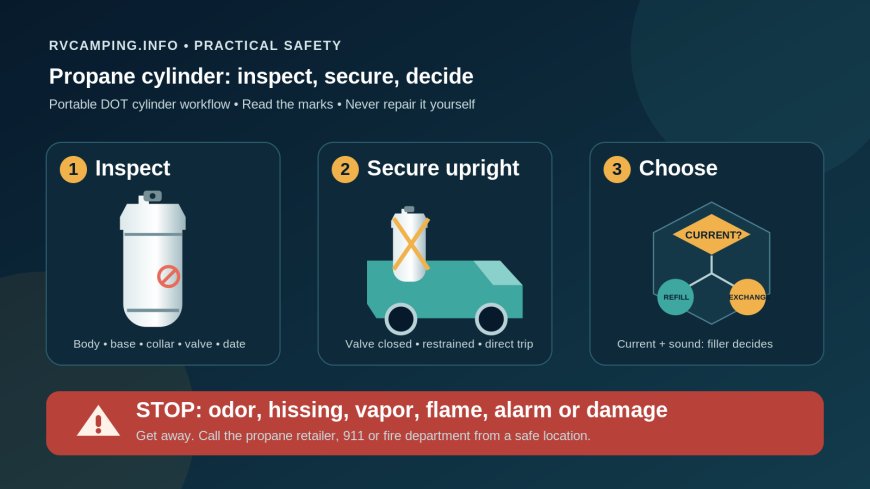
Before moving or connecting a portable cylinder, answer these questions in order:
- Do you smell propane, hear hissing, see a vapor cloud or frost that suggests escaping gas, see fire, or have an active propane alarm? Treat that as a possible leak. Do not transport the cylinder.
- Has the cylinder been in a fire, or does it have a bulge, deep dent, cut, crack, serious corrosion, damaged collar or foot ring, or a suspect valve? Remove it from service without trying to repair it.
- Can you read the DOT specification and manufacture or requalification marks? If not, let the retailer decide whether it can legally be filled.
- Is the U.S. requalification period still current? If it is overdue, choose authorized requalification, exchange or proper disposal, not a refill.
- Is the valve fully closed, the protective collar intact, and the cylinder able to ride upright in a secure holder? If not, do not start the trip.
A clean-looking cylinder can still be out of date. A current date stamp cannot excuse physical damage. It must pass both checks.
Identify what the RV carries
Look for markings before using refill dates or making transport plans.
A removable DOT cylinder normally has a specification such as DOT-4BA, DOT-4BW or DOT-4E stamped into its collar or shoulder, along with a month-and-year manufacture date. This is the container covered by PHMSA's periodic requalification rules.[2]
A permanently mounted tank should have an ASME data plate. It stays attached to the RV and is filled through the installed service connection. Its tank, brackets, valves, regulator and piping are one system. The absence of a DOT requalification date does not make an ASME tank overdue, and a DOT cylinder's 12-year initial period should not be copied onto an ASME tank.
Some RVs, conversions and specialty equipment do not follow the usual trailer-versus-motorhome pattern. If the marks are hidden, painted over or unclear, stop. The RV builder, tank maker or qualified propane professional can identify the container without guesswork.
Inspect a portable cylinder without taking it apart
Set the disconnected cylinder outdoors on a stable surface, away from flames, sparks, smoking and running appliances. Keep it upright. This is a visual check, not a repair session.
Start at the bottom, where road moisture and trapped debris often collect:
- Check the foot ring and lower shell for heavy rust, scaling, pitting or metal loss.
- Scan the body and weld areas for bulges, cuts, cracks, deep dents, gouges or evidence of impact.
- Look for scorch marks, blistered coating or other signs that the cylinder was exposed to fire or unusual heat.
- Confirm the foot ring and protective collar are present, firmly attached and not badly bent.
- Inspect the exposed valve area for damage, leakage, contamination or an obviously defective pressure-relief device. Do not probe, loosen or disassemble anything.
- Read the specification, manufacture date and later requalification marks.
PHMSA tells fillers not to fill cylinders with excessive rust or pitting, dents, bulges, cuts, cracks, missing or damaged protective parts, or a leaking or defective valve or relief device.[2] PERC's consumer guidance also rules out continued use after fire exposure or whenever the container is damaged, and it sends repair work to the retailer or a qualified professional.[1]
Do not sand away deep corrosion to see what remains, hammer a collar straight, replace a valve, defeat an overfill device, or paint over marks before an evaluation. Those actions can hide damage or cross into regulated cylinder work. Put the cylinder aside outdoors where people will not handle it, then call the retailer for safe return or disposal instructions. Never put a propane cylinder in household trash.[1]
Read U.S. cylinder dates correctly
For a typical refillable DOT propane cylinder in the United States, PHMSA's current consumer poster says the initial requalification is due within 12 years of manufacture. A later mark sets the next interval according to the test method:[2]
- A requalification date with no letter generally carries a 12-year interval.
- An
Safter the date identifies a proof-pressure requalification with a 10-year interval. - An
Eidentifies an external visual requalification with a 5-year interval.
The stamp is usually month and year, not an expiration day. Do not infer the next due date from cylinder appearance or an exchange brand sleeve. Ask the filler when a mark is incomplete, illegible or unfamiliar. PHMSA says approved requalifiers perform the testing or examination and apply the requalification mark.[2]
These are U.S. rules. Canadian cylinders and travel elsewhere can involve different marks and intervals. Confirm local requirements before crossing a border or seeking a fill.
Transport removable cylinders as cargo
Close the cylinder valve before loading, even when the cylinder feels empty. Keep the protective collar exposed and able to guard the valve. Do not attach makeshift plugs or accessories that the cylinder or valve maker does not specify.
Transport each cylinder upright and prevent it from tipping, rolling or sliding. A purpose-made stabilizer plus straps in an open pickup bed is a strong arrangement. PERC also lists tie-downs, cylinder stabilizers, boxes and crates as ways to restrain a cylinder, but whatever you use must hold the base and body rather than loading the valve or handwheel.[1]
Keep cylinders away from ignition sources. Avoid the passenger area. Never load a cylinder that is leaking or suspected of leaking. Drive directly to the retailer or campsite, then remove portable cylinders from the vehicle immediately. PERC warns that a hot parked vehicle or a leak can release propane into an enclosed space.[1]
PERC's 2025 guide lists U.S. limits for a closed-body vehicle: no more than four 20-pound cylinders, no cylinder larger than 45-pound capacity, and no more than 90 pounds of propane. It lists 1,001 pounds as the maximum combined propane-and-container weight in an open cargo bed, while warning that state or local restrictions may also apply.[1] Those figures are ceilings, not a recommendation for an RVer to carry that much. A retailer can help with local limits, and ferries, tunnels, campgrounds and private carriers may impose tighter rules.
Do not leave a loose spare inside the RV, in a tow vehicle, or in a storage bay that was not designed and vented for propane cylinders. Return travel cylinders to the RV's approved exterior rack or cylinder compartment and secure them exactly as the RV manual requires.
Refill, requalify, exchange or retire?
Refill the same cylinder
Refilling makes sense when the cylinder has an in-date mark, readable identification, an acceptable valve and overfill-prevention device, and no disqualifying damage. It keeps a cylinder whose history and fit you know. The trained attendant still makes the fill/no-fill decision after a pre-fill inspection.
Requalify it
Ask about requalification when a sound, useful cylinder is simply out of date and its replacement cost or unusual size justifies testing. Use a DOT-approved requalifier. Do not buy a stamp, apply your own mark or treat a home pressure check as requalification.[2]
Exchange it
Exchange is convenient for a common cylinder that is near or past its date, has an older valve configuration, or is not worth requalifying. Check the replacement before leaving the cage: verify the correct size and connection, read the collar marks, look for damage, and make sure it fits the RV's holder. An exchange sleeve is branding, not proof that a particular cylinder fits every rack or that the consumer can skip inspection.
If your cylinder is damaged, unwanted or recalled, contact the exchange operator or propane retailer first and follow its return instructions. A cage is not a drop box for an actively leaking cylinder. PERC's rule is unambiguous: never transport a leaking cylinder.[1]
Retire or dispose of it
Retire a cylinder that a qualified filler or requalifier rejects, that has fire damage, or that cannot be identified. Ask a propane retailer or municipal household hazardous-waste program how to handle it. Do not vent it, puncture it, cut it, remove the valve or place it in trash or recycling.[1]
Connecting at camp is a separate check
Transport inspection does not prove the connection is leak-free. Once the correct cylinder is secured in the RV's approved holder, follow the RV and regulator instructions for connection. Keep appliances off and ignition sources away.
PERC recommends a leak check before the first seasonal use and each time a cylinder and appliance are connected. Its consumer procedure applies leak-detection solution or thick soapy water around the valve area and connection, then opens the valve slowly and watches for bubbles. If bubbles continue after closing the valve and tightening the connection, close the valve and call the propane retailer.[1]
Do not use a flame to search for a leak. Do not keep tightening a damaged fitting, substitute tape on a connection that does not call for it, or open a regulator. If the connector, hose, regulator, changeover assembly or hard piping looks worn, cracked, oily, bent or impact-damaged, leave the system off for qualified service.
When to stop and call
Call a propane retailer or qualified RV propane technician before using the system when:
- the cylinder or tank identity, date or required markings cannot be confirmed;
- a filler refuses the cylinder;
- the container has significant corrosion, impact or heat damage;
- the valve, relief device, regulator, hose, connector, piping, tank mount or cylinder rack is damaged;
- a leak check continues to bubble;
- the regulator vent is contaminated or the system will not hold normal operation;
- an appliance repeatedly fails to light, goes out, burns abnormally or leaves soot;
- an ASME tank has shifted, its brackets are corroded, or connected lines are bent or strained;
- the propane supply ran out or was shut off and service must be restored.
PERC says installation, modification and repair of tanks, cylinders, pipes and system components require a qualified professional. It also calls for a professional leak check when restoring gas after a runout or shutoff.[3] That boundary rules out valve replacement, regulator rebuilding, line repair, tank removal and cylinder requalification as campsite jobs.
A suspected leak changes the plan
Propane odor, hissing, a gas-detector alarm, unusual gas use, visible vapor or flame demands an emergency response, not more inspection.
Get everyone away. While leaving, do not operate light switches, plugs, appliances or anything else that could create a spark. Do not smoke, vape or use a flame. From a safe location, call the propane retailer, 911 or the fire department, and stay away until responders or a qualified professional say it is safe.[3]
PERC says to close the tank valve only if you can do so safely and do not suspect the leak is at the tank itself.[3] Do not approach flame, a visible cloud or a leaking valve to save the cylinder. Never drive a suspected leaking cylinder to a refill station.[1]
Before the RV returns to service, have the complete propane system checked. A fresh cylinder does not fix a leaking hose, regulator, connector or appliance.
Keep this handoff note
When calling a retailer or technician, give them the container type and markings, the RV make and model, what you observed, whether the valve is closed, and whether there is active odor, hissing, vapor, frost or flame. Say where the RV or cylinder is located. Do not move it unless the responder gives safe instructions.
The best refill decision is often made before the cylinder enters the vehicle: identify it, inspect it, read the date, and let a trained filler reject anything questionable.
Sources
What's Your Reaction?