




















RV range-hood filter and vent check before a trip
Inspect and clean an RV range-hood grease filter and vent, identify washable versus replaceable media, and know when to stop for qualified service.

RV range-hood filter and vent check before a trip
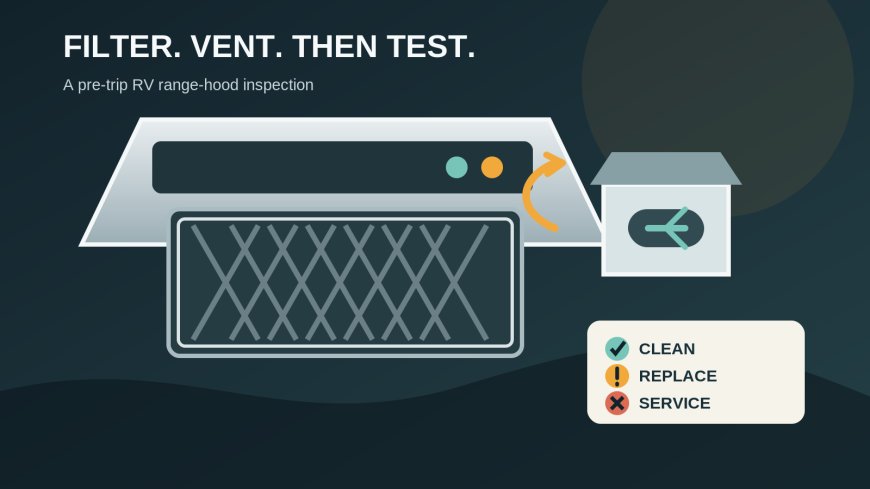
A range hood that hums is not necessarily moving air. The filter can be loaded with grease, the exterior flap can be stuck, or a charcoal insert can be past replacement. This pre-trip check separates the parts an owner can safely clean from the faults that call for the correct replacement part or a service appointment.
Start with the model label inside the hood, then find that model's manual. "Metal filter," "grease filter," and "charcoal filter" are not interchangeable terms. Dometic's CK400 uses a removable washable filter, while Furrion's FHO23SACR has a hand-washed metal holder and a charcoal filter that the manual says cannot be cleaned.[1][2] Dometic's CK2000 gives yet another procedure, including a soft nylon brush or a 65 °C dishwasher cycle for its grease filter.[3] Copy the procedure for the hood in your RV, not the one that looks similar online.
Make the galley cold and dead first
Park, set the brake, and give the range and hood time to cool. Turn every burner and oven control off. Suburban's range guide says controls must be off and the cooktop, oven, grates, and burners cool before cleaning.[5]
Then remove the energy sources that could surprise you while your hands are above the cooktop:
- Shut off LP at the cylinder or tank control specified by the RV manual. Do not turn a burner on to "bleed" the line.
- Switch off the generator and inverter output.
- Switch off the shore-power pedestal breaker, unplug the cord, and keep the plug in sight.
- Isolate the hood's 12-volt circuit using the labeled fuse, breaker, or battery-disconnect method in the RV manual. Unplugging shore power alone may leave a 12-volt hood live through the house battery.
- Confirm the hood fan and light do not operate. If either still works, stop and identify the actual circuit before touching the filter.
Furrion tells owners to isolate its hood from the power supply before cleaning and to prevent accidental re-energizing at the service disconnect.[1] The LP shutoff adds a practical barrier while working directly over a fuel-burning appliance. If your exact RV manual specifies a different isolation sequence, follow it.
Identify what is installed
Photograph the model/rating label and the filter before removal. Note which way the filter faces and how each latch, rod, screw, or rear tab sits. Put a towel over the cool cooktop so a dropped fastener does not chip a surface or fall into a burner opening.
Look for one of these arrangements:
- A washable metal mesh or metal grease filter.
- A washable metal support paired with a replaceable charcoal pad.
- A recirculating hood with no exterior duct.
- A ducted hood that sends air through a wall or roof cap.
Do not assume a dark pad is washable. The Furrion FHO23SACR manual calls for hand-washing its metal holder in mild soapy water, drying it completely, and replacing the charcoal filter rather than washing it.[1] The CK400 manual, by contrast, directs the owner to wash its removable filter in warm water with a synthetic detergent such as dishwashing liquid.[2]
Inspect before adding water
Release the filter exactly as the manual shows and support it with your free hand. Stop if a latch is cracked, a screw spins without tightening, the panel will not stay supported, or the filter seems glued in by grease. Forcing a brittle plastic tab is a poor way to begin a trip.
With the filter out, use a flashlight rather than fingers to inspect the accessible cavity:
- Grease should not be dripping, pooled, or packed around wiring and the motor.
- The fan wheel should have no visible crack, melted area, loose hub, or heavy deposit.
- Wiring insulation and connectors should show no browning, melting, or chafe.
- The duct collar should be attached, not crushed or open into a cabinet.
- There should be no insect nest, rodent material, water staining, or burned odor.
Do not remove a motor, reach into a hidden duct, spray cleaner into the fan housing, or turn the wheel by hand unless the exact manual makes that an owner step. Furrion directs owners to a service center for inadequate repairs because they can create serious hazards.[1]
Clean only the parts the manual calls washable
For a washable filter or holder, use the model's stated method. Furrion specifies mild soapy water, hand washing, no dishwasher, and complete drying for its metal holder.[1] Dometic specifies warm water and washing-up liquid for the CK400 filter.[2] The CK2000 permits a soft nylon brush with warm water and a little detergent or a 65 °C dishwasher cycle for its grease filter.[3]
That model-to-model difference is why a generic "put it in the dishwasher" shortcut is risky. A dishwasher can discolor aluminum, distort a frame, or ruin a charcoal layer that should have been replaced. Skip oven cleaner, solvents, bleach, aggressive degreaser, pressure spray, steel wool, and sharp scrapers unless the exact manual names them. The CK400 manual specifically warns against sharp or hard objects and damaging cleaners.[2]
Wipe the hood's accessible exterior and underside with a soft cloth using the approved solution. Keep liquid away from switches, lights, connectors, and the motor. Furrion warns against scouring pads, abrasives, and excessive water around the control panel.[1]
Rinse if the manual calls for it, then let every washed part dry completely. Do not speed the job with an open flame, cooktop heat, or a heat gun.
Check the exterior vent without dismantling it
A ducted hood needs a clear exit. From stable ground or a properly placed ladder, inspect the wall or roof cap only if it is safely accessible. Look for shipping tape, a travel latch left engaged, a stuck flap, insect nest, broken hinge, missing screen specified by the manufacturer, cracked cap, loose sealant, or grease streaking.
Gently operate an owner-accessible latch or flap only as the RV or vent-cap manual allows. Do not add hardware cloth, a dryer sheet, foam, or an improvised screen across the air path. Do not pry the cap open, drill the flap, disconnect ducting, or smear sealant over a drainage path. A roof cap, damaged seal, or inaccessible duct belongs to a qualified RV technician. For work that involves removing a fan or cutting into an RV, Dometic instructs technicians to shut off gas, disconnect 115-volt power, and disconnect the positive 12-volt battery terminal.[6]
A recirculating hood has no exterior exhaust flap to find. Its charcoal element handles odor, not grease indefinitely. Replace that element on the exact manual's schedule and sooner when the manual ties replacement to heavier use. Furrion's cited model recommends about three months, or more often above three hours of daily hood use; that is not a universal interval.[1]
Reassemble and test airflow
Reinstall only dry parts in their recorded orientation. Confirm every rear tab, rod, latch, and screw is fully seated. The filter must not sag toward a burner or rattle loose in travel.
Restore the hood's electrical supply while leaving all cooking controls off. Run the fan at each speed and turn the light on. Listen for scraping, surging, or a loose-panel buzz. At an exterior vent, verify the flap opens with the fan and falls closed when it stops. Use a light tissue near the intake as a rough direction check, but keep it out of the filter and never treat that as an airflow measurement.
Stop the test if the fan does not start, stalls, smells hot, sparks, trips a fuse, vibrates hard, or fails to move the exterior flap. Do not install a larger fuse, oil the motor, bend the fan blade, or run without the filter.
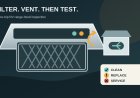
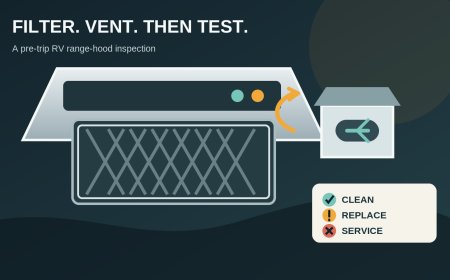
Clean, replace, or service?
| Finding | Decision before departure |
|---|---|
| Washable part is intact and comes clean using the exact manual's method | Dry completely, reinstall, and test. |
| Charcoal element is saturated, damaged, odor-loaded, or at its model's replacement point | Replace with the exact approved part; do not wash or improvise media. |
| Filter is torn, warped, corroded through, delaminated, will not latch, or remains grease-loaded after approved cleaning | Replace it. Do not stack filters or patch one with mesh. |
| Exterior flap is lightly stuck by accessible dirt and its manual permits owner cleaning | Clean gently, then verify free opening and closing. |
| Cap is cracked, sealant has failed, duct is loose/crushed, or blockage is beyond reach | Service the vent and weather seal before relying on the hood. |
| Grease is pooled inside the housing, on wiring, or deep in the duct | Stop. Arrange qualified cleaning/service; do not spray into the assembly. |
| Wiring is browned, melted, wet, chewed, or loose | Keep the circuit isolated and have it repaired. |
| Fan scrapes, stalls, overheats, trips protection, or has a cracked/loose wheel | Service or replace the specified assembly. Never upsize the fuse. |
| LP odor, soot, delayed ignition, or abnormal burner flame appears during the galley check | Leave LP off, ventilate without operating electrical switches if gas is suspected, and obtain qualified LP/appliance service. |
| Exact model or filter type cannot be identified | Do not guess. Ask the RV maker, hood maker, or dealer to identify it from the label and dimensions. |
Grease is not cosmetic dirt. USFA advises cleaning cooking equipment after each use because grease on a stove can catch fire, and Suburban warns that grease and food buildup can create a fire hazard.[4][5] Dometic's CK2000 manual is more direct: an oversaturated grease filter that no longer absorbs can cause a fire.[3]
The five-minute departure check
Once the full cleaning is done, the last pre-trip pass is short:
- Filter dry, correct for the model, and locked in place.
- Hood underside free of grease drips.
- Fan and light operate without heat, odor, scraping, or a blown fuse.
- Exterior flap opens and closes, or the hood is confirmed as a recirculating model.
- No tools, towels, cleaner, or loose fasteners remain on the cooktop.
- LP and electrical systems are restored only after the hood is fully assembled and the area is dry.
If any of those checks fails, use the table above. A delayed departure is cheaper than a patched filter, wet motor, bypassed fuse, or blocked vent.
Sources
- Furrion 12V Horizontal RV Range Hood User Manual, models FHO23SACR-BL/SS/BP/SB (manufacturer manual, revision dated October 14, 2022; accessed October 6, 2026)
- Dometic CK400 Installation and Operating Manual (manufacturer manual; accessed October 6, 2026)
- Dometic CK2000 Recirculation Extractor Hood Manual (manufacturer manual; accessed October 6, 2026)
- U.S. Fire Administration: Keep Cooking Equipment Clean (federal fire-safety guidance; accessed October 6, 2026)
- Suburban RV Range and Cooktops Operation and Maintenance Guide (manufacturer guide, March 22, 2023; accessed October 6, 2026)
- Dometic Fan Installation and Operation Manual (manufacturer shutdown guidance for fan removal/installation; accessed October 6, 2026)
What's Your Reaction?