





Shoulder-season RV camping: audit the services before you book
A five-part pre-booking audit for shoulder-season RV trips: potable water, dump stations, route access, freezing nights and reduced campground services.

Shoulder-season RV camping: audit the services before you book
An open campsite is not necessarily a fully operating campground. Use this five-part check for water, dumping, road access, freezing nights and reduced services before you pay.

A green reservation button answers one question: the campsite can be booked. Official listings show that reservable shoulder-season sites may operate without their usual water facilities or attendants.[1] A campsite can also pass through a primitive, no-running-water period before weather shuts the campground and its access road.[2]
Shoulder season is full of these mismatches. Sparrowfoot Campground in Missouri, for example, advertises water at many sites, drinking water, showers and a dump station in its general facilities description.[1] Its 2026 notice separately says the spring and fall shoulder periods have reduced rates because waterborne facilities are closed and no park attendants are on duty.[1] The notice dates those periods as March 1 through April 14 and October 1 through November 30.[1] Both statements live on the same official listing. The dated notice is the one that matters for a shoulder-season stay.
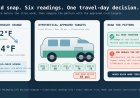
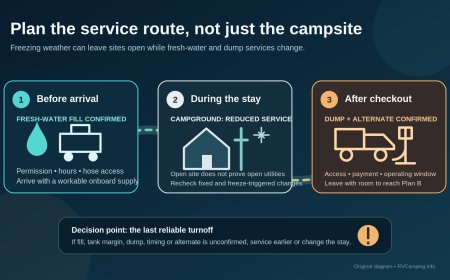
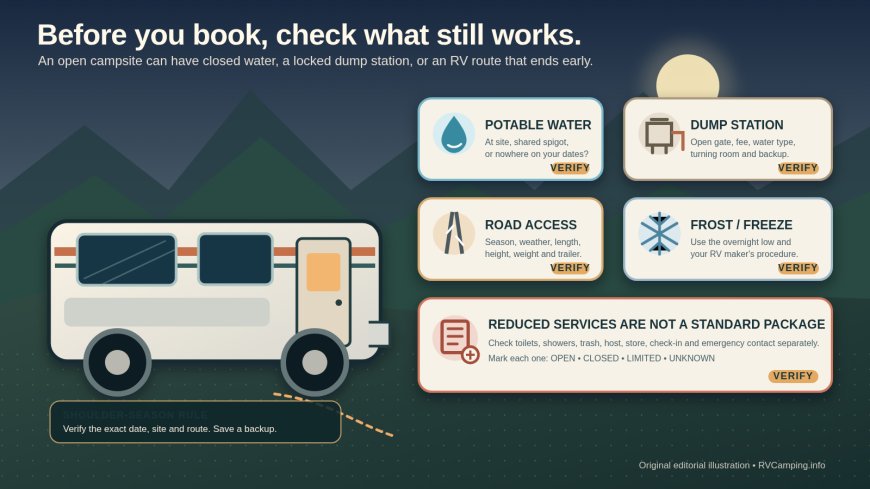
Before booking, audit five systems independently: fresh water, wastewater, the complete driving route, overnight cold and staffed or shared services. Official campground examples show that these systems can change on different schedules.[1][2][3] Record the answer for your exact dates. If one answer is vague, plan as though that service will not be available.
The 10-minute pre-booking audit
Open the campground page, the booking listing, the park's alerts or operating-hours page, its road-status page and a point forecast for the campground. The operating notice may contain exceptions that the general amenity list does not.[1] Then fill this table.
| System | What counts as confirmed | If it is not confirmed |
|---|---|---|
| Fresh water | A dated statement or staff confirmation that potable water is on during your stay | Arrive with enough water and a legal refill option identified |
| Wastewater | The dump station's operating dates, access rules and payment method | Choose an open station before or after the stay and size tank capacity to the interval |
| Road access | Every road on the planned approach is open and compatible with the combined rig | Save a rig-safe alternate; do not trust a passenger-car detour automatically |
| Frost | Campground-elevation overnight lows checked close to departure | Use your RV maker's cold-weather instructions or remove water from exposed systems |
| Reduced services | Restrooms, trash, check-in, store, fuel and emergency contact checked one by one | Bring the missing supplies and know how after-hours arrival works |
Do not convert the row into a single yes/no rating. A campground may have dry sites but an open dump station. Another may keep sites reservable while closing every water-fed building. Sol Duc Campground in Olympic National Park lists its resort-run RV park as summer-only.[2] After the resort closes, the campground becomes primitive with no running water.[2] The first winter storm can then close the campground and road until spring.[2] "Open," "primitive" and "closed" are separate operating states.
1. Confirm where potable water will come from
Search for three different things: water at the campsite, shared drinking-water spigots and a fill point that can accept an RV hose. An official listing may show normal water amenities while a dated seasonal notice closes waterborne facilities.[1] They are not interchangeable.
A broad listing that says "water available" does not settle which water facilities operate during your dates, and a dump station may have a different operating state from the campground's running-water system.[1][2] Ask the campground:
- Will potable water be on for my arrival and departure dates?
- Is it available at site __, at shared spigots or only at a separate fill station?
- Can I connect a hose, or must I carry water in containers?
- Has freezing weather changed the published schedule?
- If the system is off, where is the nearest legal potable-water fill that is open on my travel day?
Label the answer variable local fact in your trip notes. Add the page's updated date, the staff member's name if you called and the day you confirmed it. "Usually on through October" is not a firm answer for an October 28 arrival.
Plan the dry-camping case before paying. Estimate drinking, cooking, hand washing and toilet use based on your own measured consumption, not your fresh-tank badge. Tank capacity also does not tell you the practical fill level after accounting for payload, an off-level campsite or a long carry from the spigot.
2. Treat the dump station as a separate destination
A dump-station icon does not establish its seasonal operating details. Both Sparrowfoot and Sol Duc list dump facilities alongside water amenities that change in their shoulder or primitive periods.[1][2] Confirm:
- opening and closing dates;
- daily hours and whether a campground gate limits access;
- whether use is for registered campers only;
- fee and payment method;
- fresh-water availability, clearly separated from non-potable rinse water;
- maximum rig length, turning room and which driving direction lines up with your sewer outlet;
- whether closures appear on a different alerts page.
Put the station into the route plan like a fuel stop. Save its address, arrival side and an alternative outside the park. If the campground has no reliable cell service, save those details offline.
Also calculate the longest interval between confirmed dump opportunities. That interval, rather than the nominal length of the stay, controls your wastewater plan. A couple staying three nights after starting with empty tanks has a different margin than a family arriving after two travel days with partially filled tanks. Use your own recent tank history. Monitor levels conservatively if your gauges are unreliable.
Do not improvise disposal. If you cannot confirm a lawful dump location, change the itinerary or shorten the dry interval.
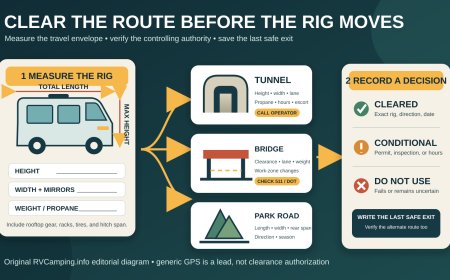
3. Audit the whole road, including the last few miles
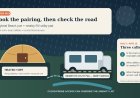
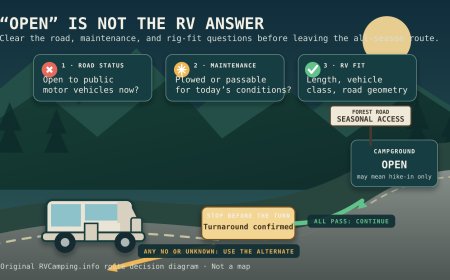
A reservable campsite does not certify your approach route. An official road schedule can impose seasonal, weather and vehicle-specific limits independently of the campground listing.[3] Review the park entrance, approach highway, campground access road, bridge limits, grades, tunnels and any scenic road you intend to use after unhitching.
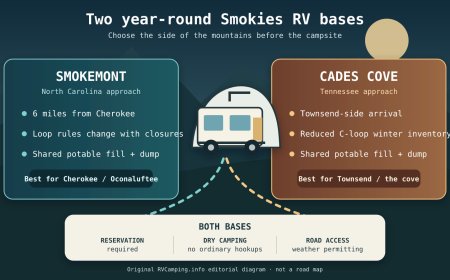
Great Smoky Mountains National Park shows why a date alone is insufficient. It lists major roads as open year-round only "weather permitting," while secondary roads use seasonal schedules.[3] Some roads remain subject to closure for snow, ice or muddy conditions, and the same schedule prohibits trailers and certain vehicles longer than 25 feet on several routes.[3] A road can therefore fail your trip for at least three different reasons: calendar closure, current conditions or vehicle restriction.
Run this route check in order, using the operating agency's current schedule and alerts as the source of local restrictions.[3]
- Map the campground using the park's official directions, not just the pin.
- List every named park or forest road after the last major highway.
- Check each road against the official seasonal schedule and current alerts.
- Record posted length, height, weight, trailer and high-clearance restrictions.
- Check construction, wildfire, snow, ice, mud and storm-damage notices.
- Build an alternate route and test that route against the same list.
- Recheck shortly before departure and again before the last reliable turnaround point.
Mark every status and restriction as a variable local fact. At the Smokies, one listed road is subject to closure from snow, ice or muddy conditions.[3] A screenshot from booking day is evidence of what you saw then, not permission to drive through a closure later.
Passenger-car reroutes deserve skepticism. A detour may use a tight switchback, low bridge, weight-limited crossing or unpaved road. If the operating agency has not identified an RV-suitable alternative, call the road authority or campground. Give total motorhome length or the truck-and-trailer combination, not just the trailer box length.
4. Use the temperature forecast, not the word "frost"
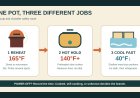
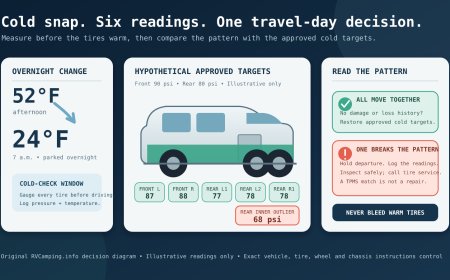
Frost language is easy to misread as an RV plumbing threshold. The National Weather Service defines a Frost Advisory around expected or occurring frost that threatens sensitive vegetation.[4] It describes a Freeze Warning as a forecast of temperatures below 32°F for a long period.[4] A Freeze Watch indicates the potential for widespread freezing within 24 to 36 hours.[4] Those products are weather alerts, not instructions for a particular RV.
The NWS also says its Freeze Watches are issued during the locally defined growing season.[4] Once that seasonal alert program ends, the absence of a watch should not be treated as proof that a campground night will stay above freezing. Check the forecast low itself.
Use the campground location or coordinates, not the nearest town by habit. Recheck the hourly or overnight forecast close to departure instead of relying only on a watch that may not be issued until 24 to 36 hours ahead.[4] Then compare the forecast with the limits and winterization steps in the manuals for your RV, water heater, filter housings and any exposed plumbing.
Your go/no-go choice depends on the actual rig. A heated underbelly, tank heaters, exposed hose, exterior filter, battery condition, propane supply and shore-power availability all change the plan. Do not borrow a universal temperature cutoff from a forum. The manufacturer instructions for the installed equipment are the relevant boundary.
If a freeze is plausible, decide before arrival whether you will:
- keep the water system in service under the maker's cold-weather procedure;
- disconnect and drain exterior hoses and accessories overnight;
- camp with the fresh-water system winterized and use a separate safe water supply; or
- move to a lower or warmer campground.
Record the forecast issue time, location and overnight low as variable local facts. Recheck after a front moves through; the forecast used at booking can be stale by travel day.
5. Inventory reduced services one line at a time
"Reduced services" is not a standard package. At Sparrowfoot, the 2026 shoulder notice identifies closed waterborne facilities and no attendant on duty.[1] At Sol Duc, the post-resort period is described as primitive with no running water before weather closes access.[2] Neither example tells you what another campground means by the same phrase.
Make a service inventory. Official shoulder-season descriptions may identify only some reductions, so anything they do not address still needs confirmation.[1][2]
- check-in booth and after-hours procedure;
- flush toilets, vault toilets and showers;
- potable water and dump station;
- trash and recycling;
- campground host, ranger presence or emergency contact;
- store, firewood, ice, propane and fuel;
- cell coverage, Wi-Fi and pay phones;
- gates, quiet hours and generator rules;
- accessible facilities and the route to them;
- nearby medical, grocery and repair options.
For each item, write open, closed, limited or unknown. Do not leave blanks. "Unknown" is useful because it tells you what to call about and what to replace with a self-contained plan.
Staffing matters beyond convenience. If no attendant is present, find out whether a gate locks, how to identify your assigned site, where to pay, how to report a problem and which phone number works after hours. Download the reservation and campground map before entering a no-service area.
Cross-check in the right order
Official pages can appear to disagree because one is evergreen while another carries a dated seasonal alert. The Sparrowfoot listing is a concrete example: its broad facilities description and its dated shoulder-season notice describe different service levels.[1] Use this order of authority for trip planning:
- a current closure, alert or dated operating notice;
- the exact campground's current facility page;
- the exact reservation listing for your dates and site;
- direct confirmation from the operating agency or campground;
- general park or regional information.
A direct phone answer can still be wrong or become stale. Repeat the critical facts back: "For site 18 on October 22, the potable fill and dump station are both operating, and Road X permits a 31-foot travel trailer, correct?" Ask where late changes are posted.
Save a small evidence packet offline: reservation, cancellation terms, site dimensions, service notes, road restrictions, map, forecast and contact numbers. Date every capture. This is not paperwork for its own sake. It keeps a generic amenity list from overruling a newer local notice while you are packing.
For the timing side of the booking, see our rolling-calendar guide to Recreation.gov reservation windows. The reservation calendar gets you a site; this service audit tells you what that site will support.
A call script that gets specific answers
I'm considering site __ for dates __ to __. My combined rig is __ feet long and __ feet high. Before I book, could you confirm five details for those exact dates?
1. Is potable water on, and where can I connect or fill?
2. Is the dump station open, what water is available there, and how do I pay?
3. Which arrival road should an RV use, and are there current or seasonal rig restrictions?
4. Which toilets, showers, trash services and check-in staff will be available?
5. Where will same-day closures or freeze-related service changes be posted?
Write down what remains unconfirmed. Then choose deliberately: accept the missing service with a workable backup, select another campground or change the dates. A cheaper, quieter shoulder-season site can be a good booking. It just needs to work as the campground that will exist during your stay, rather than the summer campground pictured in your head.
Sources
[1] Sparrowfoot, Harry S. Truman Lake
[3] Seasonal Road Schedule - Great Smoky Mountains National Park
What's Your Reaction?