






Plan an RV route over steep grades: read the signs before the descent
Plan an RV mountain route by reading grade signs, checking the exact rig's lower-gear and braking instructions, using brake-check areas, and locating escape ramps before the descent.

Plan an RV route over steep grades: read the signs before the descent
A mountain route that looks short on a map can be a poor fit for a loaded RV. Before choosing it, check the grade percentage, length, curves, surface, weather, brake-check pullouts, lower-gear instructions, and escape-ramp locations. Then compare those demands with the operating instructions for the exact motorhome chassis or tow vehicle and trailer-brake system. A generic "use a lower gear" tip is not a substitute for those manuals.
What a grade sign tells you
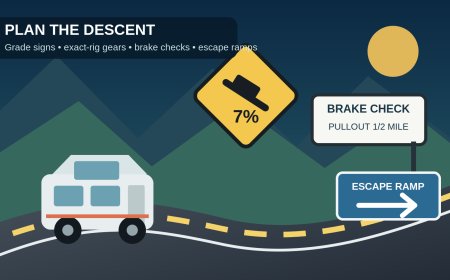
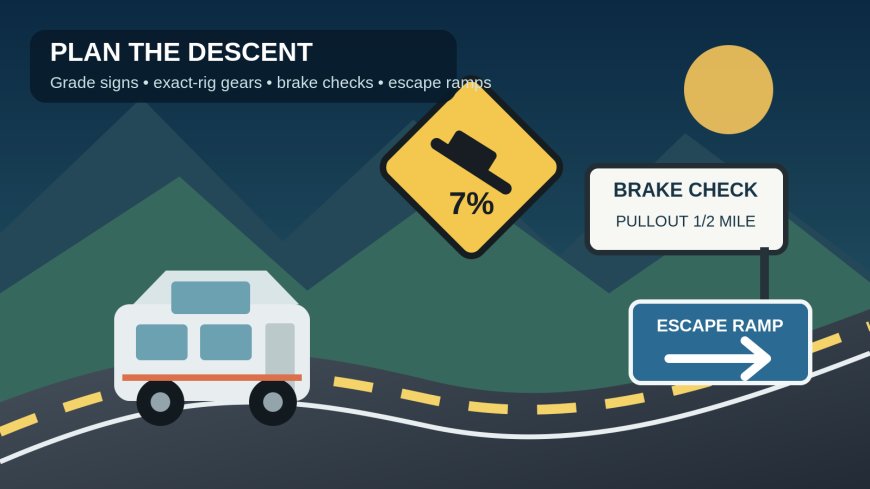
A yellow hill sign warns of a downgrade. A percentage plaque describes the slope, while another plaque may state the distance. The Federal Highway Administration defines percent grade as 100 times the roadway's elevation change divided by its horizontal length.[1] Put plainly, a 6% downgrade loses about 6 feet of elevation for each 100 horizontal feet. The sign does not tell you whether your loaded RV can hold a particular speed, which gear to select, or how much braking is available.
Treat percentage and length as a pair. A short, steep pitch and a long descent at the same percentage impose different demands. The FMCSA commercial-driver manual says downgrade speed selection depends on total weight, grade length, steepness, road conditions, and weather. It also tells commercial drivers to heed maximum-safe-speed and grade-warning signs.[2] That manual is useful for understanding the hazard, but it is written for commercial vehicles. It does not override the instructions for an RV's chassis, tow vehicle, transmission, engine brake, service brakes, or trailer-brake controller.
During route planning, record:
- the steepest signed percentage in each direction;
- the stated descent length;
- lower-gear or reduced-speed plaques;
- sharp curves and stops near the bottom;
- brake-check areas and escape ramps;
- seasonal restrictions, closures, and construction; and
- a less demanding alternate route.
Check the state DOT's current traveler-information page shortly before departure. A paper atlas or saved screenshot may not show a closed brake-check area, work zone, or weather restriction.
Choose the operating method by rig, not by folklore
The useful general principle is to enter a descent at a controlled speed and use the drivetrain's approved slowing features so the service brakes remain available. The exact way to do that is vehicle-specific.
Motorhomes
Start with the chassis manual, not only the coach builder's house manual. Identify the transmission ranges, tow/haul or grade-braking behavior, any exhaust or engine brake, speed restrictions, warning lamps, and slippery-road cautions. As one model-specific example, the 2023 Ford motorhome chassis manual says its tow/haul mode can provide engine braking and may downshift on a descent. The same section warns against using that mode on a slippery surface.[5] A diesel pusher, gasoline Class A, Sprinter-based Class C, and camper van can have very different controls. Do not transfer the Ford example to another chassis.
If the manual is missing or the controls are unfamiliar, resolve that before taking the grade. Do not experiment with an engine-brake switch, transmission range, or cruise control halfway down a mountain.
Towables
A towable has two braking systems to account for: the tow vehicle's system and the trailer's system. Confirm the loaded combination is within every applicable rating, then follow the exact tow-vehicle and brake-controller instructions for setup and testing. A 2025 Ford F-150 manual, for example, tells its drivers to shift lower on a long or steep hill, avoid continuous brake application, and use Grade Assist or Tow/Haul when equipped. It also says those features provide engine braking.[4] That is an example for that vehicle, not a universal setting.
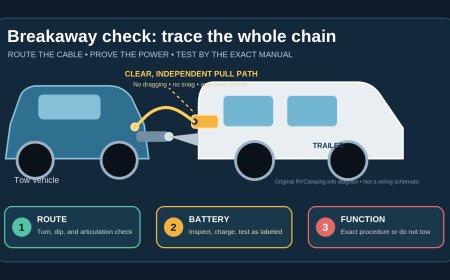
Trailer-brake gain, effort mode, manual-controller use, and breakaway checks depend on the installed equipment and load. Set and test them by the tow-vehicle, controller, and trailer manufacturers' procedures before the mountain segment. Do not copy another driver's gain number or use the trailer brakes alone as a homemade speed-control technique.
Use brake-check areas as decision points
Nevada DOT advises drivers to use provided brake-check areas near summits and the tops of steep grades, verify that the vehicle and equipment are working properly, and use recommended gears and speeds on the downgrade.[3] "Recommended" matters: the right gear and speed come from posted instructions and the manuals for the exact rig.
Build the stop into the itinerary rather than deciding at the last second. At a designated brake-check area:
- Park only where directed and keep the escape-ramp approach clear.
- Complete the pre-descent inspection specified in the vehicle and brake-system manuals.
- Confirm that no brake, ABS, transmission, or trailer-connection warning is active.
- Review the descent length, posted speed, planned transmission or retarder setting, and escape-ramp locations.
- Leave only if the rig responds normally and the driver is ready. If there is a warning, abnormal pedal feel, pulling, smoke, or a strong hot-brake odor, do not continue down the grade. Arrange qualified service.
A pullout is not permission to invent a cooling interval or touch brake components. Follow the manual and professional-service guidance. Brake hardware can be hot enough to injure, and a stopped rig can roll if it is not secured correctly.
Know the escape-ramp plan before it becomes urgent
An escape ramp is emergency infrastructure, not a turnout. Nevada DOT says these ramps may use an uphill alignment or a bed of specially sized aggregate to slow an out-of-control vehicle. It also states that truck escape ramps are not limited to trucks: any vehicle that is having braking problems or cannot slow on a downhill may use one.[3]
Note each ramp's side of the road and approximate location before the descent. Keep that path in mind while driving. If the RV is no longer responding well enough to slow, use the available escape ramp before total brake loss rather than passing it in hope of finding a better option. Enter as straight and centered as conditions allow, following posted directions. After stopping, follow the agency's instructions, call emergency help, and arrange recovery and brake repair. Nevada DOT warns drivers not to try to drive out of an aggregate bed and not to park or wait in a ramp's approach.[3]
A five-minute route decision
Before committing to the pass, answer five questions:
- What do the signs say? Record percentage, length, speed, lower-gear instructions, and any vehicle restrictions.
- What does this exact rig's manual say? Find the approved transmission, engine-braking, cruise-control, and trailer-brake procedures.
- Where can you stop before the descent? Mark the official brake-check area or another legal, level stop before the grade.
- Where are the escape ramps? Record their direction and order. Never use their entrances for parking.
- What is the exit plan? Keep a lower-grade alternate, a safe turnaround point before the descent, and enough daylight and fuel to use it.
The go/no-go call happens before the summit. If the route requires controls you do not understand, the brakes are not fully serviceable, the weather conflicts with the manual's warnings, or the driver is not comfortable with the descent, take the alternate. A longer route is often the simpler plan.
Sources
- Federal Highway Administration: Safety Effects of Horizontal Curve and Grade Combinations, Chapter 2 — definition of percent grade; retrieved September 25, 2026.
- Federal Motor Carrier Safety Administration: Model Commercial Driver License Manual — commercial downgrade-planning, gear, brake-fade, and escape-ramp principles; retrieved September 25, 2026.
- Nevada Department of Transportation: Truck Escape Ramps — brake-check areas, recommended gears and speeds, ramp users, and post-use instructions; retrieved September 25, 2026.
- Ford Motor Company: 2025 F-150 Owner's Manual — model-specific towing and downgrade guidance; retrieved September 25, 2026.
- Ford Motor Company: 2023 Motorhome Owner's Manual — model-specific tow/haul and engine-braking behavior; retrieved September 25, 2026.
What's Your Reaction?