





Pennsylvania's first winter restriction tier can stop an RV: build the hold plan before snow
Pennsylvania can bar RVs, motorhomes and passenger vehicles towing trailers at Tier 1 on affected roads. Build a lawful hold-and-recheck plan before a winter route.

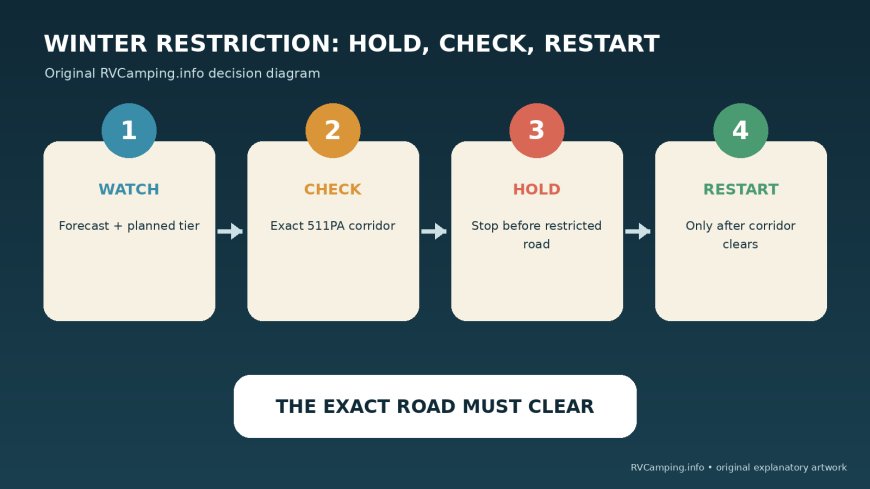
Pennsylvania's first winter restriction tier can stop an RV: build the hold plan before snow
Pennsylvania's winter restriction system has an easy trap for RV travelers: the lowest numbered vehicle-ban tier is already high enough to stop the trip. When Tier 1 applies to a roadway, recreational vehicles and motorhomes are not permitted there. Neither are passenger vehicles towing trailers.[1]
That means a pickup and travel trailer does not get to keep moving because the pickup has four-wheel drive. A motorhome does not get an exception because chains are aboard. On an affected Pennsylvania corridor, the RV category itself is the problem at Tier 1.
This is not a claim that a restriction is active today. It is a planning rule for any Pennsylvania winter itinerary: identify the exact corridors, choose a safe place to hold before each one, and do not restart until the official restriction for that roadway has been lifted.
Read the tier as a vehicle ban, not a road-condition grade
A tier number can look like a severity score: Tier 1 sounds mild, so a driver may assume careful travel is still allowed. PennDOT uses the tiers to define which vehicles are barred. Tier 5 is the most severe, but RVs enter the prohibited list at Tier 1.[1]
The distinction matters because three different notices can coexist:
| Notice | What it answers | RV decision |
|---|---|---|
| Weather forecast | What may develop over a region | Prepare, move the departure decision earlier, identify hold points |
| Speed restriction | What posted speed applies on a roadway | Obey the posted limit; this alone does not tell you whether the RV category is banned |
| Tiered vehicle restriction | Which vehicle classes may use a named road segment | If the RV or towable combination is listed, do not enter that affected segment |
Do not translate "Tier 1" into "use more caution." Translate it into the vehicle list. For an RV or a passenger vehicle towing a trailer, the answer on an affected Tier 1 roadway is stop.[1]
Know which description fits the rig
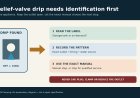
PennDOT's Tier 1 list reaches the two common RV arrangements by different language:
- A motorhome falls under "recreational vehicles/motorhomes."
- A travel trailer, fifth wheel, pop-up or other tow-behind arrangement generally puts the tow vehicle in the "passenger vehicles ... towing trailers" line when the tow vehicle is a car, SUV or pickup.
The live 511PA vehicle-restriction interface summarizes RVs/campers and tow-behind trailers among the vehicles restricted across the displayed tier system.[2] Do not narrow the rule to tractor-trailers because PennDOT discusses commercial-vehicle restrictions elsewhere on the page. The actual tier list expressly includes these noncommercial camping configurations.[1]
If the combination is unusual, get an answer from PennDOT or Pennsylvania State Police before travel. Save the response with the exact tow vehicle, trailer and roadway. Guessing that a converted bus, truck camper or heavy tow vehicle belongs to a more favorable category is not a route plan.
Build one corridor row for every Pennsylvania leg
The restriction is attached to an affected roadway or segment, not to the state's outline on a map. A February 22, 2026 PennDOT notice illustrates the moving pieces. Tier 1 began on a named set of interstates and turnpike segments at 3 p.m.; Tier 4 was planned for a different named set at 6 p.m. The agency said restrictions could change with road conditions and reports from field personnel.[3]
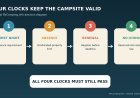
A useful trip card therefore needs one row per corridor:
| Field | Record this before departure |
|---|---|
| Corridor | Route number, direction and start/end interchange or state line |
| RV class | Motorhome, or passenger vehicle towing a trailer |
| Last safe hold | Named campground, commercial lot with permission, service plaza or other lawful stop before the segment |
| 511PA evidence | Planned or active tier, affected limits and time checked |
| Restart evidence | Official status showing the restriction has ended on this exact segment, with time checked |
| Backup | A legal overnight option that does not require entering another restricted road |
"Take I-80 west" is too vague. A restriction may cover only part of I-80, and a planned restriction can differ from the active map by departure time. Write down the limits in the same terms the official notice uses.
Put the hold point before the decision becomes urgent
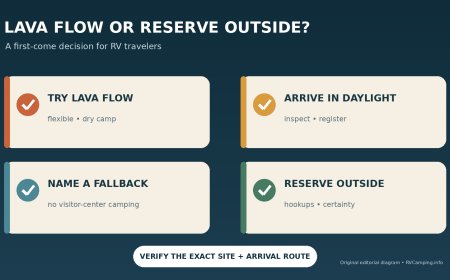
A hold point should be reachable while the route is still legal. It should not be a shoulder, interchange ramp, closed visitor center or an unverified parking lot. If the forecast creates a reasonable chance that the restriction will activate before arrival, call the candidate stop and ask four plain questions:
- May this motorhome or connected truck-and-trailer enter and wait there?
- Is overnight occupancy allowed if the restriction lasts past closing?
- What entrance remains usable in snow, and are there height or length limits?
- How should a late arrival or extended stay be handled?
The best hold point may be the current campground. Extending one night is usually cleaner than gambling on reaching a highway service plaza before a start time. If an extension is unavailable, choose the fallback while staff can still answer the phone.
Do not build the plan around stopping at the restriction boundary. Variable message signs warn drivers, but they do not create RV parking. Police activity, plows and turning traffic make the edge of a closure a poor place to improvise.
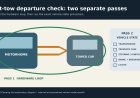
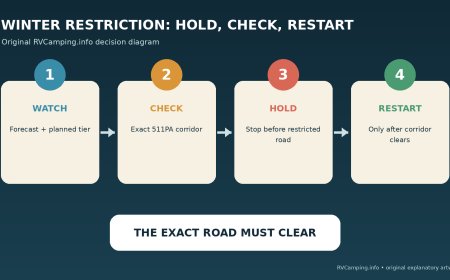
Check planned restrictions, then check again for active status
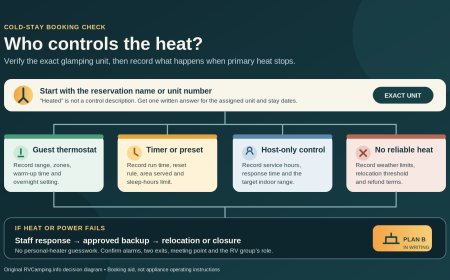
PennDOT says the agencies assess forecasts to decide whether restrictions are warranted, then review them hourly after restrictions begin. Restrictions are lifted by corridor when conditions allow.[1] The 511PA restriction tool separates planned and active tiers, which is exactly why a single screenshot from the night before is not enough.[2]
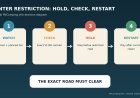
Use three checkpoints:
The evening before
- Review the forecast and 511PA planned restrictions.
- Match every planned segment against the corridor rows.
- Confirm the current campground extension or next hold point.
- Move food, medication and cold-weather supplies where they remain accessible during a delay.
Before unplugging or hitching
- Open the official 511PA vehicle-restriction view again.
- Check the exact corridor, tier, direction and limits.
- Compare the restriction start time with a conservative arrival time, not the navigation app's best case.
- Stay put if the segment is active for the rig or if the timing leaves no reliable margin to clear it lawfully.
Before entering the affected corridor
- Recheck 511PA from a safe parked location.
- Treat a planned restriction that has become active as a stop, even if the pavement at the hold point looks merely wet.
- If service is poor, call 511 or use the alternate official access method noted by PennDOT rather than relying on an old screen.[1]
A traffic camera can add context, but it does not cancel a published vehicle restriction. Neither does another RV passing the entrance.
Do not use chains as a permission slip
The Tier 1 wording makes a specific chain or approved traction-device distinction for some buses. It does not attach that exception to recreational vehicles/motorhomes or passenger vehicles towing trailers.[1] Carrying traction equipment may be wise or required elsewhere, but it does not turn a prohibited RV into an allowed vehicle on an affected Pennsylvania Tier 1 road.
Keep two questions separate:
- Is the vehicle allowed on this roadway right now?
- If allowed, is the vehicle equipped and the driver prepared for the conditions?
The first question comes before the second. A perfect set of chains cannot repair a failed permission check.
Treat an alternate route as a fresh route
A restriction on one interstate does not make every parallel road a suitable RV detour. The alternate may have lower clearances, weight restrictions, steep grades, tight towns, seasonal closures or its own winter restriction. Navigation software optimizing around a closure is not evidence that the proposed road fits the rig.
For each proposed detour, repeat the ordinary RV checks:
- legal status and current restrictions;
- loaded height and any bridge or tunnel limit;
- length, weight and trailer restrictions;
- grades and winter maintenance status;
- fuel and a lawful turnaround or hold location.
If those checks cannot be completed before the decision point, hold. A known legal stop is better than an unverified detour in worsening weather.
Restart only on current corridor evidence
Restrictions can be lifted corridor by corridor.[1] A statewide news update, improving snowfall or a lifted restriction on a nearby interstate does not prove that the planned segment is open to the RV.
Before rolling, record:
- the exact roadway and limits;
- the absence or removal of the applicable RV restriction;
- the time of the check;
- any remaining speed or lane rule;
- the next weather and 511PA checkpoint.
Then ask whether the rig and crew are still ready. A lifted ban means the legal category restriction ended. It does not promise bare pavement, open campground gates or a rested driver.
The finished decision should fit in one sentence: "At [time], 511PA shows no RV/tow-behind restriction on [exact segment]; we can reach [named next stop] before the next decision time, and [named hold point] remains available if conditions change." If any bracket is blank, the route is still a draft.
Editorial note: Pennsylvania can change planned and active restrictions as conditions develop. The official pages below were reviewed October 20, 2026. This article does not report a current active restriction and does not replace posted traffic controls or directions from officials.
Sources
What's Your Reaction?