





Crossing the U.S.-Canada border in an RV: build four inspection-ready folders
Build People, Pet, Pantry and Return folders for an RV border crossing, with separate checks for Canadian entry and the trip back into the United States.

Crossing the U.S.-Canada border in an RV: build four inspection-ready folders
By Romana
Category: RV Camping
An RV pantry is not one item at the border. Neither is "the pet paperwork." Admission decisions depend on the traveler, direction of travel, product, animal, origin, age, purpose, and recent travel history. A generic border checklist hides those branches.
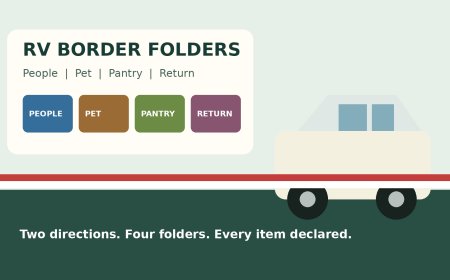
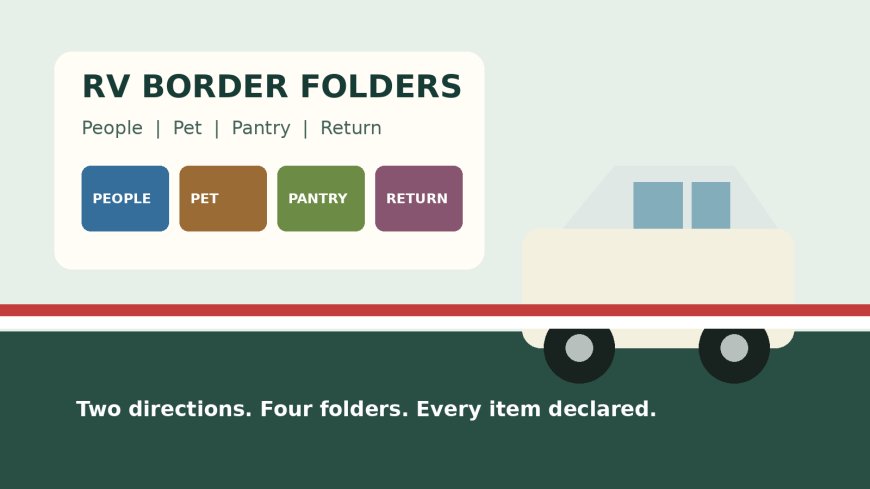
Use four folders instead: People, Pet, Pantry, and Return. Build them for the exact crossing date and direction, then keep the originals at the cab where they can be handed over without opening every cabinet.
This is a planning method, not a promise of admission. Border officers and inspection agencies make the final decision, and temporary animal or agricultural restrictions can change between packing day and arrival.
Folder 1: People
Start with every person in the RV, not the driver alone. Write each traveler's citizenship or immigration status at the top of a document list. That status controls which entry documents apply.
For entry into Canada by land, CBSA says a U.S. citizen must establish identity and citizenship. It recommends a valid passport, while also listing a U.S. enhanced driver's license and certain citizenship documents among options that may be presented.[1] U.S. permanent residents arriving directly from the United States by land or water can present a valid permanent resident card and do not need to present a passport for that Canadian entry rule.[1]
Do not turn those Canadian rules into a return-to-U.S. checklist. CBP's Western Hemisphere Travel Initiative page lists the documents U.S. citizens may use at land and sea ports, including a passport, passport card, enhanced driver's license, and certain trusted-traveler cards.[6] It separately says lawful permanent residents continue to present valid evidence of permanent residence.[6]
For each traveler, record:
- full name exactly as shown on the document;
- citizenship or immigration status;
- document type and expiration date for entering Canada;
- document type and expiration date for entering or returning to the United States;
- visa, permit, or authorization requirements that apply to that person's nationality and purpose; and
- the original document's location in the cab.
A photocopy in cloud storage is useful if something is lost, but it does not replace the original document required at inspection. Check names and expiration dates before paying a campground deposit.
Add the RV's registration, proof of insurance valid for Canada, rental authorization if applicable, campground address, trip dates, and a simple list of high-value equipment. These records help answer routine questions, but they are not substitutes for travel documents.
Folder 2: Pet
Make one cover sheet per animal. Do not file all animals under "pets," because Canada treats species and travel purposes differently. CFIA says only dogs, cats, and ferrets fit its pet category; other animals use separate import requirements.[3]
Put these facts on the cover sheet:
- species and breed or description;
- age on the crossing date;
- sex, color, name, and microchip number if applicable;
- owner and accompanying traveler;
- personal pet, assistance animal, adoption, resale, foster, breeding, show, or another purpose;
- every country the animal has been in during the look-back period required by the destination;
- vaccination records, certificates, permits, and veterinary contacts; and
- the official rule page checked, with date.
Canada's requirements can depend on origin, age, purpose, and whether the animal travels with its owner. CFIA tells travelers to review the exact situation early because a health certificate, vaccinations, tests, or treatment may have to be completed on a schedule.[3]
A return to the United States is a separate task for dogs. CDC says every dog entering or returning to the United States needs a CDC Dog Import Form receipt. A dog arriving from a dog-rabies-free or low-risk country must also appear healthy, be at least six months old, and have a microchip.[4] A dog with any visit to a country CDC classifies as high risk during that six-month window follows a different, more demanding branch.[4]
For a dog that has stayed only in the United States, Canada, and Mexico, CDC says the Dog Import Form receipt can cover multiple U.S. entries for six months as long as the country of departure does not change.[4] Save the receipt both on the phone and on paper. Check the listed port and trip details before driving to the booth.
Do not assume a rabies certificate alone completes both directions. Use Canada's import tool for entry to Canada, then CDC's dog navigator and any applicable USDA or state rules for return to the United States. If the pet is not a dog, run the correct species branch for both countries instead of borrowing the dog checklist.
Keep pet food in the Pantry folder too. Animal feed and treats can be regulated products even when the animal itself is admissible.
Folder 3: Pantry
Inventory the RV by product, not by cabinet. Open the refrigerator, freezer, dry bins, spice drawer, pet-food bin, outdoor kitchen, bait container, plant shelf, and firewood compartment.
Create one row per item or packaged group:
| Item | Quantity | Commercial package? | Country of origin | Entering Canada result | Returning to U.S. result | Action |
|---|---|---|---|---|---|---|
| Example: sealed dog kibble | record weight | yes/no | label country | check CFIA/AIRS | check USDA | keep/remove |
| Example: fresh produce | record amount | yes/no | label or receipt | check CFIA/AIRS | check USDA Canada page | keep/remove |
CBSA requires travelers to declare food, plants, animals, and related products. Its examples include meat, produce, dairy, pets, bait, firewood, seeds, bulbs, and even soil or organic debris on equipment.[2] The answer can change with the commodity, where it came from, and the province where the RV crosses. CBSA directs travelers to CFIA's Automated Import Reference System before travel.[2]
That is why "groceries from the U.S." is not a useful inventory description. Preserve original labels and receipts when they establish origin. Record mixed dishes by ingredients if the rule turns on meat, dairy, eggs, produce, or another regulated component. A home-cooked casserole without a label may require more explanation than a sealed product whose ingredients and origin are visible.
For return to the United States at a Canadian land border, USDA tells travelers to declare agricultural and wildlife products and to report farm visits or animal contact.[5] Its Canada-specific page contains product rules that can vary by commodity, origin, destination state, packaging, and current animal or plant health conditions.[5] Run the return column before leaving home, then refresh it before the southbound crossing.
Use only three action labels:
- KEEP: the current official tool permits it for this direction and circumstances, within any stated quantity and documentation limits.
- USE OR DISCARD BEFORE BORDER: the item is not permitted, its origin cannot be established, or the traveler does not want an inspection delay.
- ASK AND DECLARE: the item is uncertain or requires an officer's decision.
"Ask and declare" does not mean hide the item until an officer finds it. Put the row on the declaration list and say where it is stored.
Folder 4: Return
Many RV travelers plan the northbound crossing and improvise the trip home. The Return folder prevents that. Build it before departure, then update it in Canada.
Include:
- each person's U.S. entry document;
- each dog's current CDC receipt and supporting records;
- a fresh inventory of food and agricultural products acquired in Canada;
- receipts for purchases and repairs;
- a list of gifts, alcohol, tobacco, or other declared goods;
- farm, livestock, hunting, fishing, or animal-contact notes; and
- the chosen port's official hours and current wait-time source.
The southbound pantry is not just the leftovers from the northbound list. Cheese bought in Quebec, produce from a farm stand, firewood from a campground, and pet food purchased after arrival are new entries. USDA's land-border page says inspectors make the final admissibility determination.[5] Keep purchases accessible until that decision is made.
Run a 72-hour refresh
Three days before crossing, open every official page saved in the folders. Check for temporary restrictions, page updates, animal-health alerts, port hours, and weather or road problems. Do not rely on a screenshot from the day reservations were made.
Use this short audit:
- People: original documents present, unexpired, and matched to status and direction.
- Pet: species branch complete; age, purpose, origin, recent-country history, microchip, vaccine records, certificates, and receipts checked.
- Pantry: every regulated item listed with quantity and origin; uncertain items separated for declaration.
- Return: U.S. documents, CDC dog receipt, USDA product check, and purchase log ready.
Add a retrieval note beside every rule. For this article, the official pages were checked on September 24, 2026. Your folder should show the date you checked for your own trip.
Pack the RV for an inspection, not for concealment
Put the four folders within reach of the passenger seat. Group declarable foods in one or two accessible bins when temperature control allows. Do not bury pet records under bedding or scatter produce through several cabinets.
At the booth, turn off audio, remove sunglasses if asked, open the front windows, and answer the officer's questions directly. Declare the categories on your list, including food, plants, animal products, pets, firewood, bait, and farm or animal contact when applicable. CBSA says travelers should declare food, plant, and animal items even when unsure whether a restriction applies.[2] USDA gives the same broad declaration instruction for agricultural and wildlife products on entry to the United States.[5]
If an officer sends the RV to secondary inspection, follow directions and keep people and animals secured as instructed. An inspection is easier when the inventory says "freezer, lower left bin" instead of "somewhere in the rig."
The final go or hold decision
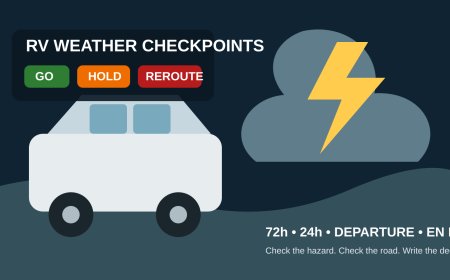
Mark the crossing GO only when every traveler has a valid document path in both directions, every animal has completed the correct species and history branch, and every pantry item is marked KEEP, USE OR DISCARD, or ASK AND DECLARE.
Mark it HOLD if a travel document is expired, a pet requirement has a future timing step, a CDC dog receipt is missing, a product's origin is unknown and cannot be resolved, or a current restriction changes the plan. Move the crossing rather than asking a border officer to repair work that required a veterinarian, permit, or replacement document days earlier.
Four folders do not eliminate questions at the border. They make the questions answerable. The people documents show who is traveling, the pet sheets show the exact animal case, the pantry list makes the RV's contents visible, and the return folder keeps the second crossing from becoming an afterthought.
Editorial note: This is general trip-planning information, not legal advice or a guarantee of admission. Requirements vary by citizenship, immigration status, animal, purpose, recent travel, product, origin, destination, and current health restrictions. Check the official tools for both directions shortly before travel. Official sources were checked September 24, 2026. No firsthand border crossing is claimed.
Sources
- Canada Border Services Agency: Travel and identification documents for entering Canada - Accessed September 24, 2026.
- Canada Border Services Agency: Bringing food, plant and animal products into Canada - Accessed September 24, 2026.
- Canadian Food Inspection Agency: Travelling with a pet - Accessed September 24, 2026. Page showed a modification date of August 14, 2026.
- CDC: Frequently asked questions on dog importations - Accessed September 24, 2026. Page showed an update date of August 27, 2026.
- USDA APHIS: Traveling into the United States from Canada at land borders - Accessed September 24, 2026. Page showed a modification date of March 31, 2026.
- U.S. Customs and Border Protection: Western Hemisphere Travel Initiative - Accessed September 24, 2026. Page showed a modification date of June 17, 2026.
What's Your Reaction?