






No sewer hookup? Build an RV dump-station route plan
A practical way to turn holding-tank capacity, campground rules, a confirmed dump station, and an independent backup into one RV route plan.


By Romana
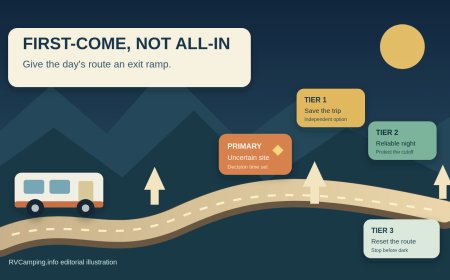
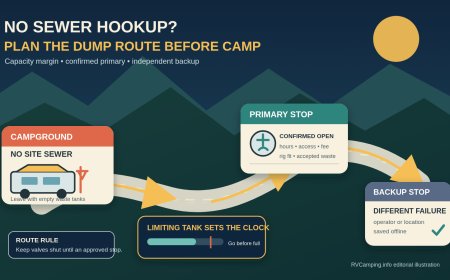
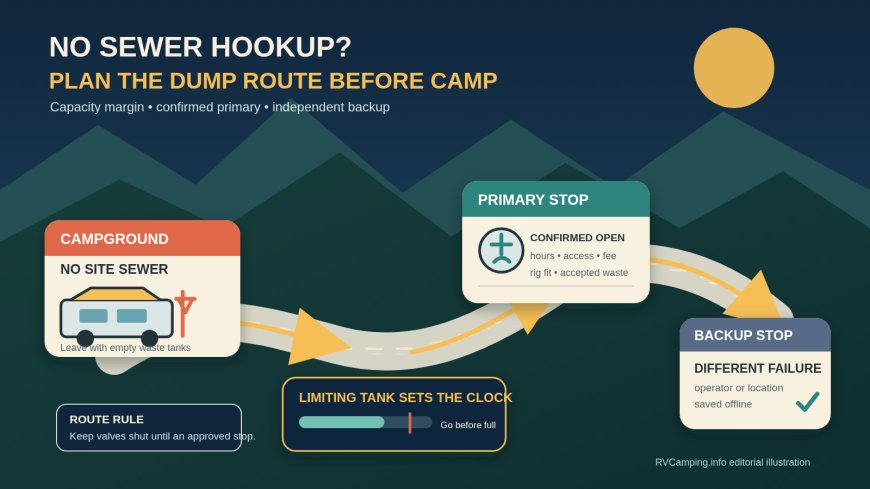
A campsite without a sewer connection is manageable if the waste plan is made before the reservation becomes a full holding tank. Start with the RV's usable black- and gray-tank capacity, estimate how many nights the smaller margin can support, and place a confirmed dump stop before that margin runs out. Save a backup on the same travel corridor. The goal is to arrive at both the campground and the dump lane with choices left.
This is a route-planning guide, not a repeat of the dumping procedure. For hose setup, hygiene, spill response, and the order of operations at the inlet, use RVCamping.info's safe RV dump-station guide.
First, identify what "no sewer" means
Campground listings compress several different service patterns into a few labels. "No sewer hookup" may mean there is no sewer at the campsite but a central dump station operates inside the campground. It may mean the dump is elsewhere in the park. It may also mean that every drop of black and gray water must leave in the RV.
Read the official facility page, reservation notice, alerts, and confirmation email. Record these as separate answers:
- Is there a sewer connection at the reserved site?
- Is there a central dump station, and is it open on the travel dates?
- Is potable fill water available at a separate, identified outlet?
- May registered campers use the station without another fee?
- May a portable waste tote or macerator be used?
- If the station is outside the campground, can the complete rig enter and turn around?
Do not infer disposal permission from a water spigot or restroom. Great Smoky Mountains National Park, for example, directs dish and bath water to utility sinks or dump stations, limits RV sewage to dump stations, and says its campgrounds do not have utility hookups.[4] That rule is local, but it shows why "gray water" and "sewage" need an actual destination rather than an improvised patch of ground.
Calculate the service deadline, not a perfect usage forecast
Tank monitor lights are rough signals, and advertised tank volume is not a promise that every gallon is usable. Build a conservative deadline from a short measured stay in your own RV.
- Leave a legal dump point with both waste tanks empty.
- Camp normally for 24 hours while noting showers, dishes, toilet use, and any water that bypasses the tanks.
- Check the monitors and, when practical, measure what is emptied at the next service stop.
- Repeat on another day before treating the result as a planning number.
Use the tank that reaches its limit first. A couple may have plenty of black-tank room while shower and dish water fills the gray tank. A family with campground showers may see the reverse. The route deadline belongs to the limiting tank, not the larger tank printed in the brochure.
A simple planning formula is:
Service interval = conservative usable capacity of the limiting tank / measured daily use
Round down. Then schedule the dump stop one travel segment earlier. If a measured gray-water pattern suggests four days, treat day three as the planned service day rather than making day four the only possible escape. Hot weather, extra occupants, illness, a closed bathhouse, or a meal with heavy cleanup can all change the pattern.
Put the stop on the route before camp
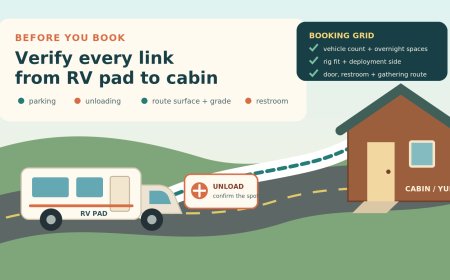
The least disruptive stop is often before check-in. Arrive with empty waste tanks, enough potable water for the site's rules and your payload limit, and no need to move a leveled RV halfway through the stay.
For a stay longer than the service interval, choose one of three plans:
- Break camp and drive the RV to an approved station.
- Use a portable tote only if the campground and station both permit it, and if the tow vehicle, hitch, tote rating, lane, and lifting method make the transfer safe.
- Split the reservation with a service night at a site that has a legal sewer connection.
A tote is not extra tank capacity until the entire chain works. The tote must be allowed at the campsite, transported without leakage, accepted at the receiving station, and handled without exceeding its instructions or the user's lifting limits. If any link is uncertain, plan to move the RV.
Verify the primary stop like a reservation
A dump-station pin is a lead, not confirmation. Save the official page and call the operator when a failure would leave no safe margin. Ask about the exact date and arrival window, fee, payment method, guest restrictions, gate code, acceptable waste, potable water, rinse water, tote rules, lane direction, height, turning space, and closures.
Bryce Canyon National Park demonstrates how much can hide behind one map symbol. Its official page says the park's only RV dump station runs from spring through fall and closes when overnight temperatures fall below freezing. Noncampers pay a fee, potable water is temperature-dependent, and the page names two alternatives about two miles north of the park.[2] A traveler who saved only the pin would miss the seasonal trigger, access price, water caveat, and backups.
Public-land destinations can package services differently. The Bureau of Land Management lists both a dry dump station and a dump station with water at La Posa Long Term Visitor Area, along with faucets, vault toilets, and trash service.[3] The same page ties use to location-specific permits and fees.[3] That is useful evidence for La Posa, not proof that another BLM camping area has any sanitation service.
Build a backup that survives the same failure
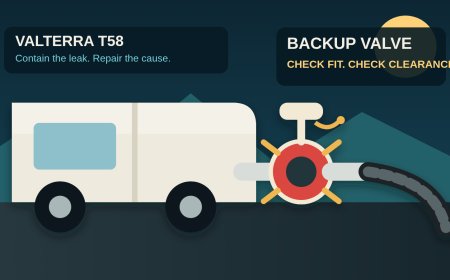
A backup across the street may share the same water system, freeze event, locked gate, or holiday staffing problem. Prefer a second station with a different operator or location and a reasonable path toward the next campground or home.
For each stop, save:
| Field | Primary | Backup |
|---|---|---|
| Official facility name | ||
| Address and entrance coordinates | ||
| Operator phone | ||
| Open date and hours confirmed | ||
| Guest or permit restriction | ||
| Fee and payment | ||
| Black/gray/tote acceptance | ||
| Potable fill status | ||
| Rig access notes | ||
| Next legal option |
Write the entrance coordinates rather than relying on a generic campground marker. A station can sit behind a separate gate or on a one-way loop. Keep the phone number offline, too. Poor reception is the wrong moment to discover that the saved pin identifies the visitor center rather than the dump inlet.
Protect the plan from bad assumptions
Do not solve a missed stop by opening a valve elsewhere. EPA warns that some holding-tank chemicals can interfere with onsite wastewater treatment, corrode equipment, or contribute to soil and water contamination; it tells users to read product labels and avoid excess chemical use.[1] An authorized station still has to be compatible with what is in the tank.
Keep black and gray water contained until the responsible operator identifies an approved receiving point. A vault toilet, storm drain, roadside grate, wash bay, or private sewer cleanout is not a substitute unless the owner and controlling authority expressly permit that use. The campground's rule, the station's acceptance policy, and local law all matter.
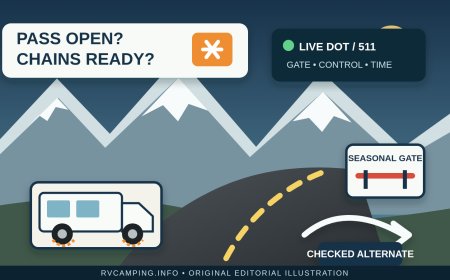
Weather deserves its own check. Freezing can close a dump station even while roads and campsites remain open, as the Bryce example makes clear.[2] Flooding, utility failures, maintenance, and seasonal staffing can also separate campsite availability from sanitation availability. Recheck the primary and backup shortly before departure and again before leaving camp for the service run.
A workable departure rule
Leave for the dump stop when the planned margin is reached, not when a monitor finally reads full. Close the loop only after confirming the station is open and the lane is reachable. If the primary fails, redirect to the saved backup while every valve remains shut.
The useful route plan fits on one screen: limiting tank, conservative service day, primary station, backup station, access facts, and the next legal option. That small record turns a campsite without sewer into a scheduled logistics problem rather than a sanitation emergency.
Sources
- Safe Wastewater Disposal for RV, Boat, and Mobile Home Owners and Operators — U.S. Environmental Protection Agency; factsheet landing page and archived PDF, updated June 10, 2026. Accessed September 21, 2026.
- RV Dump Station — National Park Service, Bryce Canyon National Park; season, fee, potable water, and nearby alternatives. Updated August 15, 2026. Accessed September 21, 2026.
- La Posa Long Term Visitor Area — Bureau of Land Management; sanitation facilities, location, permits, and fees. Accessed September 21, 2026.
- Campground Regulations — National Park Service, Great Smoky Mountains National Park; wastewater disposal and campground-hookup rules. Updated August 12, 2026. Accessed September 21, 2026.
Source credit: U.S. Environmental Protection Agency, National Park Service, and Bureau of Land Management. This article provides general trip-planning information. Confirm current facility status, rules, equipment instructions, and applicable law before travel.
What's Your Reaction?