


Camco Rhino Blaster Pro review: plumbing decides whether it reaches the tank
Research-based Camco Rhino Blaster Pro review with a drain-path test, safe rinse sequence and exact 39085/ASIN check.
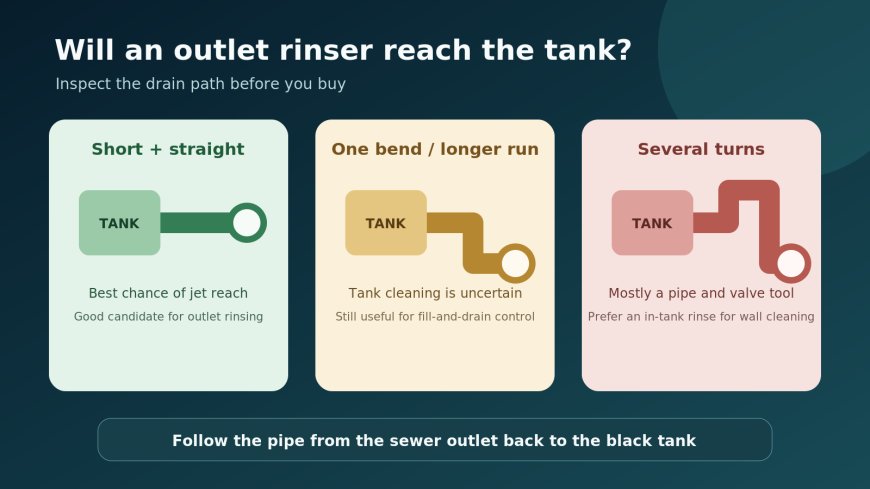
The Camco Rhino Blaster Pro is a useful sewer-outlet adapter, especially for an RV without a built-in black-tank rinse. Its clear elbow, hose inlet and second gate valve let you watch a dump, rinse the outlet path and run a controlled fill-and-drain cycle from outside the coach.[1] That convenience is real. The catch is under the RV: bends and long pipe runs can keep the reverse water stream from doing much inside the tank.
This is a research-based review of the Camco Rhino Blaster Pro, not a hands-on test. RVCamping.info did not buy or physically test the product.
The best use case is a short, simple drain path
Camco's current product page describes the Rhino Blaster Pro as a gate-valve version of its outlet rinser. It uses standard RV bayonet connections, a clear elbow and a hose connection with a vacuum breaker.[1] The Amazon listing for ASIN B00T36LJF2 identifies the product as model 39085 and GTIN 00014717390859.[2]
The hardware solves a practical problem: it puts the water connection and flow control beside the sewer outlet.[1] That can be easier than carrying a rinse wand through the RV, and it gives an older rig a way to refill and dump a tank without a factory flush inlet.[1] The clear elbow also shows when the heavy discharge has slowed.[1]
It does not guarantee that a pressurized jet reaches the tank. The Fit RV tested several flush arrangements in a clear tank and found that two 45-degree elbows changed the performance of drain-end rinsers.[3] Its test also found that clear discharge could look clean before the tank itself was clean.[3] That makes plumbing geometry more useful than the word "blaster" when deciding whether to buy.
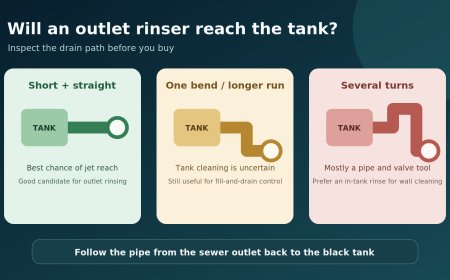
| What you see under the RV | What the adapter can reasonably do | Buying read |
|---|---|---|
| Short, nearly straight run from outlet to tank | Best chance for the reverse stream to reach the tank; also provides outside fill-and-drain control | Strongest fit |
| One bend or a longer run | Dependable for watching flow, rinsing the outlet pipe and controlled refilling; tank-wall cleaning is uncertain | Useful, with modest expectations |
| Several bends, a shared manifold or a remote tank | Water may spend most of its energy in the drain plumbing | Prefer a factory rinser or compatible toilet-entry wand for tank cleaning |
This route check is the page's main recommendation. Look from the outlet toward the black tank before ordering.[3] If the pipe disappears through several turns, buy the Rhino Blaster Pro for valve control and repeated fill-and-drain cycles, not because you expect it to scrub the far wall.
The second gate valve is the useful part
A plain outlet rinser lets water run back toward the tank while the sewer remains open. The Pro model's added gate valve can hold rinse water upstream, then release it through the sewer hose.[1] Camco also lists a vacuum breaker on the water side and a clear 45-degree elbow.[1]
That setup can loosen and carry out material near the outlet and on the tank floor after the first dump. It also gives the operator a clean stopping point: shut off the water, open the downstream gate, and watch the next discharge. Repeated small cycles are easier to supervise than an open-ended attempt to fill an unknown tank.
The product is a poor fit for someone who wants a set-and-forget flush. TCEQ treats RV sewer-flusher connections as a backflow concern. Its guidance says a nonpotable water source is safest, discourages Y-adapter arrangements that simultaneously feed the RV's potable system and sewer flusher, and says the connection should be watched and disconnected promptly.[4] The vacuum breaker included with the adapter is useful hardware, but it does not turn a sanitation hose into drinking-water equipment.
Use a dedicated rinse hose, keep the sewer hose attached to the dump inlet, and stay at the controls.[4][5] San Diego County advises securing both ends of the sewer hose before opening a tank valve, watching the hose while dumping, closing valves when they are not in use and directing residue toward the dump-station inlet.[5]
There is one limit worth spelling out: never close the Rhino gate and walk away while water enters the tank.[4] Tank monitors are often imprecise, and the clear elbow cannot show the liquid level inside the RV. If you do not know the available capacity or cannot monitor the fill continuously, leave the tank valve open and accept that you are mainly rinsing the outlet path.
Check 39085, 39086 and the ASIN before buying
The current Camco storefront identifies its single-unit product as SKU 39086, with a 12-month warranty and listed dimensions of 4.38 by 9.63 by 11.25 inches.[1] The Amazon page at the link below identifies ASIN B00T36LJF2 as model 39085 and shows GTIN 00014717390859.[2] Camco's cataloging has long used nearby numbers for packaging variants, but the purchase check is simpler than the history: the listing should show the Pro clear elbow, hose-side vacuum breaker and added gate valve.
As an Amazon Associate, RVCamping.info earns from qualifying purchases. This does not change the price you pay. Verify model 39085, ASIN B00T36LJF2 and the pictured gate-valve configuration before ordering.
Check the Camco Rhino Blaster Pro on Amazon
Buy it if your RV lacks a built-in rinser and you want outside control over repeated drain-and-refill cycles. Skip it if the drain path has several turns and your goal is to spray the tank walls. In that layout, the adapter can still make dumping easier, but the plumbing has already decided how far its water jet will travel.
Sources
- Camco, “Rhino Blaster Pro, w/Gate Valve,” accessed November 4, 2026.
- Amazon, Camco Rhino Blaster Pro listing for ASIN B00T36LJF2, accessed November 4, 2026.
- The Fit RV, “Testing Tank Flushing Systems in the Clear RV Black Tank,” accessed November 4, 2026.
- Texas Commission on Environmental Quality, “RV Parks: Am I Regulated?” revised February 2024.
- County of San Diego, “Recreation Vehicle (RV) User Resources,” accessed November 4, 2026.
What's Your Reaction?