














Victron Orion XS 50A review for RVs: fast charging starts with alternator margin
Research-based Victron Orion XS 50A review with an alternator-margin worksheet, exact EMC model check and real RV driving results.
The Victron Orion XS 12/12-50A is a strong fit for an RV that needs meaningful house-battery charging while the engine is running. It can regulate up to 50 amps in a compact, fanless charger, accepts programmable input and output current limits, and works with conventional or smart alternators.[1][2]
Its best feature is also the reason to slow down before buying: 50 amps at the house battery is not the same as a harmless 50-amp accessory load. The vehicle's alternator, factory connection point, cable run, protection and battery settings all have to support the installation. If they do, owner reports show charging in the mid-30s to high-40s while driving.[3][4]
This is a research-based review. RVCamping.info did not buy, install or physically test the charger.
As an Amazon Associate, RVCamping.info may earn from qualifying purchases. The reviewed listing is ASIN B0FRNCTJK2, Victron part ORI121217050 with EMC enhancements. Check the exact Orion XS 12/12-50A EMC model on Amazon.[5]
Start with the amps the vehicle can spare
Victron lets the installer set both input and output current in 0.1-amp steps.[2] That turns the Orion XS into more than a fixed 50-amp box. A properly chosen input limit can respect a vehicle connection point or reduce alternator load, while a battery-specific charge profile controls the house-bank side.[1][2]
The useful buying question is not "Does my alternator have a large number on its label?" It is "How much current is still available in the conditions where I expect this charger to run?" Headlights, radiator fans, heated glass, cab climate equipment and factory electronics consume part of alternator output. Idle output can also be lower than the alternator's headline rating.
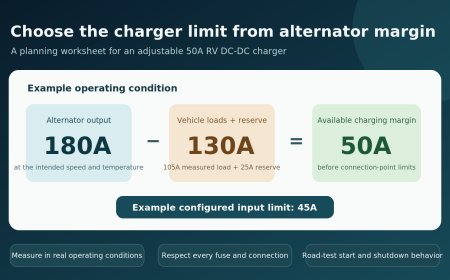
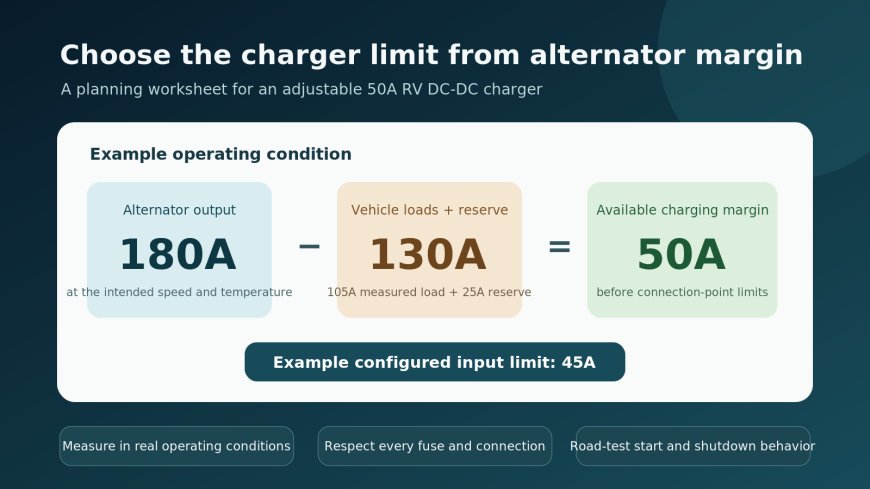
Use a worksheet like this before choosing the current limit:
| Planning input | Example value | What to verify |
|---|---|---|
| Alternator output in the intended operating condition | 180 A | Obtain vehicle-specific output data, including idle if relevant |
| Vehicle's existing demand in that condition | 105 A | Measure or get a qualified load estimate with major accessories on |
| Reserve for heat, aging and transient loads | 25 A | Set with the installer; this is not a universal allowance |
| Current left for added charging | 50 A | 180 - 105 - 25 |
| Orion input limit | 45 A | Stay below both the available margin and every connection-point limit |
The numbers are an example, not a recommendation for a particular vehicle. Their value is the order of operations. A buyer who starts with "50A charger" may design backward from the product. A buyer who starts with measured alternator margin may end up at 45 amps, 30 amps or no installation at all.
This distinction shows up in real use. FarOutRide replaced a nominal 60-amp charger that often delivered 25 to 30 amps with the Orion XS and reported about 45 amps steadily in its van.[3] An Oliver trailer owner initially saw 40 amps with a diesel engine at idle and near 50 amps while towing, then recorded 53.8Ah added during a 90-minute mixed-speed drive. On a later 175-mile run, the same owner reported a 132Ah state-of-charge increase while the Orion itself usually showed about 35 to 38 amps; solar and concurrent loads affected the net battery result.[4]
Those reports are useful because they are not identical. Cable loss, source voltage, engine speed, battery state, other charge sources and active RV loads can all separate a 50-amp product name from the number that reaches the battery.
The small case does not make this a small wiring job
The 50-amp Orion XS is rated for a 9-to-17-volt input, a 10-to-17-volt adjustable output and up to 700 watts at 14 volts. Victron lists 98.5% maximum efficiency, IP65 protection and a 5.4-by-4.85-by-1.6-inch enclosure weighing about 0.73 pound.[2] It is dramatically smaller than many older high-current chargers, and natural convection means there is no fan to hear.
Heat still matters. Victron's 700-watt rating assumes suitable cooling through 104°F, with output derating above that temperature; restricted airflow can make derating begin sooner.[2] The manual calls for vertical mounting with the terminals down, ventilation around the enclosure and a location near the battery but not directly over it.[1] A packed seat pedestal or sealed electrical cabinet can erase part of the compact charger's advantage.
The electrical path deserves the same attention as the box. The terminals accept conductors up to 4 AWG, but maximum terminal size is not a wiring prescription.[1][2] Cable length, insulation temperature rating, allowable voltage drop, routing, source connection and overcurrent protection determine the actual design. The manual provides cable and fuse guidance, while the vehicle and battery manufacturers may impose tighter limits.[1]
FarOutRide's installation is a good concrete example of why the factory connection point matters. Its guide notes a 60-amp Ford Transit connection point and recommends reducing the Orion setting below maximum to avoid opening that factory fuse; a higher-capacity connection point changes the available design space.[3] That is vehicle-specific evidence, not a rule for every Transit or motorhome.
For a trailer, the entire tow-vehicle-to-RV path joins the calculation. Connectors, long cable runs, chassis returns and disconnect hardware can introduce voltage drop or heat. The Oliver owner observed more input-voltage drop when charger output increased from 30 to 40 amps, then used the Victron app data to investigate the installation.[4] A long run that looks adequate by wire gauge alone can still fail at a connector or termination.
This is installed electrical equipment. Buyers who cannot document source capacity, conductor sizing, fuse placement, grounding and battery settings need an RV or automotive electrical professional, not a larger guess.
Smart alternator support still needs a road test
Victron includes engine-shutdown detection so the charger can stop drawing when the alternator is no longer supplying power.[1][2] That is especially useful with smart alternators whose voltage does not remain at a simple, fixed charging level.
It is not a substitute for commissioning. FarOutRide's comment section includes Transit owners whose voltage behavior caused the Orion to interpret a running engine as stopped.[3] The manual exposes start, shutdown and lockout settings, but changing them without understanding the vehicle can drain the starter battery or load the alternator at the wrong time.[1]
A sensible handoff test covers more than seeing 50 amps once. Check cold start, warm idle with major cab loads, steady road speed, deceleration behavior and engine shutdown. Watch input voltage at the charger as well as output current. Then repeat the test when the house bank is low enough to request substantial charge. A nearly full battery can make a healthy installation look weak because the charger is correctly tapering.
Battery settings need equal care. The Orion XS includes programmable charging and presets for common chemistries, plus low-temperature shutdown support when suitable temperature data are available.[1][2] The selected profile still has to match the battery maker's limits and the rest of the charging system. Solar, shore-power charging and alternator charging can coexist, but their voltage targets and control scheme should not fight one another.
Buy the current part, then choose the current limit
The Amazon listing reviewed here identifies ASIN B0FRNCTJK2 as part ORI121217050, the 50-amp model with EMC enhancements.[5] Older references and drawings may show ORI121217040. Both belong to the Orion XS 12/12-50A family, but buyers should not assume a marketplace listing, manual revision and physical label point to the same hardware generation.
The ORI121217050 is the better purchase target when the EMC-enhanced version is intended. Verify all three identifiers before installation: the Amazon ASIN, the Victron part number on the listing or invoice, and the label on the received unit. Do not transfer specifications from the 70-amp Orion XS or the 12/24-volt Orion XS 1400; their enclosure protection, output and system fit differ.[1][2]
The strongest buyer already has, or is willing to obtain, an alternator-load assessment and a professionally designed cable path. That owner gets fast, configurable charging without a cooling fan, plus Bluetooth setup and operating data.[1][2]
Skip it when the only available source is a lightly rated factory circuit, when the tow-vehicle cable run cannot be upgraded cleanly, or when the house battery rarely needs energy between camps. A lower current charger may be cheaper and easier to integrate. Direct alternator-to-lithium charging without current control is not the shortcut.
The Orion XS earns its place by being adjustable. Treat 50 amps as the ceiling, not the installation plan. The right setting is the one the vehicle can supply on a hot day at the engine speeds you actually use, through wiring that stays within its limits.
Sources
- Victron Orion XS 12/12-50A manual, revision 12 (accessed November 3, 2026)
- Victron Orion XS DC-DC battery chargers datasheet (accessed November 3, 2026)
- FarOutRide Orion XS installation and long-term review (accessed November 3, 2026)
- Oliver owner installation and driving results (accessed November 3, 2026)
- Amazon US listing for ORI121217050 (accessed November 3, 2026)
What's Your Reaction?