
A 2028 RV may reject a pedestal your old rig accepted: what GMI changes
Model-year 2028 RVs add a grounding monitor interrupter. Learn what a GMI changes at campground hookups and what to ask at delivery.
By RVCamping.info Research Desk | Checked November 5, 2026
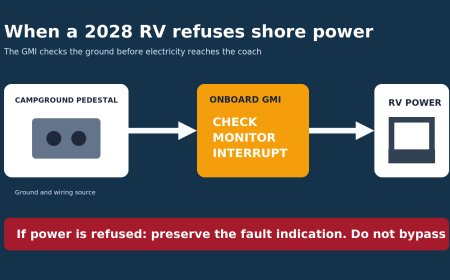
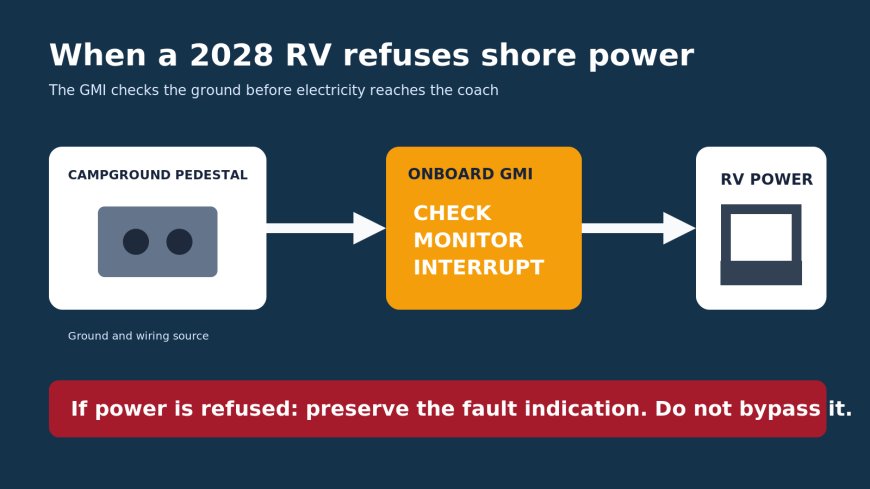
A campground pedestal can power a current RV and still fail the next generation of shore-power checks. Starting with model-year 2028, new 30-amp and 50-amp RVs must have a grounding monitor interrupter, or GMI. The device checks the power source before admitting electricity and keeps watching the ground connection while the RV is plugged in.[1]
The practical change is easy to miss. A dark RV will no longer point only to a tripped breaker, a bad cord or a problem inside the coach. It may be the GMI refusing a pedestal that has an open, weak or incorrectly wired grounding path. Moving to another site might restore power, but it does not diagnose the first site.
For anyone shopping for a 2028 RV, the useful question is not whether the coach "has GMI." It must. The useful question is whether the dealer can show you how that particular installation reports a fault and what the owner should do next.
The GMI sits ahead of the RV's normal power distribution
RVIA says the GMI is permanently installed after the shore-power connection and before the panelboard, or before the transfer switch when the RV has one.[1] That position explains why a fault can leave the entire shore-power side of the coach dark before any branch-circuit breaker appears to be the problem.
It is also why a GMI is not simply another name for a portable surge protector or a GFCI outlet. RVIA describes a GMI as a ground-integrity device: it screens the receptacle wiring and grounding path before admitting power, then disconnects if the ground is lost during use.[1] A GFCI looks for an imbalance in current. Those jobs overlap in the broad goal of shock protection, but they are not interchangeable.
The rule covers new model-year 2028 RVs with 30- or 50-amp service. RVIA set January 1, 2027 as the effective date and tied mandatory enforcement to each manufacturer's 2028 model-year production. Those coaches are expected to reach the market during 2027.[1] A calendar-year 2027 purchase can therefore be either side of the change. Check the coach model year and installed equipment rather than assuming from the sale date.
One listing announcement makes the transition more concrete
RV News reported on November 4 that Intellitec's 50-amp Futuro GMI had achieved UL listing. Its 30-amp version was still in final testing, with approval expected by the end of 2026, and 50-amp deliveries were expected to begin by the second quarter of 2027.[2]
That is a supplier announcement, not proof that every 2028 RV is production-ready today. It does show why the implementation timeline matters. RVIA had previously delayed enforcement when listed devices were not commercially available, and the current requirement now meets actual listed-product development.[1][2]
The Intellitec announcement also mentions surge protection as a feature of that product family.[2] Buyers should not generalize that feature to every GMI. The code-driven function is ground monitoring and interruption. Surge protection, displays, fault memory and reset behavior must be checked on the exact unit installed by the RV manufacturer.
Ask for a failed-power demonstration before delivery
A normal pre-delivery inspection proves that the coach works on the dealer's good power source. It does not show whether the owner can interpret a refusal at a campground. Add one short handoff to the sale:
- Have the dealer identify the GMI's physical location and model.
- Ask where its status or fault indication appears. It may be on the device, a remote panel or another display, depending on the installation.
- Ask the dealer to explain the manufacturer-approved response to a ground or wiring fault, using the owner's literature for that exact GMI.
- Confirm how the coach behaves on generator or inverter power, if equipped, and whether the indications differ from a shore-power refusal.
- Keep the GMI instructions with the electrical and transfer-switch documents, not buried in a generic appliance packet.
The point is not to have a dealer create a live electrical fault. A simulated display or a walk-through of the documented indicators is enough. Electrical work and energized testing belong with qualified people; RVIA expressly directs electrical work to licensed electricians.[1]
This handoff also catches a thin-documentation problem before travel. If nobody can identify the device, find its instructions or explain a fault indication, the owner is being sent out with a safety interlock they cannot distinguish from a dead coach.
When shore power is refused at a campground
Start by treating the refusal as a safety signal, not as an inconvenience to bypass. Do not defeat the GMI, alter the shore cord or use an adapter to make the warning disappear. RVIA identifies damaged feeder cords, compromised adapters, a lost pedestal ground and current on the grounding conductor among the conditions the new requirement is meant to address.[1]
Then separate what you can observe from what requires diagnosis:
- Record the site number, pedestal receptacle used and the GMI indication.
- Disconnect according to the RV and GMI instructions.
- Inspect the plug, cord and adapter for visible damage or overheating without opening electrical equipment.
- Tell campground staff that a GMI-equipped RV refused the source and give them the exact indication.
- Use another site only if the campground authorizes the move. A second site accepting power narrows the problem, but it does not clear the first pedestal for anyone else.
A plug-in circuit analyzer may catch an open ground or reversed polarity, but RVIA warns that ordinary testers do not reproduce every condition a GMI can detect.[1] This is not a contest between the RV and the pedestal. A campground electrician may find a source problem; an RV technician may find a damaged cord or fault on the coach side. The device's report, the owner's manual and qualified testing decide which path to follow.
The buying decision is really a support decision
GMI should improve protection against an energized RV frame, commonly called "hot skin." It may also produce a new kind of arrival problem: the coach is safe but dark until a real grounding or wiring fault is found.[1]
That trade is reasonable, but only if the handoff keeps up with the hardware. Before accepting a 2028 model, get the device identity, fault-display location, exact instructions and service contact in writing. On the road, preserve the indication and involve the campground rather than trying to outsmart the interlock.
The first season of GMI-equipped RVs will expose some old pedestals and some owner assumptions. A coach that refuses power has not necessarily failed. It may be the first one on the row able to explain why the connection was unsafe.
Source note: The UL listing and delivery timing are attributed to RV News' report of Intellitec's announcement. RVIA is the source for the requirement, timeline, placement and operational guidance. Product-specific features must be verified on the exact installed GMI.
Sources
What's Your Reaction?