



Before You Book: Parking, Unloading and Accessible Routes for an RV-and-Cabin Group
Verify RV fit, overnight parking, unloading space and the complete route between cabins, yurts, restrooms and gathering areas before a mixed group books.

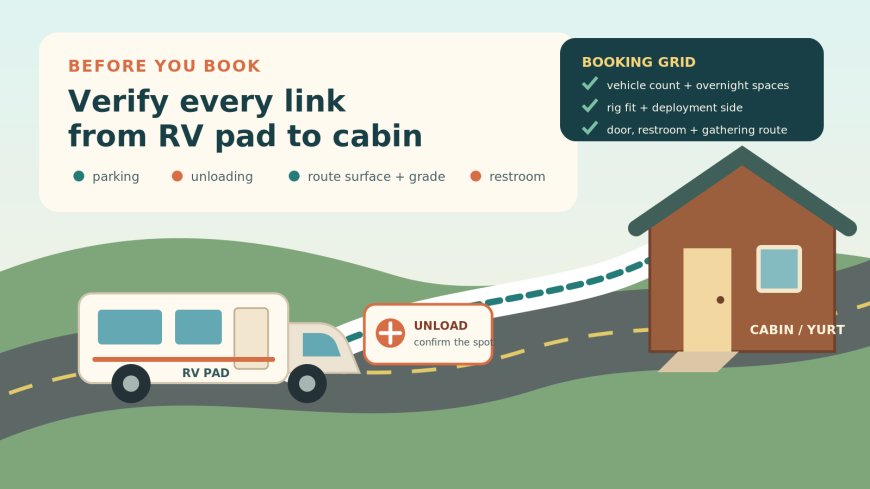
Before you book: parking, unloading and accessible routes for an RV-and-cabin group
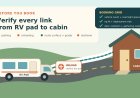
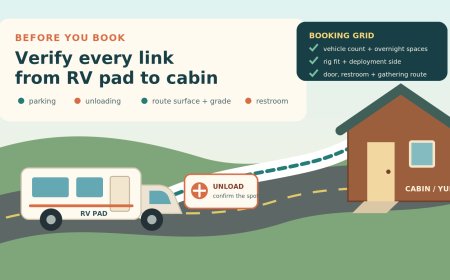
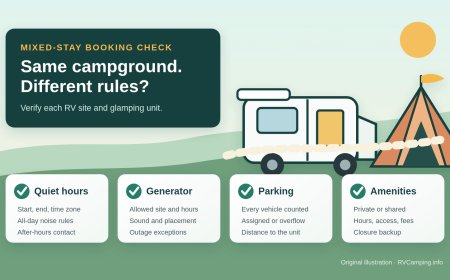
A cabin labeled accessible and an RV site that fits the rig can still leave the group with an unworkable gap between them. Verify the whole arrival chain before paying: entrance, RV approach, parking, unloading point, route to the cabin or yurt, restroom and shared gathering space.
For a mixed group, the best booking is not necessarily the pair of units that look closest on a campground map. It is the pair that works as one small system. The RV must reach and occupy its site without blocking a road. Cabin guests need legal overnight parking. Luggage and mobility equipment need a permitted unloading point. The person using the most demanding route needs a surface, grade, width and distance that work for them.
Do this before the cancellation deadline, preferably before booking. A reservation label such as "ADA," "accessible," "walk-in" or "parking nearby" is a useful lead, not a complete route description.
Start with one route chain
Write the trip as a series of links. Do not let "the unit is accessible" stand in for the missing links.
- public road to campground entrance;
- entrance or registration stop to the RV loop;
- RV loop to the assigned RV pad;
- cabin vehicle parking or unloading point to the cabin/yurt entrance;
- cabin/yurt to the restroom or bathhouse;
- each sleeping unit to the planned shared table, fire ring or shelter; and
- each unit to an exit or staffed contact after hours.
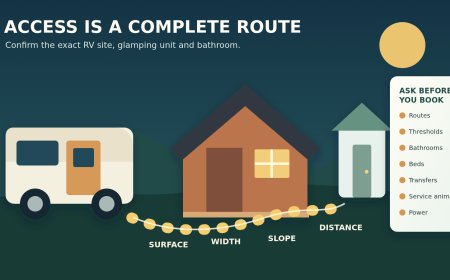
For every link, record who will use it, how they will travel, the distance, surface, steepest section, narrowest point, lighting and any gate, curb, step, threshold or road crossing. Include the return trip. A downhill route that seems manageable on arrival may be a hard uphill trip after dinner.
The Access Board's guide for federal outdoor developed areas calls the connecting paths at camping facilities outdoor recreation access routes, or ORARs. Under those federal ABA provisions, ORAR surfaces must be firm and stable; the minimum clear width is 36 inches; and a route narrower than 60 inches needs passing spaces at specified intervals. The same guide discusses slope, obstacles, openings and resting intervals.[1] Those figures are useful vocabulary for asking precise questions. They are not a promise that every state, local or private campground follows the federal outdoor standard, and they do not decide whether a particular route works for one traveler.
Build the booking grid before comparing prices
Make one row for the RV site and one for every cabin or yurt. Leave a cell blank until the campground supplies an answer.
| Booking item | RV site | Cabin/yurt | Proof to save |
|---|---|---|---|
| Exact unit number and loop | reservation page or staff email | ||
| Overnight vehicles included | fee/rules page | ||
| Extra vehicle location and fee | written reply | ||
| Maximum rig length and vehicle combination | n/a | site detail page | |
| Back-in or pull-through | n/a | site detail page | |
| Passenger-side deployment space | dimensions or staff measurement | ||
| Unloading point | marked map or written directions | ||
| Distance from parking/unloading to door | measured distance, not "nearby" | ||
| Route surface and grade | current photo/video or staff description | ||
| Steps, thresholds, curbs and gates | current photo/video | ||
| Route to restroom and gathering area | marked map and description | ||
| After-hours access | gate and contact instructions |
Vehicle rules vary even within a public park system. Oregon State Parks says one vehicle is included with a cabin or yurt reservation and that most parks allow one extra vehicle for a daily fee.[4] Camano Island State Park says each cabin or campsite includes one overnight parking pass, requires an extra overnight pass for additional vehicles, and prohibits camping in park parking lots.[6] Count the motorhome, tow vehicle, towed car and every arriving car the way the property counts them. Do not assume that an overflow lot is an extra campsite or that people may sleep in a parked vehicle there.
Check RV fit and deployment space separately
"Fits a 35-foot RV" usually answers only one question. Ask whether the listed length includes the tow vehicle, tongue, rear overhang or a towed car. Confirm road width, turn radius, branches, gate width, one-way approach, pad length and whether leveling blocks may be used. Ask where the tow vehicle or toad goes after setup.
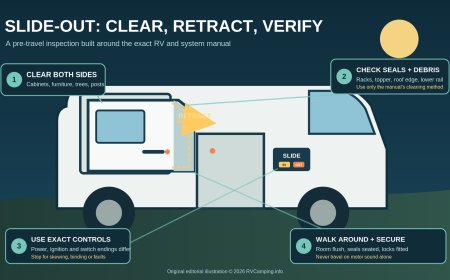
Then check the occupied width. Record the RV body, slide-outs, awning if it will be used, entry steps and any wheelchair lift or ramp. Add the working room the equipment instructions require. A wide site can become unusable if a tree, utility pedestal, fire ring or neighboring parking position occupies the deployment side.
The Access Board's federal outdoor guide treats RV parking within camping units with mobility features as more than a long strip. It specifies width, a firm and stable surface and slope limits, and explains that the width must account for a passenger-side lift and access to driver-side utility hookups.[1] The Board's broader parking guide also notes that RV and trailer spaces are covered, but the ADA Standards do not contain technical provisions specific to those spaces; it points to the federal outdoor ABA provisions as a reference for non-federal sites.[2]
That distinction matters when talking to staff. Ask what standard or feature the listing means instead of telling the campground that every RV site must match one number. For the actual rig, send this:
Our motorhome/trailer is [overall travel length] long and [body width] wide. When occupied it needs [slide/lift/ramp/step] space on the [driver/passenger] side. The equipment requires [clear area]. Can unit [number] provide that area without entering the road, neighboring site, vegetation or utility area? Where must the other vehicle be parked?
Treat unloading as a planned operation
If cabin parking is remote, decide how people and gear reach the door. "You can unload first" is incomplete. Ask where the vehicle stops, how long it may remain, whether another vehicle can pass, and whether the stop has room for the actual lift, ramp, walker or transfer method. Confirm the route from that point to the entrance.
Do not use an accessible parking access aisle as a general gear-staging area. Keep boxes, coolers, ramps, carts and people out of neighboring access space. If the property has a designed or designated passenger loading zone, the Access Board guide says accessibility provisions address its pull-up space and access aisle. The guide also makes clear that these requirements generally apply where a passenger loading zone is actually designed or designated; occasional curbside loading does not automatically make an area a formal passenger loading zone.[3]
A workable arrival script names the order:
- the RV checks in without blocking the entrance lane;
- the cabin vehicle goes to the approved unloading point;
- the passenger exits before loose luggage crowds the clear area;
- mobility equipment comes out next;
- one person takes essential medication, keys and weather gear to the unit;
- the rest of the gear follows by the approved route; and
- the vehicle moves to its assigned overnight space before the time limit expires.
If the route needs a cart, ask whether the campground supplies one, whether guests may bring one and where it can be stored without narrowing the path. A cart is not a fix for steps, deep gravel or a cross slope that the traveler cannot use.
Translate vague listing words into measurements
Official pages show why this step matters. Washington State Parks describes all five Seaquest yurts as walk-in units with parking nearby.[5] That tells you not to expect parking at the door. It does not state the route distance, grade, surface, nighttime lighting or whether a wheeled cart is available.
Oregon State Parks says its ADA cabins and yurts have entrance ramps and accessible restrooms and identifies those units in the reservation system.[4] That is more useful, but a mixed group still needs to know where the vehicle unloads, whether the route from parking to the ramp remains firm in wet weather, and how the unit connects to the specific restroom and RV site.
Camano Island's official FAQ is unusually specific in a different way: cabin 5 is identified as ADA accessible and has a ramp between the cabin and bathhouse. The same document says some pull-through campsites fit only certain RVs depending on length and directs guests to the reservation system or call center for fit.[6] One page can therefore answer the bathroom connection and still leave the RV-to-cabin group route for the organizer to verify.
Replace vague words with these questions:
- How many feet is it from the approved unloading position to the door?
- Is the entire route paved, boardwalk, compacted aggregate, loose gravel, sand, soil or grass?
- What is the steepest running grade and cross slope?
- What is the narrowest clear width after posts, gates and parked vehicles?
- Are there steps, curbs, raised thresholds, drainage gaps or roots?
- Where can two mobility devices or a wheelchair and cart pass?
- Does rain create mud, standing water or a soft shoulder?
- Is the route lit after sunset, and are lights operating on our dates?
- Does the route cross the campground road? If so, where?
- Are construction, seasonal closures or maintenance likely to change it?
Ask for current photos or a short phone video taken from the parking position to the door, then onward to the restroom. A wide-angle listing photo can hide grade and distance. If measurements matter, ask staff to measure rather than estimate.
Let the traveler define what works
Do not book an "accessible" unit for someone without asking what they need. One person may need a lift deployment area and firm route. Another may walk short distances but need frequent resting places. A person with low vision may care most about lighting, edge protection and predictable obstacles. Someone with fatigue or pain may need the shortest route even if a longer route meets a design standard.
Use a private, practical prompt:
We are comparing unit [A] and unit [B]. The campground reports [distance, surface, grade, steps, lighting and restroom route]. Which details would make either route workable or unworkable for you? Is there equipment space or an arrival sequence we should confirm?
Do not ask the campground to decide what a guest can manage. Ask staff for facts about the facility; the traveler makes the personal decision. Also ask whether any accessibility feature is temporarily out of service. A compliant design on paper does not help if a route is closed or a lift deployment area is occupied.
Use one marked map for the whole group
Screenshot the official campground map and mark only confirmed facts. Use separate symbols for:
- RV travel path and backing direction;
- RV body, slide, lift/ramp and utility sides;
- cabin overnight parking;
- approved unloading point;
- verified accessible route;
- restroom or bathhouse;
- shared gathering place;
- overflow parking; and
- entrance, gate and after-hours contact point.
Add distances and surfaces beside each route. Keep uncertain links in red. If a red link remains when the free-cancellation deadline approaches, call again or choose another property.
Proximity on the map should not override a workable route. Two units across a loop road may be visually close but require repeated road crossings. Units farther apart may connect by a firm, lighted path with a usable grade. Choose based on the trip the group will actually make, including bathroom trips and the route back after dark.
Send one confirmation message before payment
Put all unresolved items in one note so staff can answer against the same units:
We plan to reserve RV site [number/type] and cabin/yurt [number/type] for [dates]. Our RV is [travel dimensions] and uses [slides/lift/ramp] on the [side]. We expect [vehicle count] vehicles total. Please confirm: (1) where each vehicle parks overnight and all extra fees; (2) whether the RV and deployed equipment fit entirely within the assigned area; (3) the approved cabin unloading point and unloading time limit; (4) the distance, surface, steepest grade, narrowest width and any steps/curbs from unloading to the unit; (5) the same route details from the unit to the restroom and our RV site; (6) current closures or construction; and (7) after-hours gate and assistance procedures. A marked map or current photos would help.
Save the reply, unit pages, rules, map and cancellation terms as PDFs or screenshots. Note the staff member and date if an answer arrives by phone. Reconfirm shortly before travel because weather, maintenance and unit assignments can change.
Do not book yet if one of these is unresolved
Pause the reservation when:
- the property will confirm only an accommodation type, not a unit number or equivalent route;
- the RV length fits but deployment space is unknown;
- "parking nearby" has no distance or surface description;
- staff cannot identify a legal unloading position;
- an extra vehicle has no legal overnight space;
- the accessible route depends on crossing an occupied site;
- the restroom route is missing from the accessibility description;
- the traveler has not reviewed the route facts; or
- the required answer exists only in an old review or an unverified map pin.
A ten-minute call before booking is cheaper than discovering at 4 p.m. that the yurt is walk-in, the RV cannot deploy its lift, and the extra car has nowhere to stay. The reservation is ready only when every link in the route chain has an owner, a location and evidence.
Sources
- Chapter 10: Outdoor Developed Areas Official source; accessed September 19, 2026.
- Chapter 5: Parking Spaces Official source; accessed September 19, 2026.
- Chapter 5: Passenger Loading Zones Official source; accessed September 19, 2026.
- Cabins and Yurts Official source; accessed September 19, 2026.
- Seaquest Yurts Official source; accessed September 19, 2026.
- Camano Island State Park Frequently Asked Questions Official source; accessed September 19, 2026.
What's Your Reaction?