





La Posa LTVA or an RV Park? A Quartzsite Stay Decision Guide
Compare La Posa LTVA with a developed Quartzsite RV park by water, waste, power, stay length and services before choosing your winter campsite.

By Romana | Campgrounds
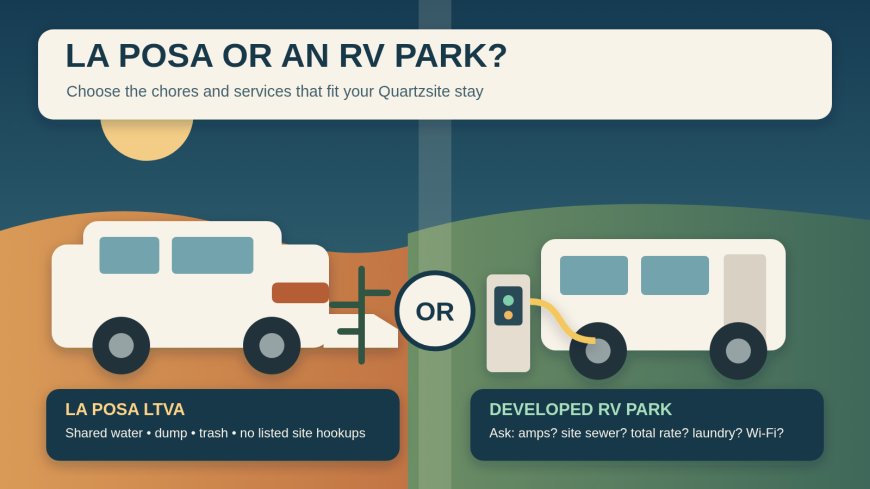
Quartzsite gives winter RV travelers two very different ways to stay: camp on open public land at La Posa Long Term Visitor Area, or book a site at one of the town's developed RV parks. The choice is less about which one is "better" and more about which chores you want to handle yourself.
A recent Camping for Foodies account of boondocking at La Posa South raised that practical question.[1] This guide uses that story only as the starting point. The fees, facilities and rules below come from current Bureau of Land Management information checked on September 7, 2026.[2][3][4]
The short answer
Choose La Posa if your rig can operate without utility hookups, you are comfortable managing batteries and tanks, and you value room and a potentially long winter stay more than campsite services.
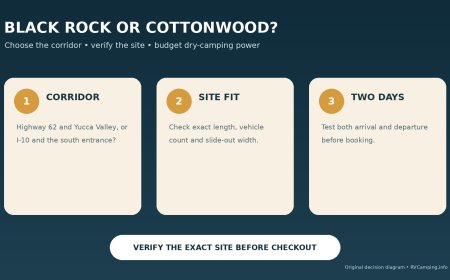
Start with a developed RV park if you need reliable shore power, want water or sewer at the site, require showers or laundry, or would rather have a defined site and a staffed office. Do not assume every park supplies all of those things. Ask before paying, especially during Quartzsite's busiest winter weeks.
La Posa versus a developed RV park
The BLM side of this table is based on the agency's La Posa page and supplementary rules. Because rates and amenities vary among private parks, the RV park column is a list of booking questions rather than claims about every property.
| Decision point | La Posa LTVA | Questions to ask a developed RV park |
|---|---|---|
| Water | The BLM lists eight water faucets. It does not describe water connections at individual campsites, so plan to move or carry water between the faucet and your rig.[2] | Is the site full-hookup, water-and-electric, or dry? Is potable water available at the site or only at a central fill? Is water included in the quoted rate? |
| Waste | La Posa has a dry dump station, a dump station with water and trash service. An LTVA permit is required to use LTVA dumping and trash facilities. Sewage, gray water and garbage may not be dumped on the ground.[2][4] | Is there sewer at the site or a central dump station? Is a mobile pump-out available, and what does it cost? How often is trash collected? |
| Power | The BLM facility list does not include public electric hookups. Generators are allowed, but they may not create unreasonable noise; quiet hours are 10 p.m. to 6 a.m. unless posted otherwise.[2][4] | How many amps does the pedestal provide: 20, 30 or 50? Is electricity metered on weekly or monthly stays? Are generator hours or backup-power rules posted? |
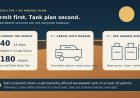
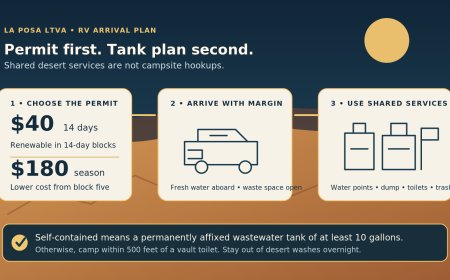
| Stay length and fee | From September 15 through April 15, the long-term permit is $180 for up to the seven-month season or any part of it. A $40 short-visit permit covers 14 consecutive days and may be renewed. From April 16 through September 14, the BLM page lists an overnight charge of $15 for each vehicle or a $75 annual vehicle permit, with a 14-days-in-28 limit.[2][3][4] | What is the nightly, weekly or monthly rate for your exact dates and rig? Are taxes, electricity, reservation fees or deposits extra? Is there a minimum stay or cancellation deadline? |
| Services | The BLM lists 10 accessible vault toilets, the water and waste facilities above, a dance floor and a ramada. The page does not list campsite hookups, showers, laundry or Wi-Fi.[2] | Are restrooms and showers open around the clock? Is laundry on site? Is Wi-Fi intended for streaming or basic use? Can the office receive mail or packages? |
That last column is worth using as a phone script. A park advertised as "full service" may still have metered electricity, weak Wi-Fi at distant sites or restrictions that matter to a long rig. Get the total price and exact site features in writing.
What the La Posa fee buys
La Posa is not a no-service patch of desert. The BLM's current listing names drinking-water faucets, dump options, trash service and vault toilets.[2] Those shared facilities remove several of the hardest parts of extended dry camping, but they do not turn the campsite into a conventional utility pedestal.
The winter permit structure is the bigger distinction. The BLM reaffirmed on February 18, 2026, that its Yuma Field Office offers a $180 long-term permit for up to seven months and a renewable $40 permit for 14 consecutive days at La Posa and Imperial Dam.[3] For someone planning several weeks or a season near Quartzsite, that creates a very different cost structure from buying one private campsite night at a time.
Price alone can still be a bad reason to choose it. If you need to run a generator for long stretches, make frequent water runs, ration tank space or drive into town for every shower and load of laundry, the lower permit fee may buy you more work than you want.
The power question usually decides it
Water and waste at La Posa have named facilities. Electricity is the part you bring with you. The official facility list does not advertise public hookups, while the rules specifically address generator noise.[2][4]
Before choosing La Posa, sketch one ordinary day of electric use. Include the refrigerator's operating mode, furnace blower, medical devices, laptops, fans, lights and any inverter loads. Then ask whether your batteries, solar harvest and generator plan can repeat that day when clouds, short winter daylight or cold nights change the math.
A developed park may simplify that problem, but verify the pedestal rather than relying on the word "hookup." A 30-amp site, a 50-amp site and a metered monthly site are different products. If uninterrupted power supports medical equipment, remote work or temperature control for a pet, confirmation from the park should carry more weight than the nightly-rate difference.
Tank management comes next
La Posa's faucets and dump stations make a longer dry-camping stay possible, but the campsite itself remains a tank-management exercise. How many days can your freshwater, gray and black tanks support your actual habits? If the honest answer is three days, decide whether moving the RV or transporting water and waste every few days sounds acceptable.
The sanitation rule is firm: do not release gray water, sewage or garbage on the ground.[4] The rules require campers without a self-contained unit to choose a spot no more than 500 feet from a vault toilet or restroom. To count as self-contained, a unit needs a permanently affixed wastewater holding tank with at least 10 gallons of capacity; the BLM does not count portable toilet or portable holding-tank systems for that definition.[4]
That detail matters for vans, truck campers and small trailers. A rig that works well for dispersed camping elsewhere may need to camp within the specified toilet radius at La Posa.
A few La Posa rules that affect site choice
The supplementary rules are not background reading. They change where and how you can set up:
- Display the permit decal as directed on transportation vehicles and camping units.[4]
- Leave at least 15 feet between dwelling units.[4]
- Do not leave the camping unit or site unoccupied for more than five days without advance approval from an authorized BLM officer.[4]
- Keep pets leashed and dispose of their waste.[4]
- Do not camp overnight in desert washes.[4]
- Use only the authorized U.S. Highway 95 entrances to La Posa.[4]
- Follow posted rules, which take precedence if they differ from the general supplementary rules.[4]
The no-wash rule deserves extra attention when picking a level spot. A broad, flat channel may look convenient in dry weather, but it is not an overnight campsite under the La Posa rules.
When La Posa is probably the better fit
La Posa makes sense when most of these statements are true:
- Your RV can comfortably dry camp for several days at a time.
- You already have a workable battery, solar or generator routine.
- Shared water and dump facilities are enough; you do not need them at the campsite.
- You are staying long enough for the permit structure to matter.
- You are comfortable choosing your own spot while observing spacing, access and wash restrictions.
- You do not mind planning showers, laundry, packages and internet separately.
When to start with an RV park
Call developed parks first when shore power is non-negotiable, tank capacity is small, mobility makes shared facilities difficult, or you want onsite conveniences. The same advice applies to a first Quartzsite visit if you would rather learn the area before testing a new boondocking setup.
Ask each park the five groups of questions in the table. Then compare the full stay, not just the posted base rate: campsite utility level, electric charges, waste handling, length-of-stay terms and the services you will actually use.
Make the decision before arrival day
La Posa works best when it is a deliberate dry-camping choice, not a surprise discovered after pulling off Highway 95. A developed park works best when the reservation confirms the utility and service details that prompted you to pay for it.
Check the BLM page again just before travel. Fees, access conditions and posted site rules can change after this article's September 7, 2026 review date.[2][4] If you choose a park, confirm the answers for your exact site and dates. That turns a vague choice between "cheap desert camping" and "an RV park" into a practical match between your rig, your stay and the chores you are willing to do.
Discovery credit: The Hidden Tradeoffs of Boondocking in Quartzsite (What We Learned at La Posa South) — Camping for Foodies
Editorial note: Camping for Foodies was used only to discover the topic. RVCamping.info independently checked current La Posa fees, facilities and rules against Bureau of Land Management sources. No claims about amenities or prices at individual developed RV parks are made here; the park comparison is framed as a pre-booking checklist.
Sources
[1] The Hidden Tradeoffs of Boondocking in Quartzsite
[2] La Posa Long Term Visitor Area
[3] Yuma Field Office updates broaden volunteer opportunities
What's Your Reaction?