



Booking a Pet-Friendly Campground for an RV-and-Cabin Group
Use a two-accommodation checklist to verify pet rules, cabin or yurt restrictions, fees, supervision, service-animal access, and evacuation plans.

Booking a pet-friendly campground for an RV-and-cabin group
By Romana | Category: Glamping
A campground can welcome a dog at an RV site and still refuse that same dog in a cabin, yurt, or glamping unit. For a mixed group, “pet-friendly” is therefore not a property-wide answer. Treat the trip as two linked reservations: first prove that the RV site works for the animal, then separately prove that the exact rental unit works. Get both answers in writing before either reservation becomes nonrefundable.
This checklist is for groups splitting between an RV and a cabin, yurt, safari tent, or similar rental. It compares policies posted by two operators on September 10, 2026. The examples are not endorsements, and policies and prices can change.
The useful comparison is accommodation against accommodation
Riverside Campground & Cabins in Big Sur says pets may stay in its sites, cabins, and rooms, with a maximum of two per accommodation. Its posted price is $5 per dog per night at a site versus $30 plus tax per dog per night in a cabin or room. It also requires leashes, cleanup, and attendance, and says cabin guests complete a pet-owner agreement.[1]
Oregon State Parks uses a different model for its cabins and yurts. Pets may enter only units specifically designated pet-friendly; those units carry a $10 nightly charge, and the limit is two cats or dogs. The agency says that since April 6, 2026, the $10 charge is part of the rate for a designated pet-friendly unit and is not refunded when a guest arrives without a pet.[2]
Oregon’s inventory is unit-specific, not merely park-specific. Its pet guidance says South Beach State Park has 14 pet-friendly yurts, while the statewide cabin-and-yurt page still tells guests to choose a designated pet unit.[2][3] Seeing “pet-friendly yurts at this park” is not proof that the yurt left in your search results accepts pets.
| Booking question | Riverside example | Oregon State Parks example | What the group must verify |
|---|---|---|---|
| Does the RV or campsite accept the animal? | Yes, subject to the posted pet rules and two-pet limit.[1] | Check the selected park and site rules. | Exact site number or site type, species, count, and any local closure |
| Does the rental accept the animal? | Cabins and rooms are included in the stated policy.[1] | Only designated pet-friendly cabins and yurts.[2] | Exact unit number, not just property name |
| What does the animal cost? | $5 per dog per night at a site; $30 plus tax per dog per night in a cabin or room.[1] | $10 per night built into the designated pet-friendly unit rate.[2] | Per pet, per unit, per night, per stay, tax, and deposit terms |
| Can the animal stay behind? | No; the posted rule says pets may not be left unattended.[1] | The agency warns against leaving an animal alone in a vehicle; also check the park and unit rules.[3] | Whether “unattended” includes inside an RV, crate, cabin, or vehicle |
The price gap matters, but the unit restriction matters more. A group that books the last yurt first and asks about the dog later may end up with two unusable reservations.
Use a two-accommodation booking checklist
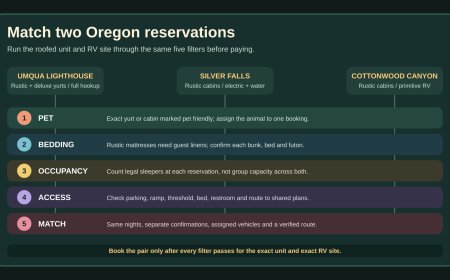
Open two notes, one labeled “RV” and the other “rental.” Do not copy an answer from one column to the other.
1. Identify both accommodations precisely
Record the campground, arrival and departure dates, RV site number or site type, and rental unit number or type. Save the URL for each listing. If the booking engine guarantees only a category, ask whether every unit in that category has the same pet status. If not, ask how the operator guarantees a pet-designated unit.
For the animal, record species, number, approximate size, and any question the operator asks about behavior or vaccination. Do not assume a dog policy covers a cat. Oregon’s designated facilities expressly cover up to two cats or dogs; Riverside’s posted fee is worded per dog even though the same FAQ also refers more broadly to pets.[1][2] That wording is a reason to ask about a cat or another species, not a reason to fill in the gap yourself.
2. Run the same rule check twice
Ask these questions for the RV site and then again for the rental:
- Is this exact accommodation pet-permitted for these dates?
- How many animals and which species are accepted?
- Is there a size, breed, age, vaccination, or documentation requirement?
- What fee, tax, deposit, or cleaning charge applies, and how is it calculated?
- Where may the animal walk, toilet, and exercise?
- What leash length or physical-control rule applies?
- May the animal be left inside the accommodation? If yes, must it be crated, and for how long?
- What happens if barking, damage, or an emergency causes the group to leave early?
Ask the unattended question literally. “Can the dog stay crated in the air-conditioned RV for 45 minutes while we eat?” produces a more useful answer than “Are you dog-friendly?” A rule against tethering a dog alone outside is not necessarily permission to leave one in a rig. Conversely, a ban on leaving an animal in a vehicle may not state the cabin rule. The operator must clarify its own policy.
3. Price the whole stay, not the nightly headline
Put every animal charge into the correct reservation. A two-dog, three-night stay at the posted Riverside rates would add $30 to the site reservation or $180 plus tax to the cabin reservation. That arithmetic illustrates the policy structure; confirm the live checkout total before paying.[1]
Also ask whether a pet-designated unit costs more even if plans change. Oregon State Parks says its $10 nightly pet-friendly-unit charge is no longer refundable to a guest who arrives without a pet.[2] A group should know that before using the pet unit as a flexible backup.
4. Decide who supervises the animal
An unattended-pet ban changes the itinerary. If the cabin guests and RV guests want to take a boat tour, eat indoors, or visit a trail where pets cannot go, someone may need to stay at camp or the group may need local day care. Do not count on a closed RV as the default kennel, especially during heat, smoke, storms, or a power failure.
Write the supervision plan beside both reservation numbers:
- primary handler and backup handler;
- activities the animal can join;
- activities that require a sitter or boarding;
- the operator’s written answer about crates and brief absences;
- a nearby veterinary clinic and an after-hours contact.
If the only workable plan breaks the campground’s rule, choose another accommodation before booking.
Service animals require a separate conversation
Do not treat “service animal” as a way around a pet rule. Under the ADA, a service animal is a dog individually trained to perform work or tasks directly related to a person’s disability. Comfort or emotional support by presence alone does not meet that ADA definition, though other federal, state, or local rules may apply in some settings.[4]
ADA.gov’s lodging guidance says a hotel may not confine a guest with a service animal to pet-friendly rooms or charge a pet cleaning fee for ordinary hair or dander. It may apply the same damage charges it applies to other guests. Staff generally may ask only whether the dog is required because of a disability and what work or task it has been trained to perform; they may not demand certification.[4]
The ADA does not make unattended stays permissible. Its guidance says the handler is responsible for care and supervision and that a hotel guest may not leave a service dog alone in the room because the dog must remain under the handler’s control.[4] Local licensing and vaccination rules that apply to all dogs can still apply to service animals.[4]
A campground, state park, concessionaire, and separately operated lodging unit can involve different legal frameworks. Ask the operator how it handles the exact reservation, and request an accessibility contact if the first answer simply repeats the pet policy. This article offers booking guidance, not a legal conclusion about a particular property.
Build one evacuation plan for the whole group
The RV and rental may be in different loops, behind different gates, or served by different roads. The group needs one plan that still works when the animal and carrier are in the “wrong” accommodation.
Ready.gov advises taking pets when officials order an evacuation, choosing a safe destination in advance because many shelters and hotels do not admit pets, and arranging a buddy who can care for or evacuate an animal if the owner cannot.[5] Its suggested kit includes food, water, medicine, identification, copies of records, a backup leash, and a sturdy carrier for each pet.[5]
Before arrival, save the campground’s alert channel and evacuation instructions. Mark two meeting points: one inside the property and one outside the hazard area. Put a leash or harness, carrier, medication, several days of food and water, records, and a current photo where either sub-group can reach them. Keep the microchip contact current; Ready.gov also recommends an out-of-area emergency contact.[5]
Then assign actions rather than vague intentions:
- The person nearest the animal loads it.
- The RV driver disconnects only if there is time and follows official instructions.
- The rental group takes the portable kit and does not wait at the cabin for the RV.
- The buddy calls or texts one agreed status phrase.
- Everyone meets at the outside point if the campground separates vehicles.
Ask one awkward but necessary question at check-in: “If we must leave without the RV, may we return for it later, and where will official updates be posted?” The answer may depend on the incident, but knowing the channel prevents a dangerous attempt to re-enter.
The booking record to keep
A good confirmation packet has both reservation numbers, screenshots or PDFs of both pet policies, an itemized pet cost for each accommodation, the exact unattended-pet answer, and the name or email of the person who confirmed any ambiguity. Add the evacuation route, buddy, veterinary contact, and animal records.
Recheck the policy shortly before the cancellation deadline and again before departure. If a material rule changed, contact the operator while there is still time to move both reservations. The group has a workable campground only when the RV column and the rental column both say yes.
Sources
What's Your Reaction?