







The late-arrival RV campground check-in plan
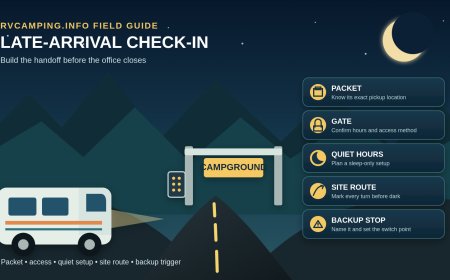
A five-part plan for retrieving an after-hours packet, using the gate, observing quiet hours, finding an RV site in the dark and switching to a lawful backup stop.

The late-arrival RV campground check-in plan
By Romana
Source note: This guide uses official campground and park rules retrieved September 20, 2026. Procedures vary by property and can change. The reservation confirmation, direct instructions from campground staff, posted signs and on-site rules control.
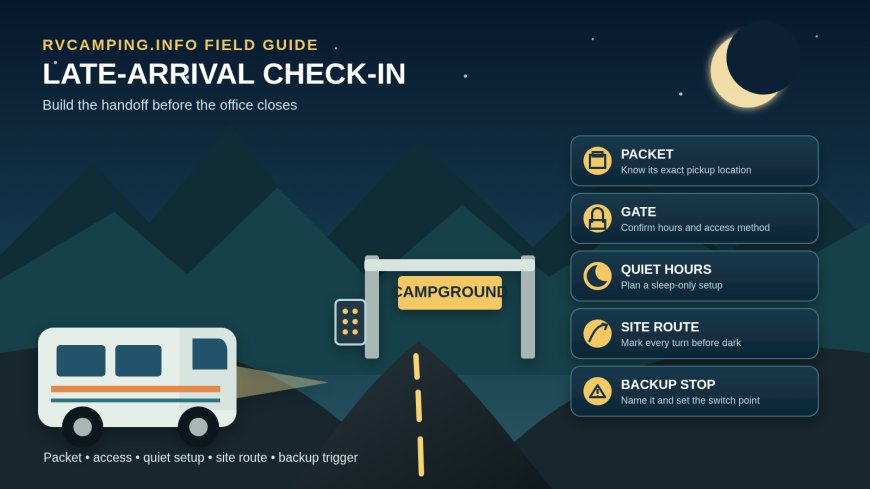
A late campground arrival should be a planned handoff, not a search conducted with an RV idling at a locked gate. Before the office closes, confirm five things: how you receive the after-hours packet, how the gate works, when quiet hours begin, how to reach the assigned site, and where you will stop if entry or navigation fails.
The key is to turn a reservation into an arrival file that works without cell service. A confirmation number alone may not reveal the gate code, packet location or correct loop. Different parks handle the same situation differently: one leaves a packet, another posts an arrival list, another expects a prior phone call, and some restrict late access altogether.[1][2][3][5]
Call before closing, not from the gate
Contact the campground while a person can still fix the plan. Give the reservation name, arrival date, rig length, towing status and realistic arrival window. Ask staff to describe the late-arrival procedure from the public road to the site.
Use exact questions:
- Will my site be assigned before I arrive?
- Where is the packet, envelope or arrival list?
- Is the entrance gated, and does it close at a fixed time?
- Will the code, key or access card be in the packet, sent separately or given by phone?
- Which entrance should an RV use after hours?
- Is my route to the site passable for my total length and height?
- Where may I wait without blocking a lane if the packet or gate does not work?
- Must I report to the office the next morning?
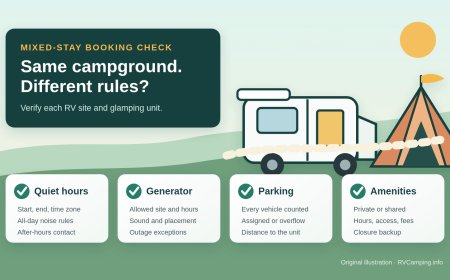
- When do quiet hours and generator restrictions begin?
- At what time could an unclaimed reservation be released?
Those are not theoretical differences. Clearwater/Lake Tarpon KOA says a reservation packet is placed in a cabinet beside the main building for office-closed arrivals and asks those guests to finish registration the next morning.[1] Elkmont Campground uses an arrival list at the kiosk to reconnect a camper with a forgotten site number; its NPS page also says those park campgrounds have no gate.[2] Lake Bob Sandlin State Park publishes gate hours and tells late arrivals to contact the park during office hours to obtain the code.[5]
Do not combine these examples into a generic rule. “They probably leave an envelope” is not a procedure for the campground you booked.
Save an offline arrival file
Put the answers where both driver and navigator can reach them without opening an email thread. Save screenshots or a PDF locally, then write a short text note with:
- campground name, physical entrance address and local time zone;
- reservation name and confirmation number;
- office and after-hours contact numbers;
- office closing time, gate hours and quiet hours;
- packet cabinet, night-registration box or kiosk location;
- assigned site and loop;
- staff-provided entry instructions;
- next-morning registration requirement;
- campground map and a marked route to the site;
- backup-stop address, permission status and latest permitted arrival.
Keep sensitive access information out of a public trip-planning document. Share a gate code only with people on the reservation, and follow the property’s rules about code handling. Do not place it in a windshield note or a campsite photo.
Test the file in daylight with the phone in airplane mode. The navigator should still be able to find the entrance, packet location, site and backup stop. Otherwise, the plan still depends on signal.
Treat the gate code as one link, not the whole plan
A valid code does not guarantee entry. The keypad may be on the driver’s blind side, the approach may not hold a truck and trailer, or the gate may require a card, key or confirmation from security. Ask how the hardware operates and what to do if it fails.
Before turning into the entrance:
- stop at a legal, well-lit location if available;
- put the code or key instructions on the navigator’s screen;
- confirm that the RV can clear the entrance without stopping across a public road;
- retract mirrors only if the driver can still maneuver safely;
- use the specified RV entrance rather than following passenger cars;
- allow the gate to complete its cycle instead of tailgating another vehicle.
Never have the driver search email or enter a code while the combination is moving. If the keypad cannot be reached safely, follow the campground’s fallback instructions. Do not send a child out beside moving traffic and do not force a gate.
Utah State Parks illustrates why the access question belongs early in the call: its statewide policy says most parks do not permit entry after 10 p.m. and directs guests who will be late to notify the individual park.[3] At Lake Bob Sandlin, the public page lists a 10 p.m. gate closing but an earlier office closing, so a traveler who waits until the gate closes has already missed the published window for requesting the code.[5]
Navigate the campground before dark
A map pin at the entrance is not a route to the campsite. Campground roads may be one-way, loops may have separate branches, and a site number can be visible only from one direction. Build a low-speed route before departure.
Mark these points on the campground map:
- public-road turn;
- RV entrance and gate;
- office, kiosk or packet cabinet;
- first loop decision;
- assigned site;
- overflow or temporary waiting area approved by staff;
- exit route for the morning.
Then compare the route with the rig. Ask about low branches, tight turns, grades, seasonal barricades and whether a towed vehicle must be disconnected before the loop. If a map has a “north” arrow but no obvious driving direction, ask rather than infer.
On arrival, slow down enough to read signs without sweeping headlights across occupied sites. Big South Fork’s campground rules set a 5 mph speed limit and require vehicles to remain on the assigned pavement or in designated parking.[4] That is a property-specific rule, but it supports a broader planning habit: arrive with the route already known so navigation does not become repeated circling.
If you miss a turn, continue only where the map confirms a loop. Do not back a trailer in darkness without a spotter and a clear escape path. Stop in the pre-approved waiting area, walk the route with a light if allowed, or use the backup.
Make quiet hours change the setup
Late check-in permission is not permission for a normal daytime setup. Elkmont permits after-hours arrival but asks campers to minimize light and noise; its posted quiet period runs from 10 p.m. to 6 a.m.[2] Clearwater/Lake Tarpon KOA publishes a 10 p.m. to 8 a.m. interval.[1] Utah State Parks gives 10 p.m. to 7 a.m. as its general quiet-hours window.[3] These examples show why the actual property’s clock belongs in the arrival file.
Prepare a sleep-only setup before the travel day:
- fill fresh water and test the house battery earlier;
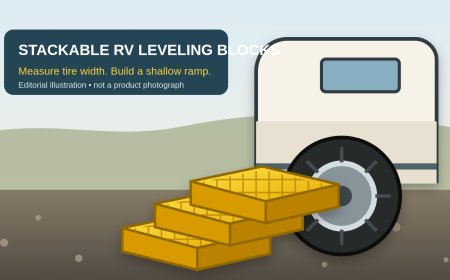
- place leveling blocks, wheel chocks and the electrical adapter where they can be reached without unloading bins;
- pre-cool food and secure loose interior items;
- put pet leads and waste bags by the door;
- use a low, downward-facing work light;
- agree which tasks can wait until morning.
After quiet hours begin, park, chock, connect only what is needed and go inside. Skip awnings, outdoor furniture, sewer work and repeated repositioning unless a safety problem requires action. Use radios rather than shouted directions, and keep backup alarms and door slams to the minimum that safe parking allows.
Generator assumptions deserve a separate check. Big South Fork bars generator use during its 10 p.m. to 6 a.m. quiet period and also prohibits idling a vehicle then to recharge batteries.[4] A tired arrival is a poor time to discover that the planned power source cannot be used. If the batteries cannot support a quiet overnight, choose an electrical site or stop earlier.
Protect the reservation from a no-show
“Late” can mean after the office closes, after the gate closes or after the first reserved night. Those are different thresholds. Ask what action holds the site and record the name or channel used to notify the property.
Utah State Parks says a reserved campsite may be released if it is still unoccupied at 10 a.m. on the following day, and it tells travelers to check the selected park’s own late-arrival rule.[3] At Big South Fork, a guest who already has a reservation may proceed to the site after business hours, while an unreserved arrival must complete a reservation before occupying one.[4]
If the trip slips to the next day, update the reservation through the authorized channel rather than assuming payment keeps every remaining night intact. Save the confirmation of that change. Never occupy an apparently empty site merely because the office is closed; it may be assigned to another late arrival.
Build a lawful backup stop
The backup is not “somewhere nearby.” It is a named, lawful place that the RV can reach before the driver exceeds a conservative stop time. Ideally it is a second campground or another overnight location where permission, availability and vehicle fit have been verified directly.
For each candidate, record:
- address and entrance coordinates;
- phone number and hours;
- same-night reservation or check-in method;
- latest permitted arrival;
- maximum rig length and road restrictions;
- gate or access procedure;
- price and cancellation terms;
- whether overnight parking is expressly permitted;
- a second option if the first is full.
Do not treat a retail lot, rest area, trailhead or roadside pullout as an automatic campsite. Rules and landowner permission vary. Confirm the specific location and date, and arrive prepared to move if authorized staff say no.
Set the switch point before departure: “If we are not through the campground gate by 9:30 p.m., if the packet is missing, or if the route to the site cannot be confirmed, we go to Backup A.” The exact time should leave margin before the backup’s own check-in limit.
Use a two-minute arrival decision
At the final safe stop, the navigator reads the file and answers five questions:
| Check | Go condition |
|---|---|
| Packet | Its location and contents are confirmed |
| Gate | The access method works within the allowed hours |
| Quiet | Arrival and essential setup can follow current rules |
| Route | The assigned site has a verified, rig-suitable path |
| Backup | A lawful alternative remains reachable and available |
Proceed only when all five answers are yes. If the code is missing, the gate is closed, the map is ambiguous or the driver is too tired for a dark-site maneuver, use the backup. The cost of an extra night is easier to manage than a blocked entrance, damaged RV or improvised overnight in a prohibited place.
A finished late-arrival plan fits on one screen: packet, access, quiet-hours setup, site route and backup trigger. Build it while the office is open, then let the plan remove decisions from the darkest part of the travel day.
Sources
What's Your Reaction?