



Kalaloch vs. Mora vs. Sol Duc: which Olympic campground works best for your RV?
Compare Kalaloch, Mora, and Sol Duc for RV size, hookups, dump stations, booking, generator rules, road closures, and the best Olympic National Park base.
By Romana | Updated September 10, 2026
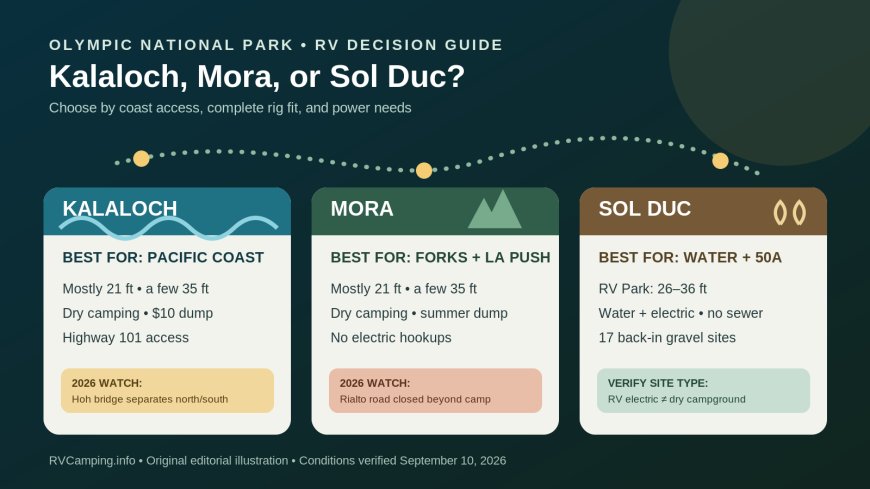
For most RV travelers, the choice is simple once you name the trip's priority. Pick Kalaloch for the easiest ocean-focused stay and direct Highway 101 access.[4] Pick Mora for the north coast and Forks, but not for Rialto Beach during the current road project.[2][5] Pick the Sol Duc RV Park when 50-amp electricity and water at the site matter more than privacy.[6] Kalaloch and Mora are dry campgrounds.[4][5] Sol Duc also has a separate dry campground, so reserving “Sol Duc” is not enough; the site type has to say RV electric.[1][6]
The quick comparison
| Decision factor | Kalaloch | Mora | Sol Duc |
|---|---|---|---|
| Best practical use | Pacific coast and south-side base | Forks, Second Beach and Third Beach base during the 2026 Rialto closure | Lake Crescent/Sol Duc hiking base; only choice here with site hookups |
| 2026 reservation pattern | Required May 15-Sept. 20; first come, first served outside that window | Required May 15-Sept. 20; first come, first served outside that window | Required March 20-Nov. 1; walk-up sites may be available through resort desk |
| Booking channel | Recreation.gov | Recreation.gov | Recreation.gov |
| Published RV fit | Sites for 21 ft; a few for 35 ft | Sites for 21 ft; a few for 35 ft | Dry campground: 21 ft, a few 35 ft; RV Park: 26-36 ft |
| Hookups | None | None | RV Park: water and 50-amp electric; no sewer hookup |
| Dump station | $10 | $10, summer only | $10 onsite |
| Restrooms and water | Flush toilets and potable water | Flush toilets and potable water | Dry campground has restrooms and water; RV Park restroom is about 1/4 mile away |
| Published generator rule | Official page states quiet hours of 10 p.m.-6 a.m.; confirm any narrower posted limits onsite | Same park quiet-hour rule; confirm any narrower posted limits onsite | Official listing expressly includes generators in the 10 p.m.-6 a.m. quiet rule |
| 2026 access issue | Hoh River Bridge closures will separate Kalaloch from Forks and the north side on listed September/October dates | Campground remains open, but Mora Road is closed beyond it and Rialto Beach is inaccessible by that road | Sol Duc Road is open; seasonal road and severe-weather closures remain possible |
The prices currently published by NPS are $24 per night at Kalaloch and Mora, $33 for the Sol Duc dry campground, and $58 for the Sol Duc RV Park.[1] A park entrance pass is separate, and Recreation.gov may display transaction or reservation details before checkout.
Kalaloch: best when the coast is the trip
Kalaloch is the cleanest match for an ocean itinerary. The entrance is directly off U.S. 101, about 34 road miles below Forks, and campers can reach the beach from the facility.[4] NPS lists 170 sites, but Recreation.gov currently describes 160.[1][4] Treat the live inventory and the dimensions on the individual reservation as controlling rather than relying on either campground-wide count.
The size limit needs the same discipline. NPS summarizes the campground as mostly 21-foot sites with a few up to 35 feet.[1] Recreation.gov warns that most pads cannot take a large RV or trailer, and that narrow roads, tight turns and low branches can make maneuvering difficult.[4] A “35-foot” campground maximum does not mean every 35-foot motorhome, truck-and-trailer combination or slide configuration will fit. Read the driveway length, equipment limits and warnings for the exact site.
Kalaloch has potable water, flush toilets and a $10 dump station, but no campsite hookups.[1][4] Recreation.gov places the nearest showers six miles south at Queets Trading Post or 28 miles north at Bogachiel State Park; verify outside-facility hours before depending on either.[4] Kalaloch Lodge, half a mile away, is the nearby source named for food, propane, firewood and other goods.[4]
The 2026 booking setup rewards a second look after the six-month release. A and B loop sites release six months ahead, C and D two weeks ahead, and E and F four days ahead.[4] Some bluff sites in A, D and E are permanently closed because of erosion, so an old campground map can overstate ocean-edge inventory.[4]
Kalaloch's major September caveat is not inside the campground. WSDOT's Hoh River Bridge work will close Highway 101 overnight September 14-22, then fully September 24-29, October 1-6 and October 8-13.[3] There is no nearby detour; NPS says routing around the east side adds at least four hours.[3] Kalaloch is south of the closure, while Forks, Mora, Hoh Rain Forest and Sol Duc are north.[3] On those dates, Kalaloch should be treated as a south-coast base, not the first night of a casual three-campground hop.
Mora: good for Forks and the north coast, with one big 2026 catch
Mora is the better geographic base for Forks and the beaches reached from the La Push side. Recreation.gov places Forks 13 miles away and La Push 9.5 miles away.[5] Its 94 sites have potable water and flush toilets.[1][5] There are no electrical hookups, and the $10 dump station operates in summer.[5]
Large-rig fit is weak. NPS again uses the “21 feet, a few for 35 feet” summary, while Recreation.gov says most sites cannot accommodate RVs or trailers over 30 feet.[1][5] The campground roads also have low branches, tight turns and narrow sections.[5] A 31- to 35-foot rig therefore has a small set of possibilities, not a general green light. Book only after the exact equipment field accepts the complete setup.
The catch is Rialto Beach. NPS currently says Mora Campground remains open, but Mora Road is closed to all traffic beyond the campground through October 15, 2026, leaving Rialto inaccessible by that route.[2] Recreation.gov displays November 9 instead.[5] Because the official pages disagree, use the live NPS conditions page for day-of-travel decisions and do not promise yourself a campground-to-Rialto drive. NPS points visitors toward alternatives such as Ruby Beach during the closure.[2]
Mora still works for Second Beach, Third Beach, Forks and north-side plans. It is a weaker choice if Rialto was the reason for camping there, and it becomes awkward for a Kalaloch transfer during the Hoh River Bridge closure dates.
Sol Duc: choose the RV Park for power, not the campground name
Sol Duc presents two different products in one booking complex. The regular campground is dry: NPS lists 82 sites at $33, generally for 21-foot equipment with a few sites up to 35 feet.[1] The separate RV Park is a 17-space gravel lot for vehicles from 26 to 36 feet, with back-in sites, limited privacy, water and electric hookups.[1][6]
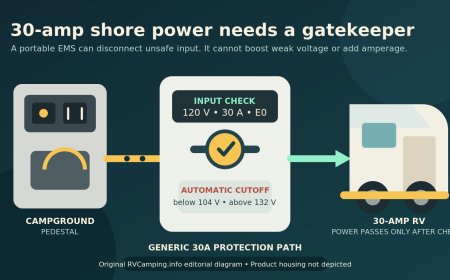
The concessioner's current page is more specific about power: its RV Park pedestals have 50-amp connections and the sites have frost-free water hydrants.[6] There are no sewer hookups.[6] A $10 dump station is onsite.[6] Travelers with 30-amp RVs should bring the proper adapter and manage total load; an adapter changes the plug connection, not the coach's electrical capacity.
The convenience tradeoff is easy to miss. The RV Park has no public restroom of its own; the concessioner says the restrooms are in the campground about a quarter mile away.[6] Laundry is not offered.[6] Pool admission is also separate from the camping rate.[6] The RV Park is practical shore power beside a resort, not a full-service private RV resort.
For generator planning, Sol Duc is the only option in this comparison whose official reservation and concession pages expressly name generators. They prohibit loud sound, including generators, from 10 p.m. to 6 a.m.[6] The NPS campground page publishes the same quiet hours park-wide but does not give a more specific generator schedule for Kalaloch or Mora.[1] Do not convert silence in an online listing into unrestricted daytime use: read the confirmation and posted rules, and ask staff about any loop-specific or temporary restriction.
Sol Duc Road and the area are open for the season on the September 10 conditions page.[2] Reservations are available through November 1, and unreserved or cancelled sites may be offered through the resort front desk.[1][2] Primitive camping may continue after the serviced season while the road stays open, but no running water is promised then.[6] That is a different proposition from a serviced RV Park reservation.
Which one should you book?
Choose Kalaloch if the Pacific beaches south of the Hoh River are the point of the trip. Its Highway 101 location avoids a long spur road, and its dump station, potable water and nearby store make dry camping manageable.[1][4] During the bridge closures, arrive from the south or accept the long east-side reroute.[3]
Choose Mora for Forks, La Push, Second Beach or Third Beach. Do not choose it solely for Rialto before the beyond-campground road closure ends.[2] Mora and Kalaloch cost the same and offer a similar dry-camping service set, so geography and exact site fit should decide between them.[1][4][5]
Choose the Sol Duc RV Park if shore power and an onsite water connection are worth the higher rate and gravel-lot setting.[6] Choose the regular Sol Duc campground only if your rig fits its exact dry site and you do not need hookups.[1][6] Sol Duc is the logical base for the resort pools, Sol Duc Falls area and Lake Crescent side, but it is not an efficient ocean campground.
A five-minute booking check
- Measure the full travel setup, then record RV length, tow vehicle or toad, height, width and slideout needs.
- Open the exact Recreation.gov site record. A campground's largest published pad is not your pad.
- Confirm the site type at Sol Duc. Look for an RV electric listing if hookups are required; a standard nonelectric site is the dry campground.
- Map the approach around the Hoh River Bridge closure schedule. Do not assume Highway 101 connects Kalaloch to Mora or Sol Duc on a closure date.[3]
- Recheck Olympic National Park's current conditions and road page before departure. Save the reservation and rules offline.
Source credit: RVCamping.info compared current National Park Service, Recreation.gov and Olympic National Parks concession pages retrieved September 10, 2026. The base-selection framework and RV power, tank and routing analysis are original editorial work.
Sources
What's Your Reaction?