









Death Valley RV campgrounds compared: Furnace Creek, Sunset, Texas Springs, or Stovepipe Wells?
Compare four low-elevation Death Valley RV campgrounds by season, hookups, generator rules, total rig length, reservations, and operator.

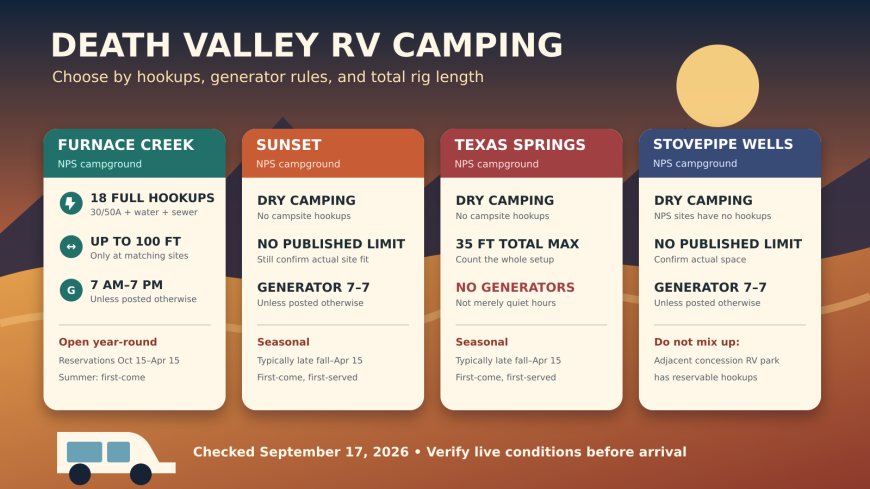
Death Valley RV campgrounds compared: Furnace Creek, Sunset, Texas Springs, or Stovepipe Wells?

By Romana | Updated September 17, 2026
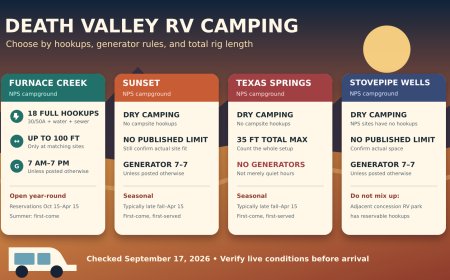
For most RV travelers, Death Valley's four familiar low-elevation campgrounds sort themselves into distinct jobs. Furnace Creek is the only NPS choice here with reservable full-hookup sites. Sunset is the roomy, no-hookup fallback. Texas Springs suits smaller rigs that can camp without a generator. The NPS Stovepipe Wells Campground is the western dry-camping base, while an adjacent concession-run RV park is a separate, reservable hookup option.
The calendar matters as much as the amenities. Furnace Creek is open year-round, but reservations apply only to stays from October 15 through April 15; the other three NPS campgrounds typically operate from late fall until April 15 and do not accept reservations.[1] On September 17, 2026, the park's conditions page, last updated September 16, listed Sunset, Texas Springs, and the NPS Stovepipe Wells Campground as seasonally closed. Furnace Creek was open for first-come, first-served summer camping.[3]
Planning date: This comparison was checked September 17, 2026. A typical season is not an opening announcement. Recheck the Death Valley alerts and conditions page and the exact campground or booking record before driving in.
The short answer
- Choose Furnace Creek if you need a reservable NPS site, full hookups, or a site that can fit a long combination. Only 18 sites have hookups, and an overall 100-foot figure does not mean every site fits that length.[1][2]
- Choose Sunset if you can dry camp and want the best chance of finding an NPS site during the cool season. NPS says this large campground almost always has space, even during peak season.[1]
- Choose Texas Springs if your total vehicle length is 35 feet or less and you can go without a generator. The generator ban is absolute, not a quiet-hours rule.[1]
- Choose the NPS Stovepipe Wells Campground if a western park base works better and you are prepared to dry camp. Do not confuse it with the adjacent concession-run Stovepipe Wells RV Park, which has hookups and takes bookings.[2][5]
Side-by-side RV comparison
| Decision factor | Furnace Creek Campground | Sunset Campground | Texas Springs Campground | Stovepipe Wells Campground (NPS) |
|---|---|---|---|---|
| Operator | National Park Service | National Park Service | National Park Service | National Park Service |
| Typical season | Open year-round | Late fall-April 15 | Late fall-April 15 | Late fall-April 15 |
| Booking | Reservations Oct. 15-April 15; otherwise first-come, first-served | First-come, first-served | First-come, first-served | First-come, first-served |
| Campsite hookups | 18 full-hookup sites; other sites are dry | None | None | None |
| Published RV length boundary | Some sites up to 100 ft total; site-specific fit controls | No campground-wide RV limit published | Up to 35 ft total length | No campground-wide RV limit published |
| Generator rule | 7 a.m.-7 p.m. unless posted otherwise | 7 a.m.-7 p.m. unless posted otherwise | Prohibited | 7 a.m.-7 p.m. unless posted otherwise |
| Best fit | Utility-dependent RVs, advance planners, long rigs with a confirmed matching site | Self-contained rigs seeking a flexible cool-season fallback | Compact, generator-independent RVs | Self-contained rigs centered on the western side of the park |
The NPS-wide generator window is 7 a.m. to 7 p.m. unless a campground posts a different rule. Texas Springs is the named exception where generators are prohibited.[1] Sunset and the NPS Stovepipe Wells Campground have no park-published campground-wide RV length restriction, but that is not the same as a guarantee that every parking space, turn, or shared vehicle allowance fits an unlimited rig.
Furnace Creek: the utility and reservation choice
Furnace Creek is the most capable NPS campground in this group, but only a small part of it works like a full-service RV park. NPS lists 18 full-hookup sites with water, sewer, and both 30- and 50-amp electrical connections.[2] The same page warns that the campground pedestals do not support EV charging. Plugging an electric vehicle into them could damage the vehicle or campground electrical system.[2]
Reservations are available for the October 15-April 15 camping season, at least two days ahead and up to six months ahead. NPS says these hookup sites often book six months in advance, so they should be treated as a scarce site type rather than a last-minute upgrade.[2] Outside the reservation season, Furnace Creek remains open with limited summer capacity on a first-come, first-served basis.[1][3]
The published maximum also needs a careful reading. NPS says Furnace Creek has sites that can accommodate up to 100 feet in total length, then immediately directs campers to site-specific details because not every site can do so.[1] Measure the complete occupied length: motorhome and toad, or trailer and tow vehicle. Confirm the selected site's equipment limit and parking arrangement before paying.
Furnace Creek is the safest first search for an RV that needs air conditioning on shore power, water, sewer, or a confirmed long site. It is not a blanket promise of hookups, and a reservation at a dry site does not gain utility access simply because hookup pedestals exist elsewhere in the campground.
Sunset: the capacity fallback
Sunset's advantage is availability, not amenities. NPS describes it as the park's largest campground and says it almost always has sites available, even in the peak winter and spring season.[1] All NPS campgrounds other than Furnace Creek are first-come, first-served when open.[1][2]
There are no campsite hookups. Generator use follows the general 7 a.m.-7 p.m. window unless staff post a different rule.[1] NPS publishes no campground-wide RV length restriction for Sunset.[1] Still, arrive with a dry-camping plan that covers battery charging, freshwater, wastewater, and overnight temperature swings. "No RV length restriction" is a rule statement, not a measured-site guarantee.
Sunset works well as Plan B when Furnace Creek is full and the RV can operate without shore power. It is also the simplest of these choices for a larger rig that does not fit Texas Springs' 35-foot total limit, provided the driver confirms current access and can select an actual space safely.
Texas Springs: quiet power rules and a hard size screen
Texas Springs removes two types of RV immediately. NPS caps the campground at 35 feet in total length, and generators are prohibited.[1] A 30-foot trailer plus its tow vehicle does not meet a 35-foot total-length rule. Measure the whole traveling setup rather than the coach body alone.
This campground has no hookups, and it is first-come, first-served when open.[1][2] Battery capacity has to cover the stay without generator charging. That includes the furnace blower on cold nights, refrigerator controls, water pump, lighting, device charging, and any inverter loads. Solar can help, but it is not a guaranteed substitute for a generator on a short winter day or a shaded site.
Texas Springs is a sensible fit for a van, small motorhome, truck camper, or genuinely short trailer combination with enough battery margin. It is a poor backup for a larger trailer or any RV that needs daily generator time.
Stovepipe Wells: two neighboring facilities, two different products
The name causes avoidable booking mistakes. The NPS Stovepipe Wells Campground is a seasonal, first-come, first-served dry campground. NPS publishes no campground-wide RV length restriction for it, and the general 7 a.m.-7 p.m. generator window applies unless posted otherwise.[1]
The adjacent Stovepipe Wells RV Park is not another NPS campground loop. NPS identifies it as concession-run and says hookup sites are available there.[2] The current concession website markets 14 RV sites under a "Full Hookup RV Site" booking page.[5] Availability, rates, equipment limits, cancellation terms, and the precise utility package should be confirmed in the live reservation before purchase.
That distinction changes the decision. A traveler who arrives expecting hookups at the NPS campground will be in the wrong facility. Use the NPS campground for first-come dry camping. Use the concession booking channel when a reservable hookup site is the requirement.
Heat can overrule the campground comparison
These are low-elevation desert campgrounds, not four interchangeable year-round bases. NPS says overnight summer temperatures can remain above 100°F and advises summer visitors to stay on paved roads, carry extra drinking water, and stay with a disabled vehicle until help arrives.[4] Its camping guidance says the three seasonal campgrounds regularly close in mid-April as temperatures rise, while Furnace Creek continues with limited capacity.[1]
An electrical plan is not a complete heat plan. A pedestal can fail, an RV air conditioner can trip a breaker, and a generator is limited to daytime hours at these NPS campgrounds. Texas Springs does not permit one at all.[1] In severe heat, do not treat an RV air conditioner as the only life-safety system. Carry emergency water, monitor the forecast, keep the engine and cooling system in good condition, and have an exit route to a cooler place.
Road conditions deserve a separate check. On September 17, the NPS conditions page carried a road-status timestamp of September 4 and warned that conditions can change quickly.[3] It also listed specific damaged and closed roads. Do not infer that a campground being open makes every scenic side trip or approach suitable for a long RV.
A booking sequence that prevents the common mistakes
- Check the live conditions page. Confirm that the campground and intended approach are open rather than relying on the typical season.[3]
- Measure total occupied length. Eliminate Texas Springs above 35 feet. At Furnace Creek, match the whole setup to a specific site instead of relying on the 100-foot upper bound.[1]
- Decide whether hookups are required. Search the 18 Furnace Creek hookup sites first. If Stovepipe Wells is the preferred area, use the concession RV park's booking channel, not the NPS campground pay station.[2][5]
- Decide whether generator charging is required. Remove Texas Springs if it is. At the other NPS campgrounds, design the power plan around the 7 a.m.-7 p.m. operating window.[1]
- Use the correct arrival model. Furnace Creek reservations cover October 15-April 15. Sunset, Texas Springs, and the NPS Stovepipe Wells Campground are first-come, first-served when open.[1][2]
- Save the conditions page, reservation details, site dimensions, and rules for offline use. Cell service cannot be assumed throughout Death Valley.[4]
The practical hierarchy is short. Start with Furnace Creek when utilities or advance certainty matter. Keep Sunset as the broad dry-camping fallback. Use Texas Springs only after both the 35-foot total-length test and the no-generator test pass. At Stovepipe Wells, decide which facility you mean before comparing anything else.
Source credit: RVCamping.info compared National Park Service camping, campground, heat-safety, and current-conditions pages with the official Stovepipe Wells concession booking page, all retrieved September 17, 2026. The elimination sequence, RV resource analysis, and operator distinction are original editorial work.
Sources
- Camping in Death Valley (accessed September 17, 2026)
- Developed Campgrounds (accessed September 17, 2026)
- Alerts & Conditions (page last updated September 16, 2026; accessed September 17, 2026)
- Death Valley Summer Guide (accessed September 17, 2026)
- Book a Full Hookup RV Site | Stovepipe Wells (official concession booking page; accessed September 17, 2026)
What's Your Reaction?