



















Thaw first, stay powered: a safe slow-cooker plan for an RV campsite
Plan a safe RV slow-cooker meal with thawed ingredients, verified campsite power, thermometer checks and a clear response to outages.

Thaw first, stay powered: a safe slow-cooker plan for an RV campsite
By Romana | October 17, 2026 | Cooking
A slow cooker can turn a travel day into dinner, but an RV site adds one failure mode a home recipe rarely discusses: the appliance may lose power without the cook noticing. The safe plan has two separate parts. Food starts thawed, cold and prepared for slow cooking. The RV electrical setup must then supply uninterrupted power under the appliance, RV and campground rules.
Quick answer: Thaw meat or poultry completely before it goes into the slow cooker. Keep perishables refrigerated until preparation, use a recipe suited to slow cooking, keep the lid on and verify doneness with a food thermometer. Before starting, check the cooker's nameplate, its manual, the RV's available capacity and the campground's connection and generator rules. If power is interrupted while the meal is still cooking and nobody can establish what happened, discard it rather than guessing from appearance.[1][4]

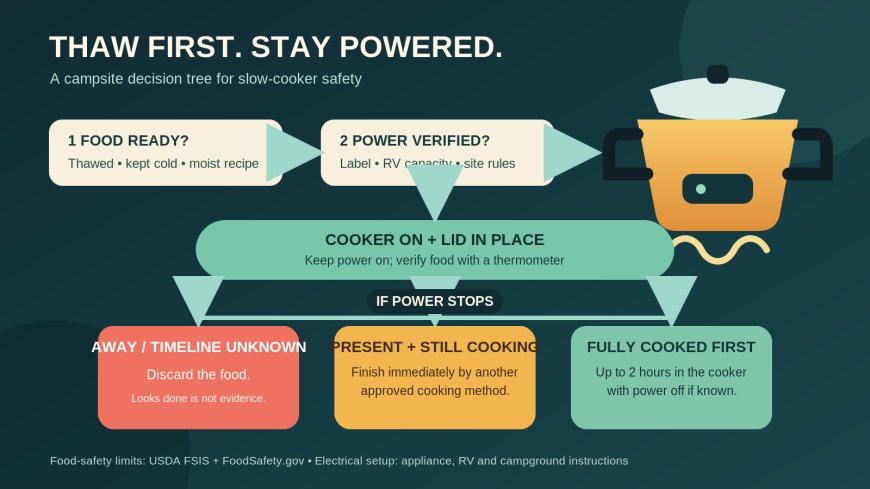
The food-safety decision and the electrical decision meet at one point: an uninterrupted cook. Original RVCamping.info diagram.
Start with the meal, not the outlet
USDA says meat and poultry should be thawed before they enter a slow cooker. Perishable ingredients should stay refrigerated until preparation; meat and vegetables prepared early should be stored separately. USDA also recommends recipes with plenty of moisture, including stews, soups, chili and pasta sauce, and says a commercially frozen slow-cooker meal should be handled according to its manufacturer's directions.[1]
That produces a simple campsite prep sequence:
- Thaw meat or poultry in safe refrigeration before cooking day.
- Keep the ingredients cold while setting up the site and RV.
- Wash hands and begin with a clean cooker, utensils and work surface.
- Follow a tested recipe and the appliance manual for ingredient quantity and cut size.
- Put vegetables in first when the recipe calls for them; USDA notes that vegetables cook more slowly than meat in a slow cooker.[1]
- Add the recipe's specified liquid, plug in, switch on and keep the lid in place except when the recipe requires stirring or the cook checks doneness.[1]
Do not treat the crock as a thawing chamber. The appliance may need several hours to reach a bacteria-killing temperature, which is why USDA's advice keeps perishable food cold before the cook begins.[1]
Make a campsite power check before loading food
A recipe cannot tell you whether one particular campsite circuit can run one particular appliance. Read the slow cooker's nameplate or manual for its rated input. Then check the RV manual and energy-management display, if fitted, for the load already in use. Finally, read the campground's rules for pedestal use, adapters, outdoor appliances and generators.
This is an equipment-and-site check, separate from federal food-safety guidance. RVCamping.info is not giving a universal wiring method or promising that a particular receptacle, inverter, adapter, extension cord or generator is suitable. RVs, pedestals and appliances differ. If the documents leave any doubt about the connection, ask campground staff and a qualified RV electrical professional before starting.
Useful questions are concrete:
- What input does this cooker's label specify?
- Which other loads may cycle on during the cook, including air conditioning, water heating or battery charging?
- Will an energy-management system shed the slow-cooker circuit?
- Does the campground allow the intended connection and the appliance's location?
- If a generator is the planned source, are its hours long enough for the entire recipe, and is operation allowed for that whole period?
If the answer to the last question is no, choose another meal. Scheduled generator hours are not a safe basis for a cook that needs power after quiet time begins.
Use the slow cooker as designed
USDA advises consulting the instruction booklet for the size of meat or poultry appropriate to that cooker. It also says to keep the lid in place and make sure the appliance is plugged in and turned on. Cooking on low for the full recipe is considered safe; when possible, USDA suggests starting the first hour on high and then switching to low or the recipe's setting.[1]
Set the cooker on a stable surface where its cord, steam and hot exterior will not create a campsite traffic problem. Keep it protected from weather and follow its manual's clearance and location instructions. Do not improvise an outdoor installation just because the RV counter is busy.
Write the start time down. A phone alarm for the recipe's first check is useful, but it is not evidence that power stayed on. If the campground supply is prone to interruption or the RV sheds circuits, stay close enough to catch a shutdown. A smart plug or monitor can be a convenience only if the manufacturer permits that use; it does not override electrical ratings or settle whether interrupted food is safe.
Measure food, not optimism
Color, bubbling sauce and a tender texture do not replace a food thermometer. FoodSafety.gov lists these minimum internal temperatures: 165°F for all poultry, casseroles and leftovers; 160°F for ground meat and sausage; and 145°F plus a three-minute rest for whole cuts of beef, bison, veal, goat, lamb and pork.[4]
Check the thickest food in the coolest likely part of the cooker without touching the crock. A mixed dish may contain ingredients with different targets, so use the highest applicable target. Follow the recipe and appliance instructions as well; reaching a number early does not necessarily mean the dish has completed its intended cook.
USDA says food remains safe while the cooker is operating. Once dinner is ready, serve it or keep it under the appliance's intended hot-holding conditions. USDA directs cooks to move leftovers into shallow, covered containers and get them into refrigeration no later than two hours after the cook ends.[1]
Do not use a slow cooker to bring cold leftovers back up to temperature. USDA recommends reheating cooked food by stove, microwave or conventional oven to 165°F, then transferring it to a preheated slow cooker for holding at no less than 140°F as measured with a thermometer.[1]
If the power stops, use this decision
An interrupted cook needs a food-safety response, not an electrical guess.
Nobody was present for the cook: USDA says to throw the food away if the power went out while nobody was home, even if the food looks done. At a campsite, apply the same logic when everyone was away and the interruption history cannot be established.[1]
Someone noticed while the food was still cooking: USDA advises finishing the ingredients immediately by another cooking method. That alternative must itself be safe, permitted at the site and capable of completing the food promptly. Do not leave a partly cooked crock waiting for power to return.[1]
The food was completely cooked before power failed: USDA gives it a maximum of two hours in the switched-off cooker when someone is present and knows it had finished cooking.[1] Record the outage time. Serve, move it into a reliable hot-holding setup, or refrigerate it within the applicable window.
The broader FoodSafety.gov outage chart adds another boundary: discard casseroles, soups and stews after exposure to 40°F or above for more than two hours.[3] USDA also says never to taste food to decide whether it is safe and gives a closed refrigerator up to four hours during an outage.[2] That refrigerator rule is not permission to give an unpowered slow cooker four hours. Use the specific slow-cooker guidance for the crock.[1][2]
Keep electrical troubleshooting away from the meal
If a breaker, pedestal, inverter or energy-management system interrupts the cooker, stop and establish the food timeline first. Repeatedly resetting equipment can obscure how long the meal was without heat, and the cause may require qualified attention.
For the electrical side, follow the RV, appliance and campground documentation. Do not open panels, bypass protective devices, defeat energy management or invent an adapter chain to save dinner. The replacement meal costs less than damaged equipment, a fire or an uncertain pot of food.
For the food side, write down four facts:
- Was the meal fully cooked before the interruption?
- Was anyone present to know when power stopped?
- How long has the cooker been off?
- Can another approved cooking method finish the food immediately?
Those answers lead to the discard, finish-now or short completed-food holding branches in the diagram. If the timeline is unknown, it belongs on the discard branch.
A five-minute departure check
Before leaving camp while dinner cooks, run this card:
- Ingredients were fully thawed and stayed refrigerated until prep.
- The recipe, load size and setting match the cooker manual.
- The lid is seated, the cooker is on, and the start time is recorded.
- The appliance input and available RV capacity were checked without relying on a universal wattage rule.
- Campground rules allow the setup for the full cooking period.
- No scheduled shutdown, generator curfew or load-shedding plan will interrupt the cooker.
- A food thermometer is ready for the final check.
- Someone will know whether power remained on; otherwise the meal will be discarded after an outage.
The cautious plan may occasionally end with sandwiches. That is better than asking appearance, smell or a restarted clock to prove what happened while camp was empty.
This article's thawing, slow-cooker operation, outage response, leftover handling and temperature limits come from the federal sources below. The RV load review and site-rule checklist are RVCamping.info planning controls, not federal electrical instructions.
Sources
- USDA FSIS: Slow Cookers and Food Safety — thawing, preparation, lid, settings, outage and leftover guidance (archived page reviewed October 17, 2026).
- USDA FSIS: Keep Your Food Safe During Emergencies — refrigerator and freezer outage planning and discard guidance (archived page reviewed October 17, 2026).
- FoodSafety.gov: Food Safety During Power Outage — item-specific outage discard chart and time/temperature limits (reviewed October 17, 2026).
- FoodSafety.gov: Cook to a Safe Minimum Internal Temperature — minimum internal temperatures and rest-time chart (reviewed October 17, 2026).
What's Your Reaction?