



Food delivered to the campground office needs a temperature handoff
Plan a campground-office food delivery around immediate retrieval, a measured 40°F arrival gate and ready cold storage.
Food delivered to the campground office needs a temperature handoff
By Romana | Information checked 2026-10-26 UTC | Cooking
A tracking alert is not a cold chain. If a box of meat, seafood, cheesecake or meal-kit ingredients is delivered to the campground office while you are hiking, the useful facts are whether someone received it, when you opened it and what the food thermometer read.[1]
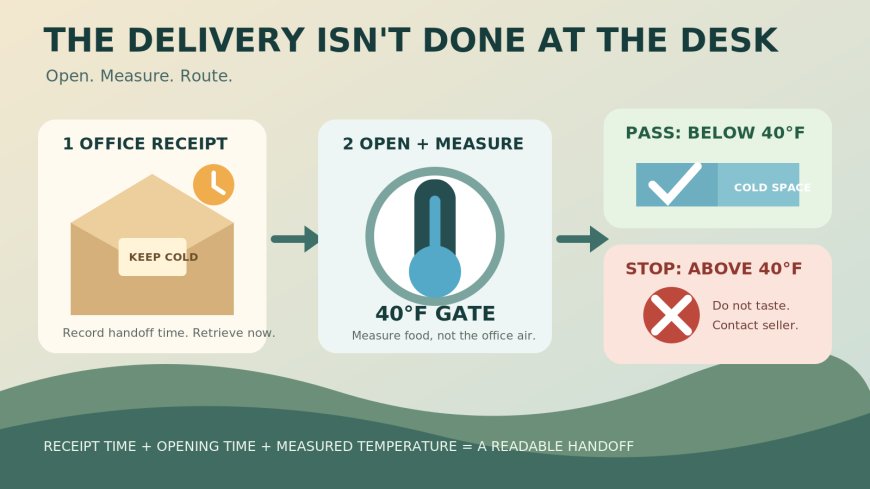
The office can accept a parcel, but only the recipient can complete the temperature check. Original RVCamping.info handoff diagram.
USDA says a perishable mail-order item should arrive frozen, partly frozen with visible ice crystals, or below 40°F when measured with a food thermometer. If it arrives above 40°F, notify the company and do not eat or even taste it.[1] That arrival rule is stricter and more useful than trying to reconstruct how long an unattended box may have been warm.
Book the handoff before ordering dinner
A campground mailing address does not guarantee refrigerated receiving. Before ordering, ask staff four narrow questions:
- May a guest receive a food shipment at this address?
- Which guest name, site number and arrival date must appear on the label?
- Will staff call or text when the carrier hands it over?
- Is there actual refrigerator or freezer space, or only a package shelf?
USDA advises telling the recipient the promised delivery date and avoiding an office delivery unless someone will be there and adequate refrigerator space is available.[1] At a campground, that means the person who orders the food owns the last segment. A staffed desk is not automatically a cold-storage service.
Schedule delivery for a day you can remain nearby. Put a clean food thermometer, a cooler with ice or frozen gel packs, and enough RV refrigerator space in place before the carrier arrives. If the RV refrigerator is already crowded or warmer than 40°F, the package has nowhere safe to go even if it passes at the desk.
Run the OPEN–MEASURE–ROUTE gate
The RVCamping.info handoff card uses three recorded fields: office receipt time, package opening time and measured food temperature.
OPEN: Retrieve and open a package marked "Keep Refrigerated" immediately. USDA expects perishable items to be shipped cold or frozen with a cold source in an insulated container and tells the recipient to open the package at once.[1]
MEASURE: Check the food itself with a clean thermometer, following the shipper's measuring instructions when provided. Ice crystals or a still-frozen product pass the condition test. Refrigerated product must read below 40°F under USDA's mail-order guidance.[1]
ROUTE: A passing box goes directly into a refrigerator at 40°F or below, a freezer at 0°F or below, or a properly iced cooler for immediate transport. A reading above 40°F is a reject-and-contact decision, not the beginning of a smell test. USDA notes that dangerous mishandling may not change taste, smell or appearance.[1]
Take a photo of the thermometer reading, shipping label and condition of the cold source before moving or discarding anything. Keep the order number. Those records support a factual conversation with the seller without turning the campsite table into an investigation bench.
Do not spend the two-hour rule twice
The familiar two-hour rule answers a different question. USDA says hot delivered food should stay at 140°F or above, cold delivered food at 40°F or below, and perishable food should be refrigerated within two hours, shortened to one hour when air temperature is above 90°F.[2]
That clock is useful for local takeout whose handoff time and temperature history are known. It does not rescue a shipped box that arrives above 40°F. With mail-order perishables, the warm interval before office receipt is unknown. Apply the mail-order arrival gate first.[1]
Once a cold shipment passes and you remove food from controlled storage for dinner, a new service clock begins. Keep cold items at 40°F or below in a cooler stocked generously with ice or frozen gel packs. If a local restaurant delivers a hot meal, keep it at 140°F or above or divide it into shallow containers and refrigerate it if service will be delayed.[2]
Record clocks by event, not by guesswork:
- Carrier handoff: when the office or guest accepted the box.
- Temperature gate: when you opened it and the measured reading.
- Meal service: when passed food later left cold storage or hot holding.
The first two document whether the shipment was acceptable. The third controls the campsite meal. Combining them into one vague "it came this afternoon" note hides the gap that matters most.
Three scenarios, three decisions
Box at 36°F, cold packs partly frozen: Record the reading and move the food directly to verified cold storage. Follow the package's storage and use-by directions.[1]
Box at 44°F, desk says it arrived 20 minutes ago: Reject it and contact the seller. The measured mail-order arrival temperature is above USDA's limit; a short office interval does not establish what happened earlier in transit.[1]
Pizza arrives hot at your site for dinner: This is takeout, not a cold shipment. Eat promptly, hold it at 140°F or above, or refrigerate within the applicable two-hour or one-hour limit. Refrigerate leftovers in shallow containers.[2]
The categories matter because they prevent a rule from wandering into the wrong job. A cold parcel gets an arrival-temperature decision. A known local meal gets a holding-and-service clock.
Put this line in the trip plan
FOOD DELIVERY: permitted address / named receiver / alert method / cold space ready / thermometer packed
If any field is blank, buy the perishables after arrival or choose shelf-stable food. Campground staff can help a parcel find your site. They cannot certify the package's temperature history for you.
Source credit: RVCamping.info reviewed the linked USDA guidance and archived evidence on 2026-10-26. The OPEN–MEASURE–ROUTE gate, three-event log and campground receiving questions are original editorial tools.
Sources
- Mail Order Food Safety — USDA Food Safety and Inspection Service — packaging, immediate opening, arrival-temperature gate and recipient planning; official page evidence archived October 4, 2026.
- Safe Handling of Take-Out Foods — USDA Food Safety and Inspection Service — hot and cold holding, one- and two-hour limits, coolers and shallow-container storage; official page evidence archived October 4, 2026.
What's Your Reaction?