





Cold-night glamping: a safer heat plan for RV, tent and cabin groups
A shelter-by-shelter cold-night plan for mixed glamping groups, covering heat choices, CO alarms, generator spacing and a pre-arrival decision tree.
By Romana
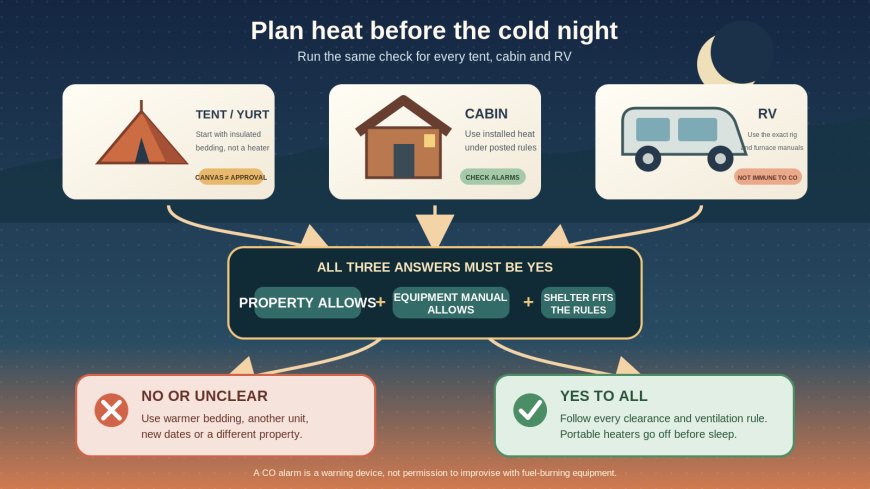
The safest cold-night plan is decided before the group arrives, not at 11 p.m. when somebody discovers the safari tent has no heat. Start with a shelter and sleep system that can handle the forecast without a portable heater. Then treat any active heat as equipment that needs three separate approvals: the property must allow it, the appliance instructions must allow that exact use, and the shelter must support every required clearance, ventilation and power condition.
Carbon monoxide changes the stakes because nobody can see or smell it. The Consumer Product Safety Commission warns that camping heaters, lanterns and stoves have caused fatal CO poisonings in tents, campers and vehicles, and says portable heaters and lanterns should not run while people sleep in those enclosed spaces.[1] A polished glamping tent is still an enclosed space. An RV is one too.
Source note: This guide draws on current CPSC and CDC safety guidance, National Park Service campground advice, and a current RV manufacturer's manual. It is a planning framework, not approval for a particular heater, property or RV.
One trip can have three different heating answers
Mixed groups often book by bed count: two people in a cabin, four in a platform tent, and another household in an RV. Heating decisions cannot be shared that way. Each shelter has different equipment, electrical service, ventilation and owner rules.
| Sleeping shelter | What it can reasonably support | What must be confirmed before use | What does not belong in the overnight plan |
|---|---|---|---|
| Glamping tent, yurt or canvas unit | A forecast-rated sleeping bag or quilt, insulated pad, dry sleep layers, hats, and property-installed heat operated exactly as posted | Whether heat is actually provided; heater type and model; overnight-use instructions; required vents and clearances; alarm locations; backup plan if heat fails | A grill, charcoal, lantern, camp stove or outdoor-only heater; any unapproved guest appliance; any portable heater left on while people sleep |
| Cabin or tiny house | Property-installed furnace, heat pump, baseboard or fireplace that staff have approved for the unit; passive bedding as backup | Operating instructions; whether guests may adjust or refuel equipment; smoke and CO alarm status; portable-heater policy; outage procedure | Cooking appliances used for room heat; a generator beside the cabin; a guest heater that violates the rental rules or appliance label |
| RV or camper | The exact RV's installed heating system when maintained and operated under the RV and component manuals; a tested RV CO alarm; cold-rated bedding in case the system stops | Furnace model and service condition; unobstructed exterior intake/exhaust; battery and fuel plan; campground generator hours and placement; alarm test and replacement status | A stove or oven used as a heater; an outdoor appliance brought inside; automatic relocation of tent or cabin guests into the RV without checking capacity, ventilation and the source of any alarm |
That table is a screening tool, not a certification. "Indoor safe" on a product page does not erase a manual's ventilation, altitude, fuel-cylinder, clearance or sleeping restrictions. Likewise, an installed furnace does not make an RV immune to a blocked vent, low battery, equipment fault or exhaust from a neighbor.
A current Grand Design travel-trailer manual, for example, lists furnaces, portable heaters, grills, generators, other RVs and vehicle exhaust among possible CO sources in and around an RV. It also warns that exhaust from a nearby tow vehicle or generator can filter inside.[5] That is why "everyone can sleep in our RV" is not a CO response plan.
Use passive warmth as the overnight baseline
The heater question gets easier when the bed itself is prepared for the expected low. Ask the tent or cabin operator for the lowest temperature the supplied bedding is intended to cover, whether a mattress pad insulates from below, and whether extra dry blankets are available. Bring sleep insulation based on the coldest credible forecast, not the daytime high.
For a platform tent, pay attention to the mattress. A thick-looking air mattress can still leave sleepers cold from below. An insulated pad or under-quilt belongs between the sleeper and the cold surface; loose blankets piled only on top do not solve that part of the problem. Change out of damp socks and base layers before bed, keep tomorrow's clothes dry, and give every sleeper a hat that can stay on comfortably.
Passive warmth is also the fallback for cabins and RVs. Furnaces need fuel and electricity for controls and fans. Campground power can fail. The CDC advises using blankets, sleeping bags and warm coats as cold-weather backup, and says people should move to another shelter when conditions become too cold.[3] Decide the move threshold before bedtime: a specific indoor temperature, a heater failure that staff cannot promptly fix, or a sleeper who remains cold after dry layers and bedding are added.
Portable electric heat is not an all-night workaround
An electric heater avoids combustion at the point of use, but it introduces fire and electrical-load questions. The CPSC says portable heaters need at least three feet of separation from bedding, curtains, furniture and other combustible material. It also says to plug an electric space heater directly into a wall receptacle, not an extension cord or power strip, and to turn portable heaters off while sleeping.[2]
Those conditions rule out many glamping setups. If the only receptacle is across the tent, an extension cord is not a fix. If the heater cannot sit on a stable, level surface outside foot traffic with three feet of clear space, the unit cannot support that heater. If the property bans guest heaters, the answer is no even when the electrical math appears to work.
Treat an allowed portable electric heater as supervised, awake-time comfort. It can warm a cabin while people get ready for bed, then it goes off. It should not be the only thing keeping the shelter within a safe overnight temperature.
Combustion equipment needs a hard boundary
The CDC bars camp stoves, fuel lanterns, hibachis and charcoal grills from indoor use in homes, tents and campers.[3] The National Park Service separately tells campers never to burn charcoal in a closed space such as a tent or RV.[4] Opening a flap or cracking a window does not convert cooking gear into a heater.
Some portable fuel-burning heaters are marketed for specified indoor or recreational enclosures. That claim is only the beginning of the decision. The exact model manual must name the intended enclosure and spell out ventilation, clearance, fuel connection, elevation and operating limits. The property must also permit it. If either answer is missing, contradictory or based on "we have always done it," do not use the heater inside.
Even where a model and property allow awake-time use, CPSC guidance remains clear: do not operate a portable heater while people sleep in a tent, camper or vehicle.[1] A tip-over switch or oxygen-depletion sensor is not permission to ignore that rule, and a personal CO alarm is not a license to improvise with outdoor equipment.
An RV has equipment, not immunity
A maintained, installed RV furnace is a different category from an unvented portable heater because it is part of a designed system. The distinction still depends on the exact rig and appliance manuals. Before the trip, the RV household should identify the furnace model, follow its required inspection and operating steps, and look for blocked or sooted exterior openings without adding aftermarket screens or covers unless the manufacturer authorizes them.
Test the installed CO alarm with its test button on the schedule in its manual and check its replacement date. Grand Design's current Transcend manual tells owners to test the CO alarm before a trip and at least weekly while the RV is in use; it says to replace an alarm that does not test properly.[5] A passing button test confirms that the alarm can perform its self-test. It does not prove the furnace or surrounding air is safe.
Generator placement is a group decision because exhaust crosses site boundaries. CDC guidance keeps gasoline engines outside and at least 20 feet from doors, windows and vents.[3] For a mixed campsite, apply that separation to every occupied RV, cabin and tent opening, point exhaust away, and obey any larger campground setback or generator-hours rule. If the assigned site cannot provide that geometry, the generator does not run there.
Do not designate the RV as a universal refuge. If a CO alarm sounds in any shelter, moving people into a nearby RV without locating the source could put them closer to generator, vehicle or appliance exhaust. Severe weather is a separate problem too: an RV should not be described as an automatic storm shelter. Follow the property's emergency instructions and the guidance for the specific hazard.
The pre-arrival heating decision tree
Run this tree for each sleeping unit, not once for the whole reservation.
-
Can the bedding and sleep system handle the forecast with no active heat?
- Yes: keep that setup as the overnight baseline and continue to check any optional heater.
- No: ask whether the property supplies an installed heater intended for that exact unit.
-
Is a property-installed heater provided?
- Yes: get the heater type, operating instructions, overnight-use rules, alarm details and outage plan in writing. If staff cannot provide them, treat the unit as unheated.
- No: ask whether guests may bring a heater and request the written appliance policy.
-
Does the property explicitly allow the exact guest heater in that shelter?
- No or unclear: do not bring it. Upgrade to a heated unit, add a sleep system that covers the forecast, change dates or book elsewhere.
- Yes: read the exact model's current manual. A generic product-family description is not enough.
-
Is it a portable electric heater?
- Confirm a wall receptacle is within reach of the factory cord, the property says the circuit can carry it, and the shelter has a stable location with every required clearance.
- If any condition fails, do not use it. If all pass, use it only while awake and attending it, then turn it off before sleep.[2]
-
Is it fuel-burning?
- If it is a stove, lantern, charcoal device, grill, generator or outdoor-only heater, it stays outside and away from openings.[3][4]
- For a heater specifically listed by its manufacturer for the exact enclosure, every manual condition and property rule must be met. It still goes off before anyone sleeps.[1]
-
Will a generator support an RV or cabin system?
- Confirm permission, operating hours, fuel rules, weather restrictions and a location at least 20 feet from every occupied opening with exhaust directed away.[3]
- If the site layout cannot meet both official guidance and property rules, choose shore power, battery capacity, another unit or another property.
-
Can every sleeper remain safe if heat quits at 2 a.m.?
- Yes: record the backup bedding, regroup point and who will check each unit.
- No: the reservation does not fit that person's needs. Choose lodging with an appropriate installed system and a verified outage plan rather than hoping a portable heater runs all night.
The strictest instruction wins. Property permission cannot override an appliance warning, and a heater label cannot override a property ban.
Ask these questions before the cancellation deadline
Send one message that names every booked unit:
- What heat is installed in each RV site rental, cabin, yurt or glamping tent?
- May guests bring portable electric or fuel-burning heaters? If so, which types and where?
- Can a portable electric heater plug directly into an in-unit receptacle without an extension cord, and is that circuit approved for the load?
- Which smoke and CO alarms are installed in each unit, when were they last tested, and what should guests do if one sounds?
- Where are furnace and generator exhaust outlets relative to tents, windows, doors and air intakes?
- What are generator hours, setbacks and shutdown rules?
- Who answers after hours if installed heat fails?
- Can the group move to a different property unit, and what temperature or equipment failure triggers that move?
Save the response with the reservation. At check-in, compare the answer with the actual unit. A heater substituted at the last minute deserves a fresh manual and rule check.
If a CO alarm sounds or symptoms appear
Headache and dizziness can signal CO exposure. So can weakness, nausea, vomiting, chest pain or confusion.[1][3]
Sleeping people and people who have been drinking may not notice early symptoms.[1][3]
Get everyone into fresh air immediately, account for every person and pet, and call 911 or the local emergency number. The Grand Design manual tells occupants to evacuate the RV when its CO alarm sounds and remain outside in fresh air.[5] Do not silence the alarm and go back to bed. Do not re-enter to diagnose a furnace, fetch luggage or move a generator. Let emergency responders identify the source and say when the area is safe.
One final check keeps the plan honest: every occupied shelter needs its own safe overnight baseline. The cabin's furnace does not protect the tent. The RV's alarm does not monitor the yurt. Solve each sleeping space before the group arrives, then agree on one response if anything fails.
Sources
[1] Portable Heaters & Camping Equipment
[2] Keep Warm and Safe This Winter
[3] What to Do to Protect Yourself During a Power Outage
[4] Camping Safety
What's Your Reaction?