

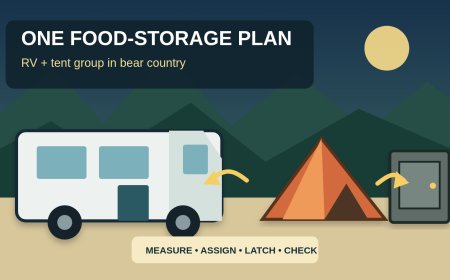

Sharing an RV with tent campers in bear country: one food-storage plan
A rules-first worksheet for mixed RV-and-tent groups to assign coolers, toiletries, pet supplies, cookware and trash to legal bear-safe storage before arrival.

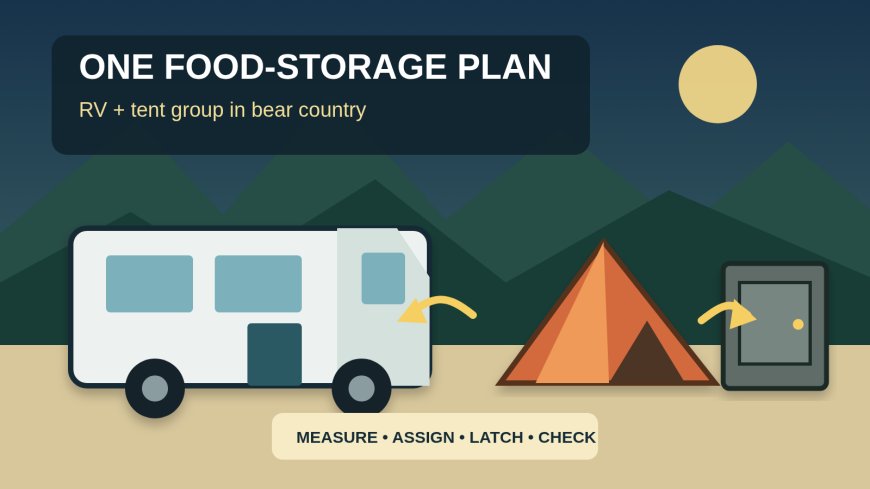
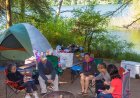
A mixed camping group can arrive with three different ideas of what "put the food away" means. The RV crew may expect to use the refrigerator and cabinets. Tent campers may plan to keep toiletries in a duffel. Someone else may leave the cooler under the picnic table because dinner starts soon.
That is exactly the sort of loose handoff that fails in bear country. The better plan is to treat every scented item as shared cargo, assign an approved storage place before arrival, and follow the rule for the exact campground rather than a generic camping habit.
Start with the campground rule, not the RV
National Park Service guidance says storage rules vary by park. One park may require a locker, another may allow a closed vehicle during certain hours, and another may require a bear-resistant container. The agency tells visitors to check the destination's own rules.[3]
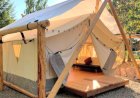
That difference matters to a group split between an RV and tents. Yosemite, for example, permits food out of sight in a fully hard-sided RV when its windows, doors, and vents are closed. It does not extend that permission to pop-ups, tent trailers, soft-sided campers, tents, or tent cabins.[1] At Yosemite campgrounds and tent-cabin lodging, provided food lockers are part of the storage system, and the park tells users to keep them latched.[1][2]
Do not turn that Yosemite example into a national rule. Use it as a booking lesson: write down the campground's exact definition of approved storage and confirm whether your rig qualifies.
Before paying, save answers to these questions:
- Does the campground require its locker even when a hard-sided RV is present?
- Is food allowed in a hard-sided RV overnight, or only during the day?
- Does a canvas pop-top, fold-out bunk, or soft rear enclosure disqualify the rig?
- Is there one locker per site, a locker per lodging unit, or shared storage?
- What must fit besides groceries and coolers?
- Are cooking rules different at the tent, cabin, or glamping unit?
A phone answer is useful, but a saved rule page is better. Conditions and wildlife restrictions can change after booking.
Make an attractant inventory for the whole group
The word "food" is misleadingly narrow. NPS treats many scented or food-related objects as attractants, including beverages, waste, ice chests, personal-care products, sunscreen, insect repellent, fuel, and meal-preparation items.[3] Rocky Mountain National Park also identifies pet food and bowls, and it requires coolers, dirty stoves, grills, tableware, and cookware to be cleaned and stored with the same care as food.[5]
Build the inventory by where items travel, not by who owns them.[3][5]
- cold food and drinks in coolers;
- dry food, condiments, coffee, and unopened cans;
- toothpaste, lip balm, deodorant, soap, wipes, sunscreen, and medicines with an odor;
- pet food, treats, bowls, and waste bags;
- trash, recycling, empty food packages, and grease;
- grills, camp stoves, pans, plates, utensils, and dishwashing supplies;
- daypacks, child seats, and clothing that may hold crumbs or food odors.
The practical test is simple. If a member of the group would be unhappy to find it crushed, chewed, or dragged through camp, it belongs on the list until the campground says otherwise.
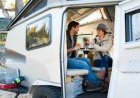
Decide whether the RV is storage, kitchen, or neither
A hard-sided RV can be an approved storage place at some campgrounds. That does not mean every RV is approved everywhere. Yosemite's rule excludes rigs with cloth pop-outs from its hard-sided definition, and it requires doors, windows, and vents to be closed when the RV is unattended.[1]
The group should make one written decision for each class of item:
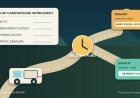
| Item group | Primary storage | Backup storage | Person responsible |
|---|---|---|---|
| Refrigerated food | Approved RV refrigerator or locker-compatible cooler | Campground locker | Meal lead |
| Dry food and drinks | Campground-approved locker or qualifying RV | Second locker/container allowed by site rule | Grocery lead |
| Toiletries | Approved locker/RV bin | Lodging storage expressly allowed by rule | Each sleeper, checked by site lead |
| Pet supplies | Approved locker/RV bin | None unless the property approves it | Pet owner |
| Trash and recycling | Bear-resistant dumpster or approved temporary storage | Approved locker/RV until disposal | Cleanup lead |
| Stove, grill, and cookware | Clean, then approved locker/RV | None left outdoors | Last cook |
Do not promise tent guests that the motorhome will hold everything until you have measured the available cabinets and cold space. Do not rely on a car as overflow without checking time-of-day rules. Yosemite allows food in a car or truck during daylight only under specific conditions, but directs visitors to lockers after dark.[1]
Measure the locker before the trip
Locker capacity is a booking constraint. Yosemite says most of its campground lockers have internal dimensions of 35 by 43 by 28 inches, while lockers at some locations are smaller. Tent-cabin locker sizes also vary with cabin capacity.[2]
Measure the largest cooler and the combined dry-food bins. Then add toiletries, cookware, the clean grill or stove if the local rule includes them, pet supplies, and the first night's trash. A cooler that fits through the locker opening may still leave no room for the rest.
If the math fails, change the packing plan before departure. Bring a smaller cooler, reduce bulky packaging, divide supplies between permitted lockers, or choose a property with storage that fits the group. Do not plan to solve the problem by leaving overflow in a tent vestibule.[1][3]
Use an arrival handoff, not a lecture later
NPS advises visitors to secure food, garbage, and scented items immediately upon arrival.[3] Grand Teton's reminder includes food, garbage, pet food, coolers, food containers, and cookware, whether clean or dirty, when those items are not in immediate use or attended.[4]
That makes arrival order important:
- Park and confirm the assigned site or lodging unit.
- Find the locker and test its latch.
- Move coolers, dry food, toiletries, pet supplies, and kitchen equipment directly to their approved places.
- Give every sleeper a five-minute bag check before tents or soft-sided lodging become cluttered.
- Put the trash route and closing time, if any, in the group chat.
- Only then unpack furniture and start cooking.
One person should own the closeout check after each meal. The job is not to police everyone. It is to catch the half-used sauce bottle, toddler snack cup, dog bowl, greasy spatula, and trash bag that each person assumes someone else handled.
Treat "attended" as hands-on control
Grand Teton tells visitors to keep attractants stored when they are not in immediate use or attended, day or night.[4] General NPS guidance tells campers to keep food within arm's reach.[3]
For a mixed group, the safest operational definition is stricter than "somebody is nearby." Food on a table is not meaningfully attended if the group walks to the restroom, gathers around a neighboring fire, or climbs into the RV to watch a game. Put away everything except what is being prepared or eaten now.
This also solves a common dinner problem. Instead of unloading every ingredient, stage one meal bin. Return each item as soon as its job is done. The table stays workable, the cleanup list gets shorter, and fewer attractants remain outside when conversation moves to the fire ring.
Close the campsite twice
Run a short closeout after dinner and again before anyone goes to bed.
The dinner closeout covers food, drinks, cookware, cooking grease, coolers, pet bowls, trash, and recycling. Wash what the campground permits you to wash, store the clean gear as required, and move waste to the correct container. Rocky Mountain National Park says camp kitchens must be kept clean and calls for toiletries to be stored in a locker or qualifying hard-sided vehicle when not in use.[5]
The bedtime closeout starts at each sleeping space. Remove snacks, gum, drink mixes, flavored water, medicines with an odor, cosmetics, toiletries, wipes, trash, pet treats, and food-stained clothing. Yosemite explicitly says not to keep food, drinks, toiletries, or trash in tents or tent cabins.[1]
Then check the RV's exterior compartments, outdoor kitchen, truck bed, stroller, and camp chairs for forgotten wrappers.[1][3]
Finish by testing the locker latch and the RV doors, windows, and vents required by the local rule.[1][2]
What to do when the rule and the group plan disagree
The campground rule wins. If staff direct everyone to use a locker, use the locker. If a temporary wildlife order bans soft-sided sleeping units, the presence of an RV on another site does not make the tent legal. If the locker is damaged or already full, contact the host or ranger instead of improvising.
A good mixed-stay plan does not make the RV the automatic answer. It gives every attractant one legal place, every meal one closer, and every sleeper the same short checklist. That is easier to follow at 10 p.m. than a vague reminder to "be bear aware."
Sources
- Bears and Food Storage - Yosemite (accessed September 22, 2026).
- Bearproof Food Lockers - Yosemite (accessed September 22, 2026).
- Storing Food - National Park Service (accessed September 22, 2026).
- Grand Teton food storage reminder (accessed September 22, 2026).
- Rocky Mountain campground food storage (accessed September 22, 2026).
What's Your Reaction?








![5 Ideas for What to Do if You’re Alone on Valentine’s Day [Galentine’s Day 2023]](https://rvcamping.info/uploads/images/202302/image_430x256_63de268cd0b7f.jpg)