





Outland Firebowl 893 review: portable flame, local rules still win
The Outland Firebowl 893 gives RV campers a contained propane flame, but its 20-pound-cylinder setup, clearances and local fire rules limit where it fits.

> Research disclosure: This is a research-based review. RVCamping.info has not purchased, lit, transported, or physically tested this fire pit.
The Outland Living Firebowl 893 Deluxe makes sense for RV campers who want a visible outdoor flame without hauling firewood or cleaning up ash.[1] It is a 19-inch, manual-light propane fire bowl with a 10-foot hose, regulator, lava rock, lid and carry strap.[1] The manufacturer's current page lists it at 23 pounds with the rocks installed and rates it at up to 58,000 Btu per hour.[1]
Skip it if you need a tiny tabletop fire, want to cook on a grate, cannot carry a separate 20-pound cylinder, or expect the words "CSA approved" to guarantee use during every burn ban.[4][6] The 893 is an outdoor decorative gas appliance, not a heater for an RV, screen room or tent.[6]
The main tradeoff is simple: the 893 is quicker and cleaner to start and stop than a wood fire, but it takes real cargo space.[1][3] The bowl, hot-rock cooldown, long hose and full-size propane cylinder all need a safe place in the camping routine.[1][6]
As an Amazon Associate, RVCamping.info earns from qualifying purchases. If you buy through an Amazon link in this article, we may earn a commission at no additional cost to you.
Check the Outland Living Firebowl 893 Deluxe (ASIN B00KY4S388) on Amazon.
Verdict in brief
The Firebowl 893 is a good fit for RVers who camp where contained propane fire pits are allowed and who value a fast shutdown more than the smell and heat pattern of a wood fire.[3][4] The included lid and carry strap distinguish the Deluxe 893 from Outland's otherwise similar Standard version.[1]
It is a poor fit for indoor or enclosed use, ultralight packing, or buyers who want one propane appliance to do double duty as a grill. Outland says the bowl uses only the supplied rocks and propane; the manual says not to add wood or other materials.[6]
Our view: buy the 893 for outdoor ambience and modest radiant warmth, not as a loophole around fire restrictions and not as emergency heat inside the RV.[4][6]
Exact model and what comes in the box
The reviewed product is the Outland Living Deluxe Fire Pit, series 893.[1][6] Outland's current product page identifies it as model 893 (FMPPC2A-2), while the linked owner's manual prints FMPPCA-2, series 893 on its cover.[1][6] That suffix conflict is worth knowing when ordering replacement parts.[1][6] Match the series number, bowl size and component before buying a part, rather than assuming either alphanumeric suffix applies to every production run.[1][6]
The Amazon listing tied to this review is ASIN B00KY4S388, titled for the 19-inch, 58,000-BTU, black 893 Deluxe with cover and carry kit.[2] The official package includes:
- a 19-by-19-by-11-inch fire bowl;
- four bags of natural lava rock, up to 4.4 pounds total;
- a factory-installed 10-foot propane hose and regulator;
- a stabilizer ring for a 20-pound propane cylinder; and
- the storage lid and carry strap.[1][6]
The ignition is manual.[1] You need a long lighter or match, and the lighting sequence matters: keep the bowl valve off, connect the regulator by hand, extend the hose, open the cylinder slowly, leak-test the joints, then hold the flame above the burner as you open the appliance valve.[6]
The RV compatibility boundary
This is a freestanding outdoor appliance.[6] It does not plug into shore power, connect to an RV quick-connect port as supplied, or use a one-pound disposable bottle.[1][6] The manual calls for a 20-pound propane cylinder, the supplied regulator and vapor withdrawal.[6]
That boundary rules out an improvised connection to a low-pressure RV quick-connect. An RV's quick-connect is often downstream of the coach regulator, while the Firebowl arrives with its own regulator. Two regulators in series can starve an appliance, and removing or bypassing the supplied regulator would contradict the listed configuration. Use only a manufacturer-approved conversion or hose arrangement, and confirm it with Outland before changing the fuel connection.
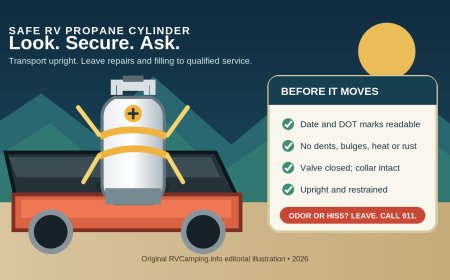
Cargo planning matters too. The 23-pound bowl is only part of the load.[1] A separate 20-pound cylinder, the 10-foot hose and a noncombustible operating footprint must fit your rig and campsite.[1][6] The hose also creates a trip line that cannot cross a path.[6] Outland requires the cylinder to remain at least 36 inches from the appliance and in the supplied stabilizer ring.[6]
Burn bans: approval is not permission
Outland describes the 893 as CSA approved and says it is safe to use during most fire bans.[1] The certification itself covers an outdoor decorative gas appliance standard; the manual identifies ANSI Z21.97-2017/CSA 2.41-2017.[6] Certification addresses the appliance design.[6] A land manager's current order decides whether you may light it.[4][7]
Rules can differ by agency, location and restriction stage. For example, the current Deschutes National Forest guidance says pressurized-gas fire pits with an on/off switch are allowed under its listed restrictions, while naming exceptions on some BLM-administered river corridors.[4] Outland's own burn-ban FAQ also tells users to check local laws before lighting.[7]
Call the campground or check the managing agency's dated restriction page on the day of use.[7] Ask specifically about a portable propane fire pit with a shutoff valve.[4][7] "Propane stove allowed" does not automatically mean "decorative propane fire pit allowed," and a host can impose a stricter campground rule.[4][7]
Clearances and the no-enclosure rule
The manual sets minimum clearances of 36 inches at the sides and 80 inches overhead, and it requires a noncombustible surface below the bowl. It also says not to use the appliance under overhead combustible surfaces.[6] That excludes use under most RV awnings, inside pop-up shelters, on dry grass, or close to a slideout skirt.
The most important limit is the blunt one: outdoor use only. The manual warns never to operate it in a camper, tent, car, home, garage or other enclosed area because the flame can produce carbon monoxide.[6]
One independent owner review reports using the Firebowl in a canopy tent with the sides covered except for an opening.[3] We would not follow that example.[6] An opening does not convert an enclosure into the outdoor, well-ventilated installation required by the manual.[6] Product instructions should win when an owner's practice conflicts with them.[6]
Heat, fuel and the 20-pound-cylinder commitment
The 58,000-BTU maximum sounds compact until fuel use enters the picture.[1][6] Outland estimates 7 to 11 hours from a full 20-pound cylinder, depending on flame height.[6] That range works out to roughly 1.8 to 2.9 pounds of propane per hour.[6] It is an estimate, not a meter: weather, cylinder fill, regulator behavior and how high you run the flame will change the result.[6]
For an RV weekend, the practical question is whether the fire bowl shares propane with anything else.[6] The supplied setup uses its own cylinder.[6] If that cylinder also needs to feed a grill through unapproved splitters, the simple listed configuration has already changed.[6] Close the cylinder valve when the bowl is not in use.[6]
The flame is decorative and exposed.[6] Wind can affect comfort and flame behavior even when the burner stays lit. Do not use the bowl as a cooking appliance unless Outland supplies an accessory and instructions for that exact use.[3][6] The manual describes an outdoor decorative gas appliance and says only the supplied rocks belong in the burner area.[6]
A safer campsite setup
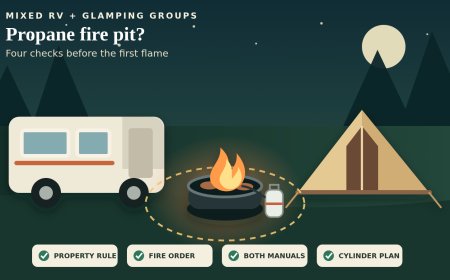
Choose the spot before connecting the cylinder.[6] The bowl needs level, noncombustible ground with the required side and overhead clearances.[6] Keep it away from the RV, awning, chairs, dry vegetation and traffic lanes.[6]
Then work through this sequence:
- Inspect the bowl, burner, regulator and the full hose. Do not light it if the hose shows abrasion, wear or damage.[6]
- Check the burner tube and screen for debris or insect nests. The manual warns that a blocked tube can cause a back-flame event.[6]
- Place the 20-pound cylinder upright in its stabilizer ring at least 36 inches from the bowl. Route the hose where nobody will trip over it and where it cannot touch the appliance.[6]
- Hand-tighten the regulator connection without tools or cross-threading it. Open the cylinder valve slowly so the excess-flow device does not trip.[6]
- Leak-test every connection with the manual's soap-and-water procedure. Bubbles or a propane odor mean close the cylinder, let gas disperse and correct the leak before use.[6]
- Keep a long lighter ready, follow the lighting order and watch for a normal burner flame. Never lean clothing or part of your body over the burner.[6]
If the flame stays unusually low, the cylinder may be near empty or the regulator's excess-flow valve may have tripped. Shut everything down and follow the reset sequence in the manual rather than repeatedly opening valves faster.[6]
Shutdown, cooldown and travel
The correct shutdown starts at the cylinder. Close the cylinder valve, then turn the bowl control off. The manual calls for at least five minutes before relighting and at least 30 minutes before moving or handling the fire bowl.[6]
The lid is not an extinguisher.[6] Outland says never to place it over an operating burner.[6] The manual gives a shorter 10-minute minimum before deploying the lid and strap, but also gives a 30-minute minimum before moving and handling the bowl.[6] Use the more conservative 30-minute handling limit, confirm the flame is out and check that the rocks and rim have cooled before packing.[6]
Keep the bowl dry in storage. Disconnect and remove the cylinder before indoor storage of the appliance, and store propane cylinders outdoors in a well-ventilated area under the rules that apply where you are staying.[6]
What independent use adds
The independent 893 review praised the fast start, adjustable heat, lack of wood smoke and sturdy build. Its drawbacks included bulk, propane-leak risk, no official cooktop and a less traditional campfire feel.[3] Those observations fit the hardware: at 23 pounds before adding a cylinder, this is portable in the car-camping sense, not the backpacking sense.
That review also demonstrates why research-based buying guides should separate experience from instructions.[3][6] A user may report that a setup worked.[3] That does not change clearances, enclosure warnings or the listed fuel path.[6]
Who should buy, and who should skip
Buy the Firebowl 893 if you:
- camp from an RV with space for the bowl and a properly secured 20-pound cylinder;[1][6]
- want a visible outdoor flame with no firewood or ash;[1]
- will check local restrictions every time; and[4][7]
- have a noncombustible, open-air campsite area that meets the manual's clearances.[6]
Skip it if you:
- expect to run it under an awning or inside a tent, screen room or RV;[6]
- need a grill, emergency indoor heater or small tabletop unit;[3][6]
- have only an RV low-pressure quick-connect and no Outland-approved connection plan; or[6]
- camp mostly where all open flames are prohibited.[4][7]
The 893 solves a narrow problem well: it gives RV campers a contained propane flame that shuts off at a valve.[1][6] It does not make every campsite suitable for a fire, and it does not replace reading the day's restriction order.[4][7]
Sources
What's Your Reaction?