












One grill, two rules: hot dogs and raw sausage at camp
Separate ready-to-eat hot dogs from raw sausage at camp, prevent cross-contamination, hit the right temperatures, and manage holding and leftovers.

One grill, two rules: hot dogs and raw sausage at camp
By Romana | September 24, 2026 | Cooking
Quick answer: Most packaged hot dogs are already cooked and ready to eat. As a listeriosis precaution, USDA says higher-risk consumers should heat hot dogs until they steam. Fresh sausage is raw: cook beef, pork, lamb, or veal sausage to 160°F, and chicken or turkey sausage to 165°F. Read the label, keep raw links and their juices away from buns and cooked food, use separate tools, and put finished links on a clean plate.[1][2][3]

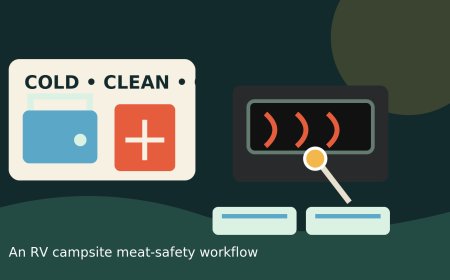
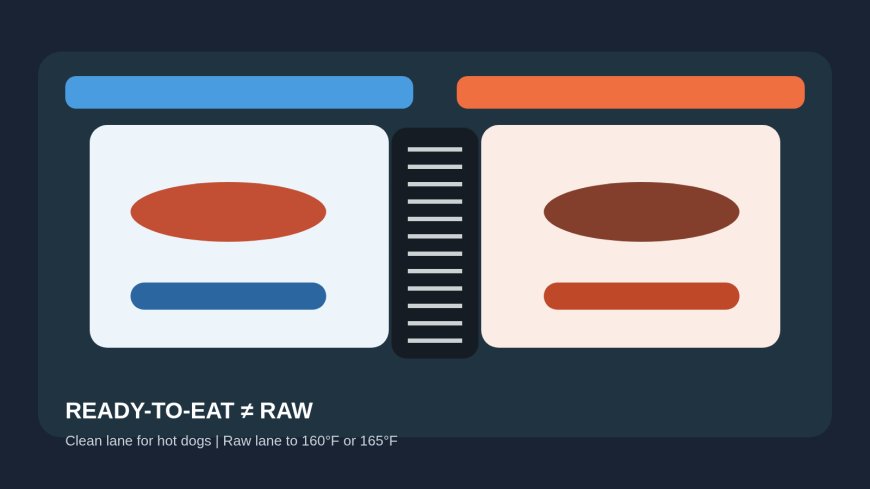
The package label decides the lane before the grill is lit. Original illustration by RVCamping.info.
Sort the packages while the print is still readable
Do the label check at home, not beside a smoky grill at dusk. USDA describes frankfurters and hot dogs as cooked sausages. It also separates uncooked sausages from ready-to-eat products. Raw-product wording includes "uncooked" and "ready to cook"; other packages direct the buyer to cook the product before eating or to cook it fully.[1][2]
The shape is useless evidence. A smoked-looking link can still require cooking, and a hot dog can arrive fully cooked. Keep each product in its original labeled package until the cook understands which one it is.
Make two marks on the shopping list:
- Ready-to-eat package: follow its reheating directions. USDA's listeriosis precaution for higher-risk guests, including pregnant people, adults 65 and older, and people with weakened immune systems, is to heat a hot dog until it steams.[1][5]
- Raw package: write the endpoint beside it. Ground beef, pork, lamb, or veal sausage goes to 160°F. Ground chicken or turkey sausage goes to 165°F.[2][3]
If a loose or repacked sausage has no reliable label and its ingredients are unknown, do not invent a temperature from its color. The clean choice is not to serve it.
Pack a raw side and a bun side
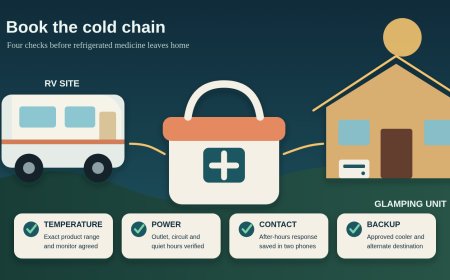
Both hot dogs and fresh sausage need cold transport. FDA's outdoor guidance calls for ice or frozen gel packs and a food-cooler temperature no higher than 40°F.[4] Put a thermometer in the food cooler and use a separate drink cooler when possible so every soda does not send warm air across dinner.
Build the cooler in layers. Buns, chopped onions, cheese, and condiments belong where raw liquid cannot reach them. Seal raw sausage in a leakproof bag or rigid bin at the bottom. Keep ready-to-eat hot dogs in their own package, away from the raw tray.
Pack two pairs of tongs. Mark the raw pair with bright tape, and bring a raw tray plus a clean landing plate. FDA requires washing raw-food dishes and tools in hot water with soap before reusing them for cooked food.[4] At a campsite with a small wash basin, a second plate is simpler than trying to remember whether the first one was cleaned well.
Handwashing belongs in the layout too. Put soap, safe running water, and paper towels where the cook can reach them before handling buns or condiment bottles. Sanitizer is useful when appropriate, but it does not remove raw meat juices or replace washing visibly dirty hands.
Draw the grill boundary before the first link lands
Use one side table or tray for raw sausage and the opposite side for finished food. The boundary should be obvious enough that a helper can see it without asking. Put the clean plate upside down until it is needed, and keep bun bags out of the raw zone.
A workable order is:
- Set out the clean landing plate and clean tongs.
- Put raw sausage on the grill with the marked raw tongs.
- Wash hands after closing the raw package.
- Handle buns, toppings, and ready-to-eat food only with clean hands and tools.
- Move cooked sausage to the clean plate with clean tongs.
Do not use the raw utensil to test or serve a finished link. Do not brush cooked sausage with marinade that held raw meat unless that liquid has been boiled as directed by safe handling guidance. The easiest campsite system is to reserve a separate portion of sauce before raw food touches it.[4]
Cook raw sausage by ingredient, not by browning
Grill marks do not announce the center temperature. Sausage can brown early over a hot flame while the middle remains undercooked. USDA says appearance is not a reliable doneness check; a food thermometer is the way to verify a safe internal temperature.[3]
Lift a link to a clean edge of the grill or clean plate for a safer reading. On a narrow sausage, push the thermometer in from an end or side far enough for its sensing section to sit in the middle.[3] Check more than one link and more than one place on thick or irregular pieces. Wind, burner hot spots, and different link sizes can produce very different results in one batch.
Use these endpoints for raw sausage:
| Raw sausage ingredients | Minimum internal temperature |
|---|---|
| Beef, pork, lamb, or veal | 160°F[2][3] |
| Chicken or turkey | 165°F[2][3] |
| Mixed meat containing poultry | 165°F |
If a reading misses the target, use the raw-side utensil to put that link back on the grill. Clean the thermometer probe between checks according to its instructions, especially before it touches ready-to-eat food.
Avoid partly cooking raw sausage at home and finishing it later at camp. Either keep it cold and cook it in one session, or cook it fully at home, cool it promptly, transport it at 40°F or below, and treat it as a leftover that must reach 165°F when reheated.[2][5]
Ready-to-eat does not mean counter-stable
A ready-to-eat hot dog has already received its cooking step; that is different from saying it can spend the afternoon on a picnic table. Keep unopened and opened packages cold at 40°F or below.[1][4]
Heat ready-to-eat hot dogs according to the package. USDA's special advice for people at increased risk is steaming hot.[1][5] Use clean tongs because a fully cooked hot dog can be contaminated by the same raw-sausage tool that just crossed the grill.
If hot dogs and raw sausage share a grill, place them so raw drips cannot run onto the ready-to-eat side. Do not move a cooked hot dog through a tray of raw links to reach the bun station.
Hold small batches, not one fading platter
Cooked food that will wait should stay at 140°F or hotter under USDA consumer guidance.[5] Measure the food, not the warming device. A turned-off grill with a closed lid may feel hot while the links fall below the holding target.
Without verified hot holding, start the service clock. The refrigeration deadline is two hours in ordinary conditions and 60 minutes if the air tops 90°F.[4][5] Time on the prep table, grill-side plate, and serving table all belongs to the same clock.
Use two small batches. Leave the second package in verified cold storage until the first is nearly gone. This cuts waste and gives the cook a clear time for each platter.
A strip of tape can carry the only times that matter:
- Raw package left cooler: ____
- Batch finished cooking: ____
- Refrigerate or discard by: ____
Leftovers need a complete story
Keep a leftover only when you can confirm that it reached the right endpoint, avoided raw juices and tools, and stayed within the service limit. Promptly chill eligible links in covered containers with a low food layer. USDA allows three to four refrigerated days for leftovers and sets 165°F for reheating.[5]
Opened packages have their own storage guidance. FoodSafety.gov lists opened hot dogs for one week at 40°F or below, fully cooked sausage for one week, and raw sausage for one to two days.[6] Once a link has been cooked and served, use the shorter cooked-leftover plan rather than stretching it to the unopened-package date.
Keep uncooked raw links sealed separately from cooked leftovers. Do not put one cooked sausage back into the raw package. If the raw package warmed above safe refrigeration or leaked into the cooler, discard affected food and clean the cooler before using it again.
Discard a link when:
- its label status cannot be established;
- raw sausage did not reach 160°F or 165°F as appropriate;[2][3]
- cooked food touched the raw tray, raw tongs, or raw liquid;
- the one-hour or two-hour service limit was exceeded;[4][5]
- refrigerator or cooler temperature cannot be verified;
- the leftover is more than four refrigerated days old;[5]
- nobody can tell which batch it came from.
Extra grilling does not erase time abuse or cross-contamination. Smell and color cannot supply the missing record.
The cook's 45-second briefing
Before opening either package, tell the group which links are already cooked and which are raw. Point to the raw tongs, the clean tongs, the landing plate, and the cooler thermometer. Say the raw endpoint out loud. Then write the service deadline on tape.
That is enough structure for a campsite cookout. The important distinction travels all the way through the meal: ready-to-eat hot dogs need clean handling and cold control; raw sausage also needs a verified cooking endpoint.
Evidence note: USDA FSIS, FDA, and FoodSafety.gov provide the product definitions, label cues, temperatures, separation rules, outdoor holding limits, storage times, and leftover guidance. The split grill layout, tape markings, cooking order, and short briefing are original RVCamping.info planning tools.
Sources
- Hot Dogs and Food Safety | USDA FSIS — Hot-dog classification, refrigeration, and steaming-hot advice for people at increased risk.
- Sausages and Food Safety | USDA FSIS — Uncooked and ready-to-eat sausage labels plus meat and poultry cooking targets.
- Food Thermometers | USDA FSIS — Thermometer use, visual-doneness limits, and side-entry placement for thin foods.
- Handling Food Safely While Eating Outdoors | FDA — Outdoor cold control, raw-food separation, clean plates and utensils, and time limits.
- Leftovers and Food Safety | USDA FSIS — Hot holding, prompt refrigeration, three-to-four-day storage, and 165°F reheating.
- Cold Food Storage Chart | FoodSafety.gov — Refrigerator limits for hot dogs, raw sausage, fully cooked sausage, and cooked leftovers.
What's Your Reaction?