









Great Sand Dunes RV Camping: Piñon Flats Rig Fit Guide (2026)
Piñon Flats has an unusual 35-foot combined-length rule and no hookups. This guide compares exact-site fit with nearby Oasis and Zapata Falls.

Great Sand Dunes RV camping: Piñon Flats rig fit and nearby alternatives

By Romana | Updated September 23, 2026
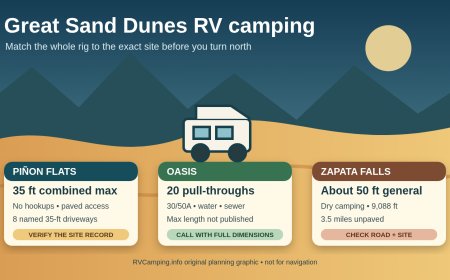
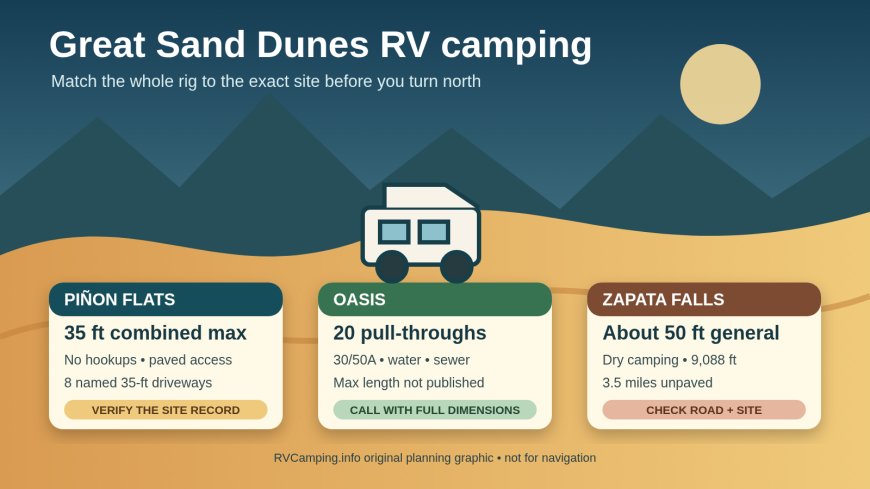
Piñon Flats is the best RV base for sleeping inside Great Sand Dunes, but it is not a big-rig campground. Recreation.gov applies a 35-foot ceiling to the complete RV or connected tow vehicle-and-trailer combination, and the National Park Service says only eight named sites have 35-foot driveways.[1][4] Most travelers with a longer setup should start with Great Sand Dunes Oasis. It has 20 pull-through, full-hookup sites just outside the entrance, though its official page does not publish a maximum rig length.[3][5] Zapata Falls is a scenic dry-camping alternative for some rigs, but the approach is 3.5 miles of unpaved road and the site-specific fit still matters.[6][7]
Short answer: Choose Piñon Flats when the exact Recreation.gov page confirms that the whole setup fits and you can camp without hookups.[1][4] Choose Oasis when water, sewer and 30/50-amp power matter more than staying inside the park.[3][5] Consider Zapata Falls only after accepting a rougher, higher approach and checking a named RV site; “about 50 feet” is broad campground guidance, not a promise for every spur.[6][7]
Great Sand Dunes RV campgrounds at a glance
| Question | Piñon Flats | Great Sand Dunes Oasis | Zapata Falls |
|---|---|---|---|
| Location | Inside the national park, one mile north of the visitor center[1] | Just outside the park entrance[3] | BLM campground 11 miles south of the visitor center[3] |
| Access | Paved highway and paved park access[2][9] | State Highway 150 address; confirm the operator's arrival directions[5] | 3.5-mile unpaved climb from Highway 150[7] |
| Rig screen | 35-foot total combined limit; only eight named 35-foot driveways[1][4] | 20 level pull-through RV sites; no official maximum length published[5] | RV loop generally handles configurations up to about 50 feet; exact spur varies[6][7] |
| Hookups | None[1][4] | Water, sewer and 30/50-amp electric at all RV sites[5] | None[7] |
| Water and waste | Potable spigots in each loop; seasonal fill hoses and dump station nearby[1] | Full hookups plus central dump station[5] | No drinking water; vault toilets[6][7] |
| Reservation | Required; no walk-up sites[1][4] | Call the operator; 48-hour notice is required for reserved bookings[5] | Recreation.gov reservation[3][7] |
| Season | April 1 through October 31[2] | NPS lists April through October[3] | Official pages call it year-round, but winter road conditions can make access unsuitable[3][6][7] |
These figures are screening rules, not a substitute for the selected campsite record. Measure the motorhome or trailer body, fixed rear rack, tow bar or tongue, tow vehicle and the length of the connected combination. At Piñon Flats, the connected number is the one that must stay at or below 35 feet.[4]
Piñon Flats: excellent location, tight geometry
Piñon Flats has 88 individual sites and three tent-only group sites.[1] The main loops take RVs and tents, but NPS describes 25 feet as the usual RV limit and then identifies a small set of longer driveways.[1] Recreation.gov is stricter about the campground-wide boundary: an RV over 35 feet, or a vehicle and trailer whose combined length exceeds 35 feet, is not allowed.[4]
The eight longest named driveways are sites 8, 39, 47, 60, 76, 77, 80 and 86.[1] NPS lists each at 35 feet total. That does not mean every 34-foot trailer is an automatic fit. A trailer needs a tow vehicle, and the complete connected setup must meet Recreation.gov's limit.[4] Nor does a 35-foot driveway answer questions about width, slide clearance, leveling or a second vehicle.
The booking warning is unusually plain: if your equipment is too large for the reserved site, staff may have no alternate space and you may have to camp outside the park.[4] Open the exact site record before paying. Check the driveway dimensions and photo, confirm the permitted equipment type, and make sure every vehicle can remain on pavement without extending into the loop road.[1][4]
Piñon Flats has no electric, water or sewer hookups.[1] Potable water spigots, flush toilets, restroom sinks and a dishwashing sink are available in all three loops, but there are no campground showers.[1] NPS says a dump station and water hoses operate near the campground in warmer months. Treat those as seasonal services and confirm they are operating before arriving with a full waste tank.[1]
Generators are allowed only during three windows: 8–10 a.m., noon–2 p.m. and 5–7 p.m.[1][4] A battery bank that cannot carry overnight loads may turn this scenic stay into a daily generator schedule. Solar can help, but trees, clouds and short fall days make output variable.
Reservations are mandatory, and both NPS and Recreation.gov say there is no first-come inventory.[1][4] Individual sites can be booked up to three months ahead.[1] The campground operates April 1 through October 31, so September 23 is within the normal season.[2] Availability on a calendar is not proof of fit; select by dimensions first and date second.
Great Sand Dunes Oasis: the nearby service upgrade
Oasis solves Piñon Flats' main service gap. The operator lists 20 level pull-through RV sites, all with water, sewer and 30/50-amp electric, plus a central dump station.[5] NPS places the campground just outside the national park entrance and lists showers, laundry, a restaurant and a store on the property.[3]
The catch is missing rig-length evidence. Neither official Oasis page used here nor the NPS area listing publishes a maximum accepted RV or connected length. “Pull-through” describes the traffic pattern, not guaranteed clearance for a 45-foot coach towing a car. Call 719-378-2222 with the full dimensions, slide count and tow plan, then ask for the assigned site's usable length and width.[5]
Oasis takes RV reservations by phone and says reserved bookings require 48 hours' notice.[5] NPS lists the campground as open April through October.[3] Because individual facilities can run on narrower dates or hours, confirm that the campground, hookups, showers and restaurant will all be operating for a shoulder-season stay.
This is the practical choice for a rig that fails Piñon Flats' combined-length rule or for travelers who need continuous shore power and sewer. The trade is simple: you sleep outside the park boundary and must verify fit by phone because the operator does not publish site dimensions.
Zapata Falls: more room on paper, rougher access
BLM describes 12 RV sites on one loop at Zapata Falls and says their gravel spurs vary in length. Its broad guidance is that the loop can generally accommodate RVs, trailers or other vehicle configurations up to about 50 feet.[6] Recreation.gov exposes the reservable records and identifies them as nonelectric RV sites.[7]
Do not turn “about 50 feet” into a site guarantee. Pick a specific RV-loop record, review its current equipment limits and images, and keep the whole connected setup within what that record can hold. The campground has no hookups and no public drinking-water system.[6][7] Bring the full water supply needed for the stay and plan tank capacity without assuming a dump station.
Access is the larger distinction. The campground sits at about 9,088 feet, reached by 3.5 miles of unpaved road from Highway 150.[7] BLM calls roads within the recreation area improved gravel, while NPS calls the approach bumpy dirt and warns that it is not plowed in winter.[3][6] A long rear overhang, low stabilizers or a heavily loaded trailer can make that climb a poor match even when the parking spur is long enough.
Official pages call the facilities open year-round.[6][7] That is an operating label, not a promise of easy winter access. Check weather and road conditions, then use the BLM contact number if snow, ice or recent washboarding could affect the climb.[3] Zapata Falls makes sense for a self-contained rig whose driver is comfortable with the road. It is not the fallback for every RV rejected by Piñon Flats.
Access and weather checks before departure
Use Highway 150 from the south or County Road 6 from the west to reach the main park area; NPS says both are paved.[9] The park specifically warns drivers not to trust mapping software that routes them onto primitive roads or hiking trails in the mountains.[9] Keep the official area map available offline and compare any GPS shortcut against it before turning.
Weather matters even during Piñon Flats' open season. Spring can bring snow and strong afternoon wind.[8] Summer afternoons can bring thunderstorms, lightning and very hot sand, while nights can fall into the 40s.[8] In fall, NPS reports nights commonly in the 20s and 30s and occasional storms with icy rain or snow.[8] Check the point forecast for the visitor center and campground elevation, not only the forecast for Alamosa.
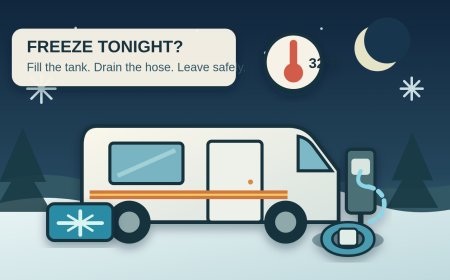
For the RV itself, retract awnings before leaving camp, secure exterior gear and allow for cold-night battery and propane demand. At Zapata Falls, add the unpaved approach to the weather check. At Piñon Flats, confirm that the seasonal dump and fill service is open. At Oasis, verify service dates directly with the operator.
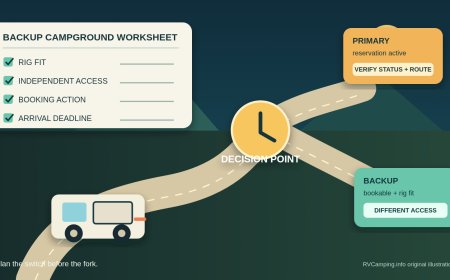
A booking sequence that prevents a bad arrival
- Measure the full connected combination, not just the trailer or coach.
- Reject Piñon Flats if that number exceeds 35 feet.[4]
- If it is 35 feet or less, open the exact Recreation.gov site record and compare equipment type, driveway dimensions, photo and parking rules.[1][4]
- For one of the eight 35-foot Piñon Flats driveways, make sure the tow vehicle is included in the calculation.[1][4]
- If hookups are required, call Oasis with the complete measurements and get confirmation for the assigned pull-through.[5]
- If considering Zapata Falls, verify both the named site and the current condition of the unpaved climb.[6][7]
- Recheck weather, road alerts and seasonal water or dump availability shortly before departure.[1][3][8]
Piñon Flats wins on location, not capacity. Oasis is the cleanest nearby answer for hookups and longer combinations, although its unpublished site dimensions require a phone verification. Zapata Falls offers a federal dry-camping alternative with broader length guidance, but its elevation and road make it a separate access decision rather than an easy overflow lot.
Editorial note: Campground rules, services and operating language were checked September 23, 2026. Recommendations are RVCamping.info analysis. No firsthand stay, road inspection or campsite measurement is claimed.
Sources
- Piñon Flats Campground, National Park Service — Site count, named 35-foot driveways, amenities, hookups, generator hours and booking cautions. Accessed September 23, 2026.
- Camping, Great Sand Dunes National Park and Preserve — Paved access, reservation requirement and April 1–October 31 operating season. Accessed September 23, 2026.
- Area Campgrounds, National Park Service — Official nearby-campground distances, seasons, services and Zapata Falls winter-road caution. Accessed September 23, 2026.
- Piñon Flats Campground, Recreation.gov — Current reservation rules, 35-foot combined limit and exact-site warning. Accessed September 23, 2026.
- Camping and lodging, Great Sand Dunes Oasis — Operator's RV-site count, pull-through configuration, hookups, dump station and phone-booking terms. Accessed September 23, 2026.
- Zapata Falls Campground, Bureau of Land Management — RV-loop count, approximate rig guidance, gravel facilities, water status and year-round language. Accessed September 23, 2026.
- Zapata Falls Campground, Recreation.gov — Reservable site types, no-hookup notice, elevation and unpaved-road directions. Accessed September 23, 2026.
- Weather, Great Sand Dunes National Park and Preserve — Seasonal temperature, wind, storm, lightning and snow context. Accessed September 23, 2026.
- Directions, Great Sand Dunes National Park and Preserve — Paved approach roads and warning against unsafe mapping shortcuts. Accessed September 23, 2026.
What's Your Reaction?