




Upper Pines, Lower Pines, or North Pines: which Yosemite Valley campground fits your RV?
Compare Upper Pines, Lower Pines, and North Pines by exact RV and trailer fit, dry-camping services, season, dump access, and 2026 reservation method.


Upper Pines, Lower Pines, or North Pines: which Yosemite Valley campground fits your RV?
By Romana
Category: Campgrounds
By Romana | September 24, 2026
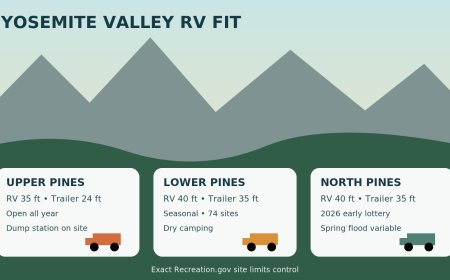
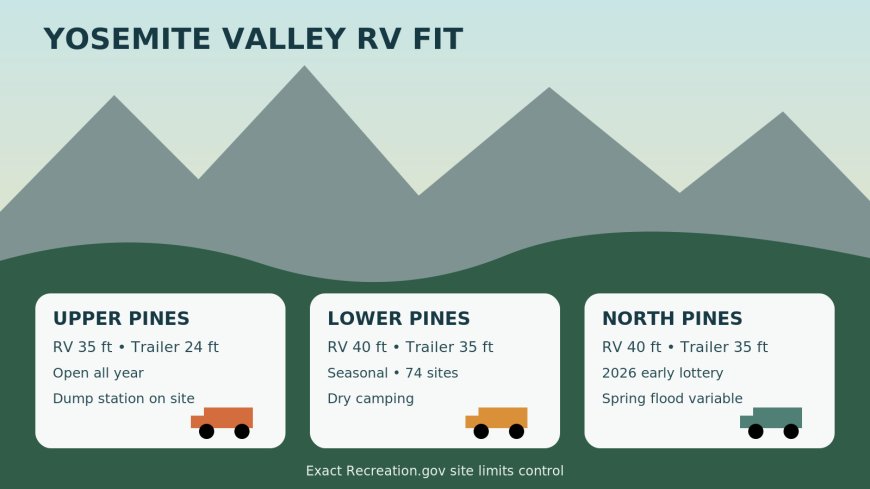
For the largest rigs, Lower Pines and North Pines have the broadest campground-level limits: RVs up to 40 feet and trailers up to 35 feet. Upper Pines tops out at 35 feet for an RV and 24 feet for a trailer.[1] Those are screening ceilings, not site guarantees. The exact Recreation.gov listing controls, and Yosemite warns that turning room can make the trailer limit shorter than the motorhome limit at the same site.[5]
Once your rig fits, the choice is mostly about season and reservation method. Upper Pines is the only one open all year. Lower Pines and North Pines are seasonal. North Pines used an early-access lottery for every 2026 reservation, while Upper and Lower Pines used the usual five-month release.[1][2][8]
Checked September 24, 2026: Operating dates, closures, flood exposure, and reservation methods can change. Search the exact dates and site on Recreation.gov before treating any campground-wide number as available inventory.
The short decision
Choose Upper Pines when you need an all-year option, have a trailer no longer than 24 feet, or want the dump station at the campground rather than nearby.
Choose Lower Pines when the 40-foot motorhome or 35-foot trailer ceiling matters and you prefer a smaller campground. It has 74 sites in the current NPS table, compared with 236 at Upper Pines.[3]
Choose North Pines when the same larger-rig ceiling works and you are willing to plan around its lottery history, seasonal operation, and the possibility that spring flood-prone sites will be held back.[1][5][8]
All three are dry campgrounds. No Yosemite campsite has electric, water, or sewer hookups.[3][4] If shore power is required, none of these is the right reservation.
Side-by-side RV comparison
| Decision factor | Upper Pines | Lower Pines | North Pines |
|---|---|---|---|
| Campground-level RV maximum | 35 ft | 40 ft | 40 ft |
| Campground-level trailer maximum | 24 ft | 35 ft | 35 ft |
| 2026 operation | All year | Apr. 21-Oct. 19 | Apr. 21-Oct. 26 |
| 2026 published fee | $36 | $36 | $36 |
| Published site count | 236 | 74 in NPS table | 81 |
| Hookups at site | None | None | None |
| Water and toilets | Tap water and regular restrooms | Tap water and regular restrooms | Tap water and regular restrooms |
| Dump station | At Upper Pines | Use nearby Upper Pines station | Use nearby Upper Pines station |
| Normal reservation pattern | Five months ahead on the 15th | Five months ahead on the 15th | Lottery in 2026; remaining inventory on normal releases |
| Best reason to choose | Year-round operation and on-site dump | Larger rig ceiling in a smaller campground | Larger rig ceiling plus a seasonal North Pines stay |
The NPS campground table supplies the dates, rates, site counts, water, and campground-wide length figures.[3] The park's Pines page contains one inconsistency worth keeping visible: its Lower Pines header says 74 total sites, while the RV information paragraph says 73.[1] That does not change the fit of an exact reservable site, but it is a good reason not to use a campground total as an inventory promise.
Rig fit: measure the equipment Recreation.gov asks about
Yosemite publishes separate motorhome and trailer limits because a back-in site can be easier for one type of equipment than another. Access roads and turning radius also matter.[5] A 35-foot motorhome is not evidence that a 35-foot travel trailer can enter the same site.
Before searching, record:
- motorhome length bumper to bumper;
- trailer length as the reservation system defines it, including the hitch if the listing calls for it;
- tow vehicle length;
- total connected length for route and staging decisions;
- slideout and awning sides;
- number of motor vehicles; and
- whether you need a level tent area in addition to the parking pad.
Yosemite allows no more than two motor vehicles at a campsite. A trailer does not count against that number if it fits on the pad, and every vehicle must be parked on a parking pad.[4] Overflow parking exists near the campgrounds, but the park says it can be very limited.[4]
Do not reserve by the 35- or 40-foot campground ceiling alone. NPS says not every site can take the published maximum and directs travelers to filter by equipment length and read the site details.[1] Its reservation FAQ goes further: if an oversize RV cannot be maneuvered into the reserved site, staff may have no replacement to offer.[5]
A label such as "standard nonelectric" is not a promise of generous RV space. Yosemite says these sites can accept tents or RVs, but many large RVs and trailers will not fit. "RV nonelectric" usually means the site lacks a suitable or level tent area, while a tent-only listing does not allow an RV.[5]
Upper Pines: the practical year-round choice
Upper Pines has the smallest trailer ceiling in this comparison: 24 feet. Its motorhome ceiling is 35 feet.[1] That immediately removes it for many longer towables even when the motorhome number looks comfortable.
Its operational advantage is substantial. NPS lists Upper Pines open all year and on reservations all year.[2][3] In winter, that avoids building a Valley plan around the seasonal openings of Lower and North Pines.
Upper Pines is also the service hub for these three dry campgrounds. Recreation.gov lists paved roads and spurs, flush toilets, drinking water, food lockers, and a free on-site dump station with potable water.[6] There are still no hookups at individual sites.[6] Curry Village has fee showers, food, and other services nearby, and the free shuttle stops at the campground entrance.[6]
Upper Pines is not the "big rig" default simply because it is the largest campground. Its 24-foot trailer ceiling is the lowest of the three. It is the strongest choice for a qualifying rig that values year-round operation and the shortest dump-station trip.
Lower Pines: more length, fewer sites
Lower Pines raises the campground-level ceiling to a 40-foot RV or 35-foot trailer.[1] For a 30-foot-plus trailer, that may be the only relevant distinction between it and Upper Pines.
The campground is seasonal. NPS currently lists April 21 through October 19 for 2026, with 74 sites and a $36 fee.[3] It has paved spurs, flush toilets, drinking water, food lockers, an amphitheater, and shuttle access; fee showers and food are within walking distance at Curry Village.[7] The dump station is at Upper Pines rather than at each campsite.[3]
Lower Pines is exposed to a booking wrinkle in May and June. The park says spring flooding can inundate parts of Lower Pines and especially North Pines, so affected sites may be withheld until water levels are known. Some may appear only days before arrival.[5] That is not dependable backup inventory for a long RV trip, but it is a reason to keep checking cancellations and newly released sites.
Choose Lower Pines when its larger equipment ceiling is necessary and the exact pad works. Do not choose it solely for a quieter or prettier experience; those qualities vary by site and date and are not guaranteed by the official records.
North Pines: same published fit, different booking risk
North Pines shares Lower Pines' campground-level limits: a 40-foot RV and 35-foot trailer.[1] It has 81 sites, and NPS lists a 2026 season from April 21 through October 26.[3]
The reservation path is the main difference. For 2026, all North Pines inventory entered an early-access lottery. Recreation.gov says any inventory left after that process returned to normal on-sale dates beginning with the February 15 release.[8] The NPS page describes the same 2026 lottery rule.[1]
Do not assume the 2026 lottery will repeat unchanged. For a later season, check Yosemite's reservation page first, then the live Recreation.gov listing. When North Pines is not using a lottery, Recreation.gov says the normal release is five months ahead on the 15th at 7 a.m. Pacific.[8]
North Pines has paved roads and spurs, flush toilets, drinking water, food lockers, and nearby shuttle access. It has no campsite hookups; the free dump station and potable water for dumping are nearby at Upper Pines.[8]
Its spring-flood exposure is the other variable. NPS specifically says North Pines has more sites affected by May and June inundation than Lower Pines.[5] A reservation already in hand is useful; hoped-for late inventory is not a route plan.
Services are nearly tied, and generators are tightly timed
None of the three offers campsite hookups.[3][4] All have tap water and regular restrooms, plus food lockers and nearby access to Curry Village services.[1][3] Showers are available for a fee at the Curry Village pool showerhouse, not inside these campgrounds.[3]
The meaningful service difference is dump-station distance: Upper Pines has it on site; Lower and North use the Upper Pines facility.[3][6][8]
Generator users need to plan around three narrow windows. Yosemite permits operation only from 7-9 a.m., noon-2 p.m., and 5-7 p.m.[4] A dry-camping power plan that requires a long afternoon run will not work here. Estimate battery, furnace fan, refrigerator controls, water pump, device charging, and medical loads before booking.
Wood fires in Yosemite Valley are restricted to 5-10 p.m. from May through September, when fire restrictions are not otherwise in effect. Stoves and charcoal fires can be used around the clock under the campground rules.[4]
Reservation choices for 2026 and later
Upper Pines and Lower Pines follow Yosemite's five-month batch release on the 15th at 7 a.m. Pacific. The release covers a month-long arrival block, and the sites commonly sell within minutes.[2][6][7]
North Pines was different in 2026 because of the early-access lottery.[1][8] Remaining sites used the ordinary release schedule. A cancellation can still return inventory, but it is not safe to arrange a long tow on the assumption one will appear.
Use this booking order:
- Eliminate any campground whose published RV or trailer ceiling is below your equipment length.
- Enter the correct equipment type and length in Recreation.gov.
- Open the individual site record. Check pad dimensions, back-in or pull-through layout, vehicle count, alerts, and photos.
- Confirm that every wheel can remain on the pad and that the turn into the site is realistic.
- Decide whether your batteries and tanks can handle a no-hookup stay under Yosemite's generator windows.
- Save the confirmation and the site details you relied on.
- Recheck campground status and road conditions before departure.
A campsite reservation does not remove the need to pay the park entrance fee.[6][8] If arrival slips by a day, call the campground. Yosemite requires check-in by the morning after the first reserved night or the reservation can be forfeited.[4][5]
Bottom line
For a motorhome from 36 to 40 feet, Lower Pines and North Pines are the only two campground-level candidates. For a trailer from 25 to 35 feet, the same is true. Upper Pines is the best operational choice for a qualifying smaller rig because it runs all year and contains the dump station.
Between Lower and North, exact site fit comes first. Then choose by season and by the reservation you can actually secure. Their official service lists are too similar to justify forcing a preference that the pad, flood status, or booking method cannot support.
Source credit: RVCamping.info compared current National Park Service and Recreation.gov records on September 24, 2026. The constraint-first fit test and booking sequence are original editorial analysis.
Sources
- [1] Pines Campgrounds - Yosemite National Park (National Park Service; accessed September 24, 2026).
- [2] Campground Reservations - Yosemite National Park (National Park Service; accessed September 24, 2026).
- [3] Campgrounds - Yosemite National Park (National Park Service; accessed September 24, 2026).
- [4] Campground Regulations - Yosemite National Park (National Park Service; accessed September 24, 2026).
- [5] Campground Reservation FAQ - Yosemite National Park (National Park Service; accessed September 24, 2026).
- [6] Upper Pines Campground (Recreation.gov; accessed September 24, 2026).
- [7] Lower Pines Campground (Recreation.gov; accessed September 24, 2026).
- [8] North Pines Campground (Recreation.gov; accessed September 24, 2026).
What's Your Reaction?