





One Campground, Separate Circuits: a Power Plan for RV and Glamping Groups
An arrival-day plan for mixed RV, cabin, yurt and tent groups to verify outlets, protect medical and phone charging, avoid cross-accommodation cords and prepare for an outage.

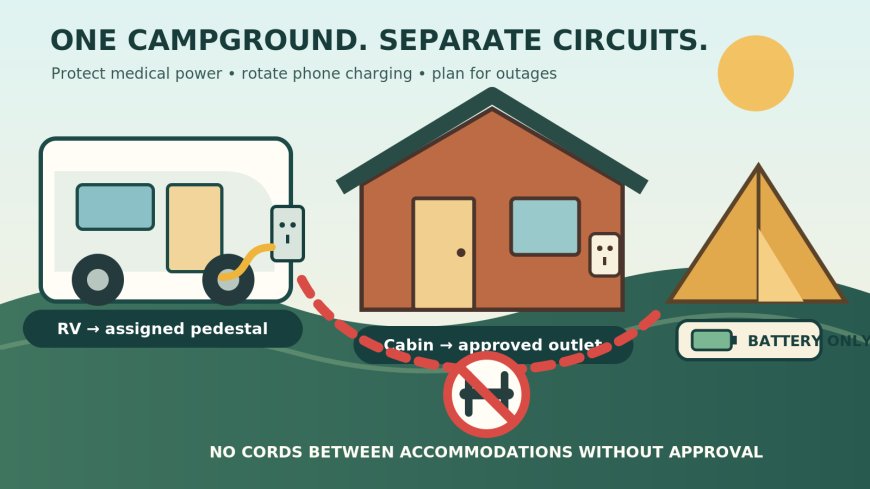

Verify each accommodation's outlets, protect medical and phone charging, and decide how the group will respond before campground power fails.
One campground, separate circuits: a power plan for RV and glamping groups
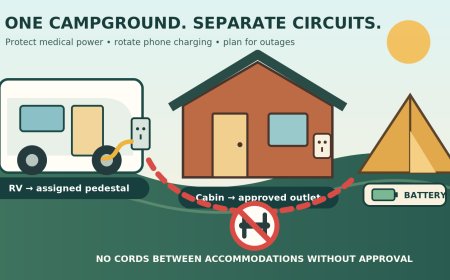
A mixed-lodging group needs a power plan, not a web of cords. Keep the RV on its assigned hookup. Keep each cabin, yurt or furnished tent on the supply the operator provides for that unit. Treat ordinary tent sites as unpowered unless staff says otherwise.[1] Then reserve limited backup energy for medical equipment and communication.[5]
That arrangement may feel fussy when everyone is parked a few steps apart. It is still easier than sorting out a tripped circuit at 2 a.m. while a CPAP user needs power and six phones are nearly empty.
This guide picks up after the reservation is made. The earlier RV and glamping electrical checklist covers booking compatibility and appliance rules. Here, the job is to turn the operator's answers into a workable arrival-day plan, set priorities and decide what the group will do if campground power fails.
Ask what an outlet is allowed to do
"Electricity" can describe installed lights, heat, a general receptacle, a small-device outlet or a restricted medical supply.[2][3] Those are different promises.
Wallowa Lake State Park shows why the label needs context. Its yurt description mentions outlets for small electronics, but it also bars appliances and cooking inside. The same page says tent/non-hookup sites have no utilities and tells visitors who depend on power to reserve suitable lodging or bring a battery pack.[2] At Great Smoky Mountains National Park, three campgrounds have 5-amp receptacles reserved for medical equipment.[3] Neither example authorizes a guest to turn the nearest socket into group power.
For every sleeping unit, record these answers from the property:
- Does this exact cabin, yurt or furnished tent have a guest-usable receptacle?
- Does it remain on overnight?
- Is it limited to phones and similar small electronics, or may it support the named device?
- Are installed heat, air conditioning or a refrigerator on the same circuit?
- May guests use a power strip, battery charger or extension cord?
- Where may charging equipment sit, and must it be unplugged when the unit is empty?
Get the answer in a reservation note or email. A photo of the receptacle after arrival does not answer any of those questions.
Draw the site as separate power islands
Sketch the booked units before unloading. Give each one a box and write its approved supply inside: "RV pedestal, RV only," "Cabin outlet, phones plus approved CPAP," or "Tent, battery only." Mark the office, storm shelter and any charging location staff identifies.
Do not draw a line between accommodations unless the operator has approved both the source and the route.[1] Pinnacles National Park, for example, allows electrical cords only at RV sites and expressly forbids connections to campground restroom receptacles.[1] A vacant pedestal, bathhouse socket or neighboring cabin outlet is not spare capacity.
Use a simple boundary at camp:
- The RV cord serves the RV.
- Cabin and yurt guests use only receptacles assigned to their unit.
- Tent guests use their own charged batteries unless the operator provides an approved tent connection.
- Nobody lends power by opening an RV window, crossing a path or feeding a cord under another unit's door.
- Staff approves any exception before a plug is inserted.
Operator permission comes first because a cord cannot change an occupancy rule, circuit assignment or appliance restriction. Even a technically adequate cord can be prohibited in that location.
Sort loads before the first plug goes in
Make one list for the entire group. Read the input information on each device or its power adapter, and include installed equipment that staff says shares the circuit. Avoid estimates based on what a similar product usually draws.
Assign each item to one of four buckets:
| Priority | Examples | Group rule |
|---|---|---|
| 1. Medical | CPAP, oxygen-related equipment, mobility-device charger, medicine cooling specified by a clinician | Preserve the approved supply and documented backup for the individual device. |
| 2. Communication | One primary phone per sleeping unit, weather radio, accessibility communication device | Charge in shifts; keep at least one working contact device with each lodging cluster. |
| 3. Basic comfort | Approved lights, installed fan or heater, small personal electronics | Use only within the accommodation's rules and remove first if capacity is uncertain. |
| 4. Optional or high draw | Kettle, hair dryer, countertop cooker, portable heater, e-bike battery | Leave unplugged unless the operator specifically approves the device and location. |
A medical label does not make equipment electrically compatible with any available outlet. The plan still needs the exact device instructions, its approved power accessories and a circuit the operator permits.[3][6]
Ready.gov advises households to decide which equipment gets power first because not everything may run at once.[7] For a campground group, settle that order while power is normal. Do not make the person with a medical need negotiate against a coffee maker after a breaker trips.
Give medical power its own plan
Ask the traveler privately what help they want. One coordinator should know the device name, required operating schedule, approved power options, where the instructions are kept and whom to call.[5] Do not ask the whole group to interpret medical requirements.
Before travel, the device user or caregiver should confirm the outage plan with the clinician, supplier or manufacturer. The FDA directs users to consult the instructions or device company about battery or generator operation.[6] The American Red Cross recommends an inventory of electrical needs, backup or non-powered alternatives, a provider discussion and an evacuation decision that preserves power-dependent care.[5]
Write down:
- the device and power-supply model;
- input shown on the approved adapter;
- expected hours of use;
- battery type, tested runtime and recharge method stated by the manufacturer;
- whether a power interruption changes therapy or requires a device check;
- supplier, clinician and emergency contact numbers;
- the nearest confirmed place that can support the need if the campsite loses power;
- the point at which the traveler will leave rather than wait for restoration.
Keep backup power for that device separate from the phone-charging pool. Label it. Charge it before departure and check it by the device maker's procedure.[5][6] Do not promise a runtime that has not been verified for the exact device, battery condition and settings.
If the device cord, connector or housing becomes wet or damaged, stop and follow its instructions. FDA guidance says not to connect a wet device or cord and advises checking device settings after electricity returns because an interruption can cause some equipment to revert to defaults.[6]
A campground receptacle marked for medical use is not unlimited. The Smokies' 5-amp example is a reminder to disclose the actual device and ask what the outlet can support.[3]
Treat phones as safety equipment, not a charging free-for-all
Pick one primary phone for the RV and one for each separate sleeping unit. Put the campground number, after-hours contact, device supplier, local emergency number and an out-of-area group contact on paper as well as in the phones.
Arrive with phones and power banks full. Ready.gov recommends charging electronics before an outage and arranging another charging source.[7] The Red Cross also recommends communication gear that works without utility power, including phone batteries or chargers and a battery or crank radio.[5]
Use a charging roster:
- Primary contact phones charge first.
- Accessibility communication devices follow their user's required schedule.
- Other phones rotate through the approved small-device outlets.
- Tablets, speakers, cameras and recreational gear wait.
Set a group check-in time so people do not drain batteries sending repeated location updates. Download maps, reservation details and emergency contacts before reaching camp. If service is weak, one phone can remain in reserve rather than every handset searching continuously for a signal.
Do not move a medical plug to make room for a phone charger. Do not add a multi-outlet adapter unless the operator allows it and the connected equipment stays within every applicable rating.[4]
An extension cord is not a bridge between camps
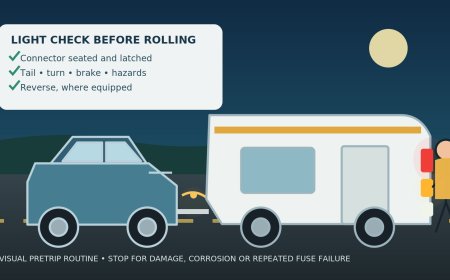
The default is no cross-accommodation cord. Ask staff before using any extension cord, even if the route looks short and the device seems small. Approval should identify the source receptacle, destination, connected device and safe route.
If the operator permits a cord, follow the device instructions and the cord label. CPSC says the connected load must not exceed the cord rating, grounded appliances need the grounding conductor intact, and outdoor use calls for an outdoor-labeled cord. It also recommends GFCI protection and rejects covering cords with rugs because trapped heat cannot escape.[4]
At a campsite, add practical route checks:
- Keep plugs and couplings dry and away from puddles.
- Do not run the cord through a door, window, vehicle lane or common walking path.
- Keep it away from tent stakes, sharp edges, grills and fire rings.
- Never bury it, tape over damage or remove the grounding pin.
- Stop using it if the jacket is cut, the plug is loose, or any part becomes hot.
Cord protection is not permission. If staff cannot approve a route between units, the answer is to move the device, change the lodging assignment or use an approved battery system. It is not to hide the cable under a mat.
Build the outage fallback before bedtime
Post a one-page outage card in the RV and give every lodging unit a photo or paper copy. It should name the coordinator, medical-power lead, communication phones, staff contact, backup location and departure trigger.[5]
When power fails:
- Confirm that people are safe. Use flashlights, not improvised flames.
- Ask staff whether the outage affects one unit, one loop or the property. Do not open a pedestal or repeatedly reset campground protection.
- Disconnect optional equipment. Leave medical equipment connected only when its instructions and the approved backup plan call for it.
- Start the medical backup clock and record the time. Contact the supplier or clinician when the written plan says to do so.
- Put phones into the agreed conservation routine. Keep one device available for campground updates and emergency calls.
- Move to the confirmed powered location or leave when the medical, heat, cold, smoke or weather trigger is reached. Do not wait for the last battery indicator.
- After restoration, reconnect in the operator's approved order and verify medical-device settings before use.[6]
The Red Cross advises people to plan a support network, keep a paper contact list and evacuate when temperature or powered medical needs make staying unsafe.[5] A campground plan should name the actual person, vehicle and destination instead of relying on "we'll figure it out."
Do not assume a generator is the fallback. Many properties restrict or ban them; Wallowa Lake prohibits generator use and points power-dependent visitors toward suitable reservations or batteries.[2] If a property allows a generator, only the operator and the generator/device instructions can define where and how it may be used. Ready.gov says generators belong outdoors at least 20 feet from building openings.[7] Never place one beside a tent, RV, yurt, cabin door or window.
The five-minute check at arrival
Before anyone plugs in, the coordinator and a staff member should review the actual assignments:
- Each RV, cabin, yurt and tent matches the reservation.
- Staff confirms which units have usable receptacles and what each one may power.
- The RV is the only load on its assigned RV connection unless staff documents another arrangement.
- Medical equipment has an approved normal supply, charged backup and departure plan.
- Primary phones and backup batteries begin the stay charged.
- No cord crosses between accommodations, roads, paths or common buildings without specific approval.
- Everyone knows the outage card location and check-in point.
If the physical setup differs from the email, pause and revise the plan with staff. Moving a cord is not a substitute for moving a person to lodging with the right service.
Safety boundary: This is a coordination checklist, not permission to alter campground wiring, inspect a live pedestal or design a medical power system. Follow the property rules and the instructions for the exact RV, device, battery and accessory. Call emergency services for a life-threatening interruption or symptoms, and leave early when the documented backup cannot support the required care.
Sources
- Campground Rules: Pinnacles National Park (accessed September 23, 2026)
- Wallowa Lake State Park (accessed September 23, 2026)
- Frontcountry Camping: Great Smoky Mountains National Park (accessed September 23, 2026)
- Limit Extension Cords To Reduce Risk Of Fire (accessed September 23, 2026)
- Power Outage Safety (accessed September 23, 2026)
- FDA Offers Tips about Medical Devices and Natural Disasters (accessed September 23, 2026)
- Be Prepared for a Power Outage (accessed September 23, 2026)
What's Your Reaction?