



The Mixed RV-and-Yurt Booking Worksheet: Match the Rules Before the Group Arrives
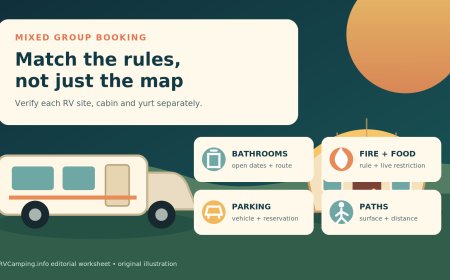
Compare bathrooms, cooking and fire rules, vehicle allowances, seasonal services and accessible paths for every RV site, yurt or cabin before a group books.

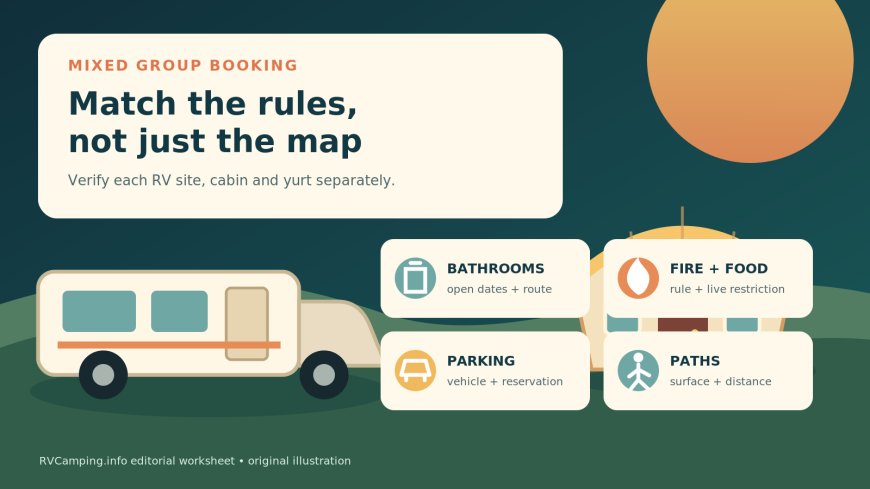
The mixed RV-and-yurt booking worksheet: match the rules before the group arrives
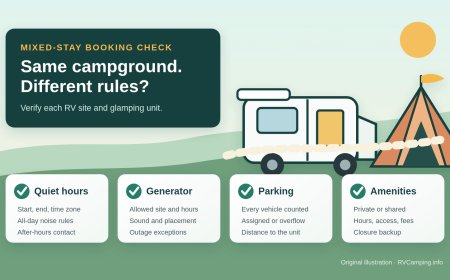
An RV site and a yurt or cabin in the same park do not necessarily share the same bathroom setup, cooking permissions, fire rules, parking allowance or accessible route. Book the pair only after one person has verified each amenity for each sleeping unit, recorded the answer, and assigned the group’s workarounds.
Mixed lodging solves a real group problem. The RV travelers keep their own bed, kitchen and bathroom. Friends who do not own a rig get a roof, heat and a door that locks. Trouble starts when the group treats those two reservations as one product.
They are often separate products with separate rules. The RV might have water and a galley while the yurt has neither. A campsite fire ring does not prove fires are allowed beside the cabin. An accessible cabin label does not describe the route to the shower. “Nearby parking” does not say whether the cabin booking includes enough spaces for the people assigned to it.
The useful question is not “Does the park have this amenity?” It is “Which booked unit has it, when is it available, and who in our group depends on it?”
Use a unit-by-unit worksheet, not a park amenity list
Copy this table into a shared document before anyone pays. Make separate columns for the exact RV site and exact roofed unit. If the reservation system has not assigned unit numbers, use the reservable site types and replace them with numbers as soon as the park does.
| Verify for the trip dates | RV site [number/type] | Yurt/cabin [number/type] | Group decision and proof |
|---|---|---|---|
| Toilet type and location | map, seasonal notice, staff reply | ||
| Shower availability and hours | |||
| Drinking-water source | |||
| Dishwashing location | |||
| Cooking allowed indoors? | |||
| Outdoor stove/grill allowed? | |||
| Fire ring present? | |||
| Current fire restriction | dated alert or recorded phone call | ||
| Fire permit or purchased wood required? | |||
| Vehicles included | |||
| Extra vehicle or RV-pad fee | |||
| May anyone sleep in an overflow vehicle? | written rule | ||
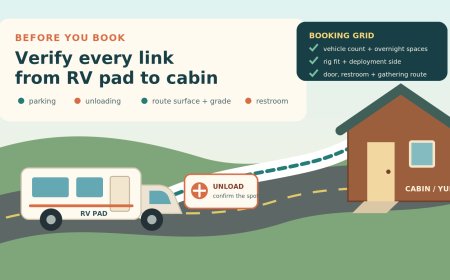
| Route to toilet/shower | distance, surface, grade, steps, lighting | ||
| Route between the two units | |||
| Accessible unit features | exact features, not a label alone | ||
| Seasonal closures or outages | effective dates | ||
| Recheck date and responsible person | name and deadline |
Use four answer codes: yes, no, unknown, and conditional. “Conditional” needs the condition beside it: gas stove only, fire permit required, restroom open only during the main season, one vehicle included, or accessible route confirmed only from one parking area.
Do not convert “unknown” into “probably.” An unanswered restroom question is still an unanswered restroom question.
Official listings show how sharply the rules can split
The point of these examples is not to rank parks. It is to show how a few familiar words can hide different operating plans.
| Official example | Bathroom and water | Cooking and fire | Parking, RV or access detail | What a mixed group still has to settle |
|---|---|---|---|---|
| Oregon State Parks rustic cabin/yurt | Shared campground restrooms and showers described as a short walk away | No cooking inside; yurts have an outdoor fire pit and picnic table | One vehicle is included; most parks allow one extra for a fee; designated ADA units have entrance ramps and accessible restrooms | Exact route, current fire restrictions, second-car plan and whether the shared restroom is open on the trip dates |
| Seaquest State Park yurts, Washington | Bathrooms and showers are described as nearby | No indoor cooking; each yurt has an outdoor fire pit with grate | All five yurts are walk-in with parking nearby | Walking distance, path condition, how food reaches the yurt and whether a current burn ban changes dinner plans |
| Pacific Beach State Park yurts, Washington | Bathrooms and showers are described as nearby | No indoor cooking and no fires in the park | A 30-amp RV pad with hookup is available for an additional fee | Whether the paid RV pad is tied to the yurt booking, where cooking is permitted without fire, and the route between sleeping units |
| Bruneau Dunes State Park cabins, Idaho | Water and restroom/shower facilities are unavailable from mid-October through mid-March; vault toilets remain nearby | Every rental has its own outdoor table and designated fire ring | The official page lists different check-in times for campsites and cabins | A cold-season water, hygiene and toilet plan, plus a split-arrival plan |
| Lake Vermilion-Soudan camper cabins, Minnesota | No indoor plumbing; cabins share a year-round heated restroom/shower building; its fill station is not a kitchen-prep or dishwashing sink | Outdoor counter, electrical outlet and fire ring with grill; campfires need a daily permit | Two cabins are identified as accessible; parking is described as very limited | Dishwashing plan, permit owner, vehicle count and the specific accessible route to shared facilities |
Oregon’s statewide cabin-and-yurt page is a compact example of rule layering. Rustic units use shared bathrooms and prohibit indoor cooking, while deluxe units add a private bathroom and a kitchenette where only the supplied microwave may be used. The same page says one vehicle is included and identifies designated accessible units by entrance ramps and accessible restrooms.[1] A group that reserves “a yurt” without recording the subtype can easily plan around amenities it did not buy.
Seaquest’s five yurts are all walk-in, with parking and bathrooms described only as nearby. They have outdoor fire pits, yet cooking is not allowed inside.[2] Pacific Beach’s yurts also prohibit indoor cooking, but that park says fires are not allowed at all. Its listing mentions a 30-amp RV pad for an extra fee.[3] The same lodging form, in the same state system, leads to two different meal plans.
Season can change the answer again. Bruneau Dunes cabins have fire rings, but the park says water and restroom/shower facilities are unavailable from mid-October through mid-March, with vault toilets nearby.[4] At Lake Vermilion-Soudan, the cabin bathroom is shared and heated year-round, but the building has no kitchen-prep or dishwashing sink. Parking is very limited, and a campfire requires a daily permit.[5]
These listings provide facts. They do not complete the group plan. “Nearby,” “accessible” and “available for an additional fee” are prompts for follow-up, not finished answers.
Verify bathrooms as a chain of tasks
A bathroom entry needs more than a toilet icon. Record:
- which toilet and shower building the roofed-unit guests are expected to use;
- whether it is open on every trip date and at the hours the group needs;
- the route from each sleeping unit, including distance, surface, grade, steps, road crossings and lighting;
- whether a key, code, coin, token or separate fee is required;
- whether the building supplies potable water, a handwashing sink, a dishwashing sink, showers, or only some of those;
- what changes during winterization, maintenance or an outage; and
- the backup if a traveler cannot use that route or fixture.
Keep personal requirements private, but make the facility questions specific. Ask staff for measurable facts. The traveler, not the reservation agent, decides whether those facts work.
A cabin marked accessible and a restroom marked accessible may still leave the connecting route undocumented. Ask whether the same continuous route connects the assigned parking space, cabin entrance and restroom. Get the surface, steepest section, narrowest point, steps or thresholds and after-dark lighting. If staff cannot confirm it, keep the worksheet entry as unknown.
Split “cooking” from “fire”
Groups often ask one question: “Can we cook?” That is too broad. Break it into six lines:
- cooking inside the yurt or cabin;
- using the installed microwave or kitchenette;
- using a portable gas stove outdoors;
- using a charcoal grill;
- using the provided fire ring or grate; and
- having a recreational fire that is not needed for cooking.
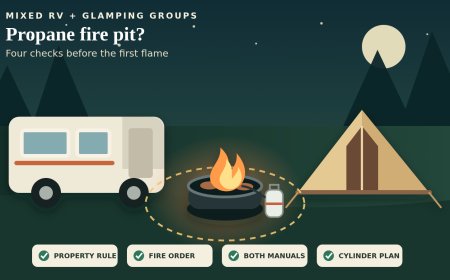
A unit can have a fire ring while a temporary restriction prohibits its use. A park can ban fires while allowing some self-contained gas appliances. A “no indoor cooking” rule may still permit only a specific outdoor location. Verify the standing lodging rule and the dated fire alert separately.
Assign one person to check restrictions 72 hours before departure and again on arrival day. That person also tells the group what fuel and appliances not to pack. Do not let every household interpret the alert independently.
Build the no-flame meal before the trip, not in the check-in lane. Decide where food will be stored, prepared, eaten and washed up. If cabin guests will use the RV galley, confirm that the RV site’s occupancy and visitor rules allow it, then schedule access so the RV occupants do not become an all-day kitchen crew.
Count parking by reservation, not by household
This article is not a rig-unloading guide. The parking job here is narrower: reconcile the vehicle allowance attached to each reservation.
List the RV itself, each tow or towed vehicle, and all cars used by cabin guests. Beside each one, write the reservation under which it will park, the legal overnight location and any fee. Then ask whether an overflow vehicle may contain sleeping occupants. Do not assume an extra parking fee buys another sleeping space.
If an RV pad is advertised as an optional yurt amenity, ask what the fee actually reserves: an occupied RV site, utility use, parking only, or something else. Confirm the booking process and whether the RV counts toward the yurt’s occupancy. Keep the answer with the receipt.
Give every mismatch an owner
A worksheet without names becomes a list of surprises. Assign these roles before the cancellation deadline:
- Reservation lead: holds both confirmation numbers, unit numbers, cancellation dates and park replies.
- Bathroom and access lead: confirms seasonal operation and route details with the travelers who will use them.
- Food lead: turns cooking and dishwashing rules into a menu, equipment list and cleanup location.
- Fire-check lead: checks the official restriction near departure and on arrival day.
- Vehicle lead: reconciles every vehicle with an included or paid overnight space.
One person can hold several roles in a small group. The names matter because a vague “somebody should call” rarely survives a busy week.
Use a simple timing sequence:
- Before payment: settle deal-breakers, including bathroom operation, indoor-cooking rules, fire alternatives, vehicle allowance and required route facts.
- Before free cancellation ends: replace every material unknown with written confirmation or choose another unit.
- Seven days out: verify assignments, seasonal services and group equipment.
- Seventy-two hours out: check fire restrictions, weather-related route changes and outages.
- Arrival day: check the park alert again and brief the group before vehicles split toward different loops.
Send one message that names both reservations
A single note reduces contradictory answers:
We are considering RV site [number/type] and [yurt/cabin number/type] for [dates]. Please confirm for each unit: the open toilet and shower facilities; drinking-water and legal dishwashing locations; indoor and outdoor cooking permissions; the provided fire ring or grill and current restriction source; included vehicles, extra fees and legal overnight parking; and the route from parking to the roofed unit, restroom and RV site, including distance, surface, grade, steps and lighting. Please also identify seasonal closures or outages that affect our dates. We will have [vehicle list] and need [specific route or fixture facts].
Save the reply with the two confirmations. Add the page URL and retrieval date beside every rule copied from a website. If staff answers by phone, record the park, staff member, date, time and exact unit discussed.
The booking gate
Pay only when the worksheet can answer five questions without guesswork:
- Where will every person use a toilet and shower, and can they reach it?
- Where will every meal be stored, cooked and cleaned up under the unit rules?
- What is the plan if the current fire restriction removes the preferred cooking method?
- Where will every vehicle legally stay overnight, and what does each space cost?
- Who owns each recheck, and when will it happen?
A mixed RV-and-yurt trip does not need identical amenities. It needs known differences and agreed workarounds. The worksheet is finished when the group can explain the trip without borrowing an amenity, route or permission that belongs to a different reservation.
Sources
- Oregon State Parks, Cabins and Yurts; statewide lodging amenities, vehicle allowance and accessibility notes. Accessed September 20, 2026.
- Washington State Parks, Seaquest Yurts; walk-in access, shared facilities, cooking and fire-ring details. Accessed September 20, 2026.
- Washington State Parks, Pacific Beach Yurts; no-fire rule, indoor-cooking restriction and optional RV pad. Accessed September 20, 2026.
- Idaho Department of Parks and Recreation, Bruneau Dunes State Park; cabin amenities and seasonal restroom/water shutdown. Accessed September 20, 2026.
- Minnesota DNR, Lake Vermilion-Soudan Underground Mine State Park Camper Cabins; plumbing, dishwashing, parking, access and fire-permit details. Accessed September 20, 2026.
What's Your Reaction?