










Campground potluck allergy plan: labels, utensils, and serving order
A practical campground potluck plan for labels, dedicated utensils, serving zones, and order that reduces allergen cross-contact without guarantees.

Campground potluck allergy plan: labels, utensils, and serving order
By Romana Category: Cooking
A campground potluck can reduce allergen cross-contact without pretending to be an allergen-free event. The workable approach is simple: ask guests what they need, keep ingredient information with each dish, give every dish its own utensil, place lower-risk dishes first, and let guests with food allergies serve before spoons start wandering.
This guide draws on FDA food-allergen and cleaning guidance, CDC planning advice, and Food Allergy Research & Education (FARE) cross-contact practices. It is a risk-reduction plan, not a guarantee. The person with the allergy, or their caregiver, decides what is safe enough to eat.
Cross-contact is the problem to manage
FDA defines allergen cross-contact as the unintentional addition of a food allergen to another food.[2] At a campsite, that can happen when the same tongs touch two pans, a cheese spoon lands in the salsa, a peanut-butter knife goes back into the jelly, or hamburger buns shed crumbs beside an uncovered salad.
Cross-contact is different from bacterial cross-contamination. Heat may kill some germs, but cooking does not make an allergen disappear. A cook cannot fix a salad by picking out the croutons or rescue chili by removing a cheese garnish after it falls in.
Reaction severity can vary from person to person and can also change for the same person over time.[4] That is why the host should not decide that a trace is "probably fine," and why a guest should never be pressured to sample a dish.
Start with one private message
When you invite people, add this note:
Food allergies or other dietary medical needs? Please message the host privately before [date]. Tell us the ingredient(s) you avoid, the cross-contact precautions you need, and whether you plan to bring your own meal. We will share ingredients and use a cross-contact reduction plan, but we cannot promise an allergen-free potluck or shared kitchen.
Follow up directly. Ask the affected guest what precautions matter for their situation, whether a sealed packaged item would be preferable, and whether they want to serve first. Do not ask them to defend the allergy or reveal medical details to the group.
CDC guidance for schools says food-allergy plans should cover both prevention and response to an emergency, including anaphylaxis.[4] A campground gathering is not a school, but that two-part framework is useful: prevent what you can, then agree on what to do if prevention fails.
The host should know the campsite address or loop and site number, where cell service works, and who can meet emergency responders at the campground entrance. The guest or caregiver remains responsible for their prescribed medication and personal emergency plan. If symptoms begin, follow that plan and seek emergency help; do not improvise treatment or wait for the potluck organizer to diagnose the reaction.
What a camp label should say
Federal allergen labeling rules cover packaged foods and beverages, with specific requirements for nine major allergens. In alphabetical order, they are Crustacean shellfish, egg, fish, milk, peanuts, sesame, soybeans, tree nuts, and wheat.[1] Those rules do not turn an index card beside a neighbor's casserole into a regulated food label. FDA also notes that federal labeling requirements do not apply to some foods wrapped after a customer's order, and that manufacturer advisory phrases such as "may contain" are not required by law.[1]
Treat the camp card as a voluntary communication tool. Do not copy the legal-looking word Contains and assume that makes a homemade dish equivalent to a factory label. Use plain, specific language instead.
Copy this voluntary potluck card
DISH: ______________________________
MADE BY / RV SITE: _________________

INGREDIENTS (include sauces, mixes and toppings):
____________________________________
____________________________________

MAJOR ALLERGEN INGREDIENTS USED:
□ milk  □ egg  □ fish: _____________
□ shellfish: ______  □ tree nut: ____
□ peanut  □ wheat  □ soy  □ sesame
□ none intentionally used

OTHER REPORTED ALLERGEN(S): __________
SHARED EQUIPMENT OR UNCERTAIN INGREDIENT? ______
PLEASE ASK: __________________________
"None intentionally used" is more honest than "allergen-free." A cook may not know what touched a campground grill, shared colander, toaster, seasoning jar, or RV counter before this meal. Also remember that people can be allergic to foods outside the federal nine; the open line lets a guest flag another ingredient relevant to this group.[1]
For a packaged contribution, keep the original wrapper beside the food or tape a clear photo of the full ingredient label to the card. If a box, spice blend, sauce bottle, or bulk-bin ingredient is missing, write ingredient details unavailable. Do not guess. The safest option for a guest may be a separately sealed item or their own meal.
The three-zone serving layout
A picnic table is narrow, people approach from both ends, and serving tools migrate. Give the buffet a traffic pattern instead of arranging dishes for looks.
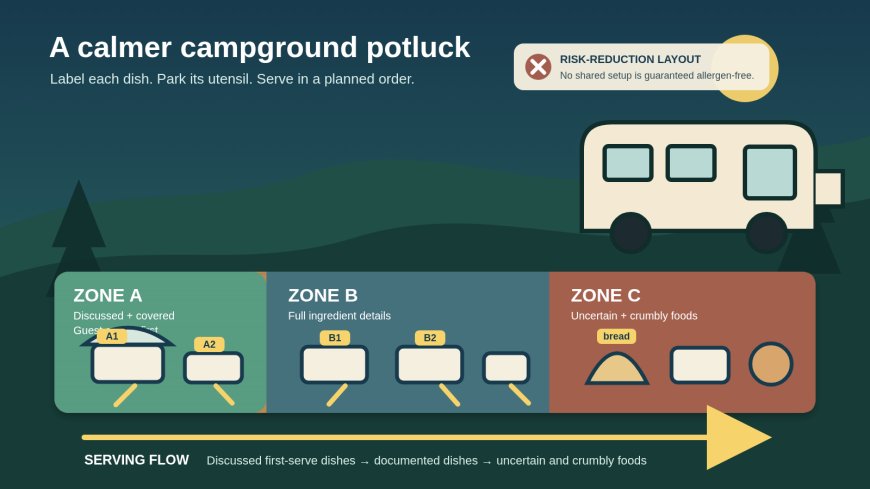
Zone A: first-serve dishes
Place dishes prepared for a specific allergy plan at the beginning of the line, on a separate table if possible. Keep them covered. Give each dish a high-contrast card and a utensil marked with matching tape. Leave a visible gap from the next zone.
This zone does not mean "safe for everyone." It means the host and affected guest have discussed the ingredients and handling. The guest still decides whether to eat it.
Zone B: fully documented shared dishes
Next come dishes with complete ingredient cards and original packages available. Put toppings in their own containers. Use squeeze bottles when practical so spoons do not move between bowls.
Zone C: uncertain or higher-spill dishes
Put unlabeled dishes, foods with incomplete ingredient information, and messy allergen-containing toppings at the far end. Bread, grated cheese, nut toppings, and crumbly desserts belong here, not upstream where crumbs can fall onto other food.
Set drinks and disposable cups on another surface. This keeps the buffet from jamming and reduces the chance that a used cup or snack-covered hand reaches across food.
One dish, one utensil, one parking spot
Use a dedicated spoon, ladle, or set of tongs for every container. Match each handle to its dish with colored painter's tape, a numbered tag, or both. Put the same mark on a small spoon rest in front of the dish. Color alone is not enough for every guest, so include a number or word.
Bring two clean backup utensils for Zone A. If a tool falls, disappears, or touches another dish, remove it rather than wiping it on a towel. FARE warns that simply brushing crumbs from utensils or surfaces is not enough; soap-and-water cleaning is needed to remove food protein.[3] FDA research found that a full wash-rinse-sanitize-air-dry process was effective at removing allergens and limiting transfer in the retail setting.[2]
In an RV kitchen, create the first-serve dish before opening other ingredients. Start with washed hands, a cleaned counter, and clean pans, boards, and utensils. Cover the finished dish and move it away from splatter and crumbs. FARE likewise recommends preparing the allergy-planned meal first and keeping it covered and away from other cooking.[3]
A foil sheet can provide a clean work surface, but it does not clean a dirty knife, toaster, grill grate, or pair of tongs. Shared fryers and cooking oil can also carry food from an earlier batch. If the preparation history is uncertain, say so on the card.
The serving order that holds up in real life
- Brief the group before uncovering food. Point out the three zones, label cards, utensil marks, and the rule against swapping spoons.
- Let guests with food allergies serve first, if they want to. They can read cards and ask cooks questions before the line gets crowded.
- Open Zone A only for that first pass. Keep other dishes covered until those plates have moved away from the table.
- Open the full buffet. Assign one adult to watch utensils for the first ten minutes and replace any that travel.
- Retire a compromised dish. If the wrong spoon enters it, the card blows away, or crumbs spill in, tell the affected guest. Do not scoop out the visible food and return the dish to Zone A.
- Keep seconds honest. After general service begins, cross-contact risk is higher. A guest may choose a covered reserve portion, a sealed backup, or no seconds.
Reserve portions are useful. Before service, the cook can place one portion in a clean, lidded container, label it with the guest's name, and hand it directly to them. That avoids a second trip through a buffet that has been in motion.
Host kit for a shared RV kitchen
Pack the system in one clear bin:
- blank ingredient cards, waterproof marker, and painter's tape;
- numbered utensil tags and matching spoon rests;
- clean backup tongs, spoons, cutting board, and lidded container;
- paper towels, dish soap, potable water, and the supplies needed for the site's normal wash-rinse-sanitize-air-dry setup;
- table clips or weighted card holders for wind;
- trash bags and a separate bin for used utensils.
Do not rely on a shared cloth for a quick wipe between dishes. FDA found that allergen removal depends on the food, surface, and wiping method; full cleaning performed better than a casual wipe.[2]
What guests should do
Tell the host early and be specific about both ingredients and handling. At the potluck, read the card, inspect the original package when available, and ask the cook about sauces, seasoning blends, shared grills, toasters, fryers, utensils, and work surfaces. "I don't know" is useful information.
Bring a meal or snack you trust if the setup does not meet your needs. Keep it closed and separate until you eat. Carry prescribed medication as directed and make sure the people you choose know your emergency plan. You can decline any dish without apologizing.
Guests without allergies have a job too: use only the utensil parked with the dish, keep children from moving spoons, do not hover bread or a plate over Zone A, and never reassure someone that a food is safe unless you have the information they asked for.
The host's 15-minute reset
Before the line opens, walk the table once:
- Every dish has a card, and incomplete information is marked plainly.
- Each dish has its own marked utensil and parking spot.
- Zone A is covered, separated, and upstream from crumbs and toppings.
- The affected guest has seen the setup and knows service is about to start.
- A clean reserve portion and backup utensils are available if planned.
- The site address, entrance directions, and emergency roles are known.
Then say the limitation out loud: "We used labels, separate utensils, and a serving order to reduce cross-contact. This is a shared campground setup, so we cannot guarantee that any food or surface is allergen-free. Please ask before serving, and choose what works for you."
That sentence may feel less hospitable than promising everyone can eat everything. It is more respectful. Good hosting gives people useful information, reduces preventable mistakes, and leaves the final food decision with the person whose health is at stake.
Sources
What's Your Reaction?