












2026 Winnebago Revel 44E review: big power, small-space trade-offs
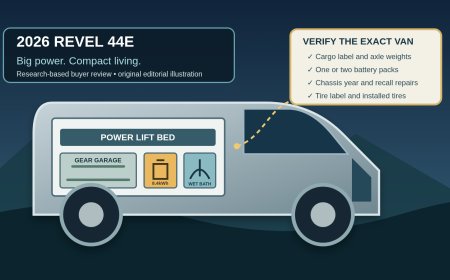
The 2026 Winnebago Revel 44E combines a short AWD Sprinter, lift-bed gear garage and 8.4kWh power system with tight living space, unresolved payload and two recall checks.

2026 Winnebago Revel 44E review: big power, small-space trade-offs
Updated September 22, 2026
Research disclosure: This is a desk-researched buyer guide, not a road test. RVCamping.info did not drive, inspect, weigh, rent, sleep in, purchase, or otherwise test this motorhome.
Review identity
| Field | Reviewed unit |
|---|---|
| Manufacturer | Winnebago Industries |
| Model family | Revel |
| Model year | 2026 |
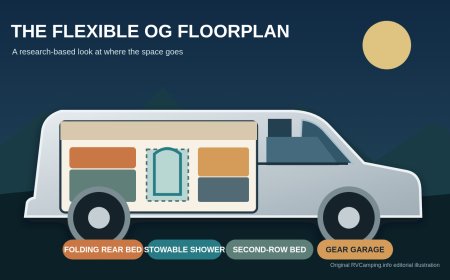
| Exact floorplan | Revel 44E with forward lounge, power lift bed, gear garage, and split-door wet bath |
| RV class | Class B camper van; the official year page inconsistently calls it a “compact class C” |
| Chassis | Mercedes-Benz Sprinter 2500, 144-inch wheelbase, AWD |
| Engine | High-output Mercedes-Benz 2.0-liter turbo diesel with four cylinders; automatic transmission with nine speeds |
| Review method | Official specifications, rolling product material, owner reports, recall records, and timestamped asking-price snapshots |
| Review date | September 22, 2026 |
Bottom line
The 2026 Winnebago Revel 44E makes the most sense for one or two travelers who actually carry bikes, skis, paddling equipment, or bulky outdoor gear and want a van-size AWD platform. Its defining choices are a bed that lifts above a cargo garage, a 35-gallon fresh tank, heated fresh and gray tanks, and an 8.4kWh standard battery system that can be doubled as an option.[1][2]
That equipment does not turn 19 feet 7 inches of van into a roomy apartment. The wet bath also serves as a gear closet, the bed and garage compete for vertical space, the refrigerator is only 3.0 cubic feet, and Winnebago publishes no unloaded vehicle weight or occupant-and-cargo carrying capacity for the 44E in the 2026 sheet.[2] The starting price is $261,808 before freight and several other charges, while sampled new-unit asks were around $178,000.[8][9]
Best fit: an active couple or solo traveler who values a short wheelbase, protected gear storage, strong electrical capacity, and AWD more than open floor space. Skip it: buyers who need a permanent low bed, a dry bath, easy indoor passage for two people, seating or sleeping for a family, a published payload calculation, or the lowest-cost chassis service network.
Official 2026 specifications
These figures apply to the 2026 Revel 44E, not the 44N, 44C, 44EC, or earlier 44E generations. The official 2026 specifications sheet is the controlling source for this table.[2]
| Specification | Official 2026 figure |
|---|---|
| Exterior length | 19 ft 7 in |
| Exterior height | 10 ft |
| Exterior width | 7 ft 5 in |
| Interior height / width | 6 ft 3 in / 5 ft 9.5 in |
| Wheelbase | 144 in |
| Fresh / gray / cassette toilet | 35 / 21 / 5 gal |
| Diesel fuel | 24.5 gal |
| GVWR / GCWR | 9,050 / 13,930 lb |
| Front / rear GAWR | 4,409 / 5,359 lb |
| Hitch rating | 5,000-lb drawbar; 500-lb maximum vertical load |
| Sleeps | 2 |
| Wet bath | 31 x 26 in |
| Refrigerator | 3.0 cu ft, 12V compressor |
| Standard battery | 8.4kWh Lithionics lithium-ion |
| Optional battery | One additional 8.4kWh pack |
| Inverter / solar | 3,600W integrated inverter; 210W solar |
| Air conditioner | 13,500 BTU, listed as optional |
| Basic coach warranty | 12 months / 24,000 miles; dealer confirmation required |
The sheet does not publish UVW or OCCC, so a buyer cannot derive payload by subtracting an official unloaded weight from the 9,050-pound GVWR. Photograph the yellow cargo label on the exact van and weigh it by axle in normal travel trim. The 5,000-pound drawbar number is also not a promise of 5,000 pounds of real-world towing capacity; Winnebago says actual capacity depends on loading, GVWR, axle ratings, GCWR, and trailer brakes.[2]
Official-source conflicts and limits
Winnebago's year-specific page, the 2026 sheet, and the rolling 44E page agree on the basic layout, 19-foot-7-inch length, 35-gallon fresh tank, 9,050-pound GVWR, and 8.4kWh standard power system.[1][2][3] Several details still require written confirmation.
First, classification is inconsistent. Winnebago places the Revel among camper vans, the specification sheet describes a van-format 144-inch Sprinter, and dealers label it Class B, but the official 2026 page says “compact class C.”[1][2][8] This review treats the 44E as a Class B because the coach remains within the original van body. Buyers should not use that marketing label to infer insurance, registration, or campground treatment; ask the relevant provider how the VIN is coded.
Second, the rolling 44E page lists GCWR at 13,900 pounds, while the official 2026 sheet says 13,930 pounds.[2][3] Thirty pounds is not worth guessing about. Use the chassis labels and VIN-specific Mercedes documentation.
Third, Winnebago's rolling Revel family page displayed the 44E as 19 feet 9 inches during retrieval, while the exact 44E page and 2026 sheet say 19 feet 7 inches.[2][3] Measure the actual unit, including installed rear accessories, before relying on a garage, ferry, or campsite length limit.
Finally, the marketing claim of up to seven off-grid days is conditional. Winnebago says actual duration varies with environment, usage, maintenance, battery age, and battery health, and the “up to” power description can refer to the optional 16.8kWh configuration rather than the standard 8.4kWh system.[1][3] Ask the dealer to identify both battery packs physically and on the window sticker before paying for the upgrade.
Floorplan and daily-use analysis
Sleeping, seating, and the gear garage
The rear bed rises electrically to expose the garage. That is the strongest reason to choose the 44E: dirty or expensive equipment can travel inside rather than on a hitch rack. Six L-track bases provide flexible restraint points, but floor area and payload are separate limits.[1][2] Load the bikes or bins you plan to carry, lower the bed fully, and confirm sleeping clearance without removing critical gear.
The forward lounge supplies belted travel seating and a removable table. It works as a compact dining or work zone, but there is no second full lounge at the rear. Two people should rehearse a rainy day with the side door closed: one cooking, one seated, bed down, wet clothing stored, and bathroom access maintained.
The official sheet says the van sleeps two. Do not treat dealer photographs, a cab air mattress option, or informal aftermarket setups as approval for additional occupants. Confirm belts, child-restraint compatibility, sleeping capacity, and axle loading for the exact build.
Bath, kitchen, and storage
The 31-by-26-inch wet bath is also a storage zone. The split door adds a privacy extension, while a removable shelf, clothes rod, cassette toilet, and collapsible containers support gear use.[1][2] That flexibility has a cost: showering means moving stored items, drying the compartment, and managing a five-gallon cassette.
A long-term owner of a 2019 Revel reported never using the shower, citing drying time, moisture, and water consumption; the same owner liked the van's compact footprint but found the living area tight.[6] The 2026 design changes the bath door, water capacity, heating, and interior details, so this is a planning prompt, not proof of a current-model defect.
The galley is deliberately small: portable single-burner induction, 3.0-cu-ft refrigerator, stainless sink, pantry, and removable counter extension.[2] Bring your largest pan and a normal grocery load. Check whether the portable cooktop has a secure travel location and whether opening the refrigerator blocks the aisle or another task.
Power, water, and climate use
The standard Power MAX package combines one 8.4kWh heated lithium battery, an EcoFlow-based controller with a 3,600W inverter, dual-alternator charging, and 210 watts of solar. A second 8.4kWh battery is optional.[2] Solar is useful for background recovery, but 210 watts is small beside an 8.4kWh battery and high-draw air conditioning. Treat alternator and shore charging as primary replenishment paths until your measured usage proves otherwise.
The 2026 sheet lists heated fresh and gray tanks plus hydronic multi-zone heat.[2] It also tells owners to follow winter-use and winterization procedures whenever camping in freezing conditions. “Heated tanks” does not certify every pipe, valve, drain, fill, or exterior connection against freezing. Ask the dealer to show the cold-weather procedure and identify every exposed component.
The 35-gallon fresh capacity is much larger than the 21 gallons described by an older full-time owner, so the older report's exact water endurance does not transfer.[2][6] The underlying behavior still matters: showers, dishwashing, and outdoor sports can consume water faster than electrical power.
Driving, parking, and service access
A 144-inch-wheelbase Sprinter at 19 feet 7 inches should be easier to place than an extended-body touring van, but it remains 10 feet tall and 7 feet 5 inches wide. The AWD system adds traction; it does not turn the coach into a rock crawler. Tanks, steps, wiring, exhaust equipment, and the long body still need clearance checks.
Older-owner evidence is mixed but useful. RV Insider contributors repeatedly praised drivability, the short footprint, and the garage layout. Some also reported rattles, fit-and-finish complaints, insulation concerns, and disappointing dealer or warranty experiences.[7] Those are self-selected accounts from earlier years, not failure rates for a 2026 coach.
What independent owners report
The independent evidence does not establish a universal Revel outcome, and no source below is a controlled 2026 durability test.
- A couple who lived full-time in a 2019 Revel for three years and more than 56,000 miles said the compact size, heater, and general durability worked well for them. They also described cramped living space, plumbing that they winterized for severe cold, limited protected gear capacity, wet-bath drying effort, and reduced Mercedes service availability.[6]
- RV Insider's floorplan-specific collection covers several earlier 44E years. Positive reports emphasize drivability, AWD traction, garage storage, and the lift-bed concept. Negative reports mention initial rattles, workmanship, insulation, leaks, and uneven service experiences.[7]
The repeatable buyer lesson is to separate layout appeal from delivery quality. A power lift bed, lithium system, hydronic heater, cassette toilet, awning, drain pump, dual alternator, and Sprinter electronics all create inspection points and separate service paths.
New purchase and asking-price snapshot
Winnebago listed the 2026 Revel family at a $261,808 USD starting MSRP. Its disclaimer excludes freight, taxes, title, license, dealer preparation, and other miscellaneous fees, and warns that pricing and equipment can change.[4] The official inventory finder is the best starting point for current dealer stock, but every unit still needs a VIN-specific window sticker and buyer's order.[13]
Snapshot captured September 22, 2026 at 00:16:18 UTC:
| Seller and location | Stock / mileage | Displayed MSRP | Displayed ask | Important terms |
|---|---|---|---|---|
| Giant RV, Downey, California | WRV185 / 1,797 mi | $276,987 | $178,296 sale price; $178,381 including listed $85 document fee | Taxes and DMV fees excluded; price expires daily; availability must be confirmed.[8] |
| Van City RV, Kalispell, Montana | 6790 / dealer page did not expose mileage in captured summary | $289,005 build sheet | $178,296 | Dealer page calls it new; confirm options, rebates, mileage, freight, and fees.[9] |
Both dealer MSRP figures exceed Winnebago's official base MSRP, likely because of installed options or dealer presentation, but the captured pages do not reconcile every dollar.[4][8][9] Compare out-the-door worksheets, not discount percentages.
Used-market snapshot
These are asking prices, not sale prices, appraisals, or a statistical market value. Listings can change or disappear. The sample was captured September 22, 2026 at 00:16:18 UTC and spans three marketplaces.
| Marketplace / seller | Coach year | Location | Mileage | Asking price | Evidence state |
|---|---|---|---|---|---|
| La Mesa RV / RecVan | 2024 | Davie, Florida | 20,124 | $133,998 | Live dealer page; stock FP224436, VIN ending 494651.[10] |
| Camping World | 2023 | Katy, Texas | 31,970 | $135,203 | Live inventory page; stock 2730421C.[11] |
| Vanlife Trader private seller | Marketed as 2023; page identifies 2022 Mercedes chassis | Seattle, Washington | 69,000 | $120,000 | Recently archived and marked sold; price is the last ask, not confirmed sale price.[12] |
The third listing demonstrates why “year” needs two fields. It was advertised as a 2023 Winnebago Revel but identified the underlying Mercedes as a 2022.[12] Battery capacity, drivetrain generation, warranties, recalls, and emissions equipment can follow different year boundaries, so a coach-year comparison alone is incomplete.
Recall check: coach and chassis require VIN searches
The NHTSA make/model/year API returned two records for 2026 Winnebago Revel on September 22, 2026.[5]
- 25V478000, air bags: Winnebago recalled certain 2025-2026 Revel and other motorhomes because SRS wiring could be caught when cab seats are adjusted. The remedy is inspection and rerouting.
- 26V385000, tire-information label: Certain 2026-2027 Revel and Revel Sport units received a label that stated the wrong tire. The remedy is a replacement label.
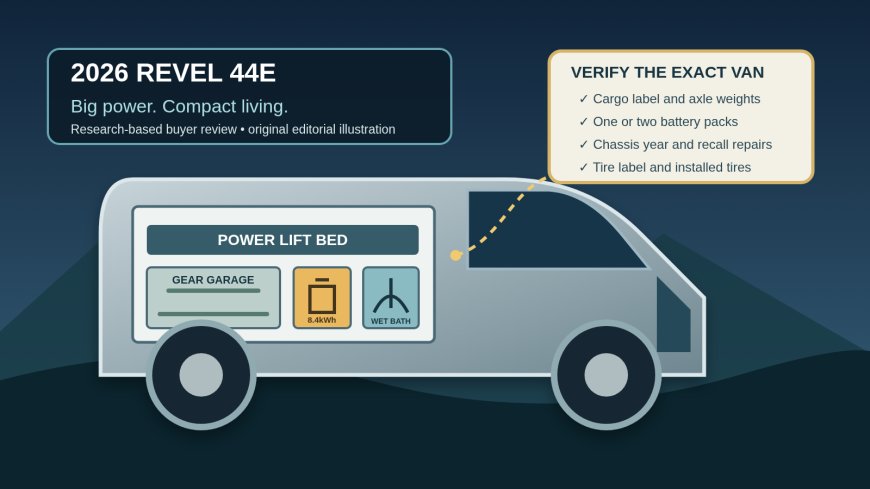
A model query cannot tell whether a particular VIN is affected or whether a repair was completed. Run the 17-character VIN through NHTSA, ask a Mercedes-Benz commercial-van dealer to check chassis campaigns, and ask Winnebago to check the coach serial. Obtain written proof of closed campaigns, then verify the tire label against the installed tires and build documents.
Used-unit inspection checklist
- Identity and year split: Match the VIN on dash, door label, title, seller record, and scan report. Record Mercedes chassis manufacture year, Winnebago coach model year, and Winnebago serial separately.
- Recall proof: Search the VIN with NHTSA and Mercedes, then the coach serial with Winnebago. Confirm remedies for 25V478000 and 26V385000 when applicable.
- Weight and tires: Photograph the yellow cargo label and corrected tire label. Weigh each axle loaded for travel; compare GVWR, both GAWRs, GCWR, hitch load, wheel rating, and tire load capacity.
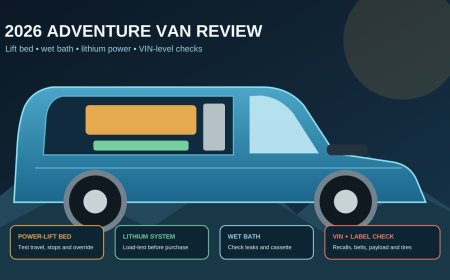
- Lift bed: Cycle the bed repeatedly from full height to sleep height. Inspect tracks, wiring, switches, limit behavior, fasteners, mattress, rear-door clearance, and a manual recovery method.
- Gear garage: Load the actual bikes or bins. Inspect all six L-track bases and cabinet mounts, look for water entry and floor damage, and verify that cargo cannot strike bed wiring or hydronic components.
- Power system: Identify whether the van has one or two 8.4kWh packs. Record battery health, firmware, fault history, charge cycles where available, and resting balance. Test shore, solar, alternator, inverter, 12V, USB, and 120V operation under load.
- Dual alternator and charging: Measure charge power at idle and while driving after the battery has room to accept energy. Inspect belts, mounts, cables, fuses, heat damage, and fault logs.
- Water and freeze protection: Pressure-test pump and city connections; fill and drain fresh, gray, and cassette systems. Inspect the exterior wash station, galley drain pump, heated tanks, low points, valves, winterization fittings, and every line near a door or exterior wall.
- Wet bath and cassette: Shower-test seams and drain operation, inspect the roof vent and split door, verify shelf and clothes-rod hardware, and check cassette blade, seals, vent, indicators, and spare-part availability.
- Hydronic heat: Run every heating zone from a cold start, verify hot water, inspect fluid level and leaks, read fault history, and confirm service intervals and the exact installed heater model.
- Galley and climate: Run the 12V refrigerator through a full cooling cycle. Load-test induction and the optional A/C, verify the roof unit is actually installed, and watch battery draw and charging response.
- Water intrusion: Moisture-meter roof penetrations, fan and A/C curbs, awning and rack mounts, acrylic windows, side and rear doors, bath perimeter, floor edges, and underbody entries.
- Cab and SRS wiring: Rotate and adjust both front seats while watching harness clearance. Scan all modules for current, pending, and stored codes; do not accept warning-light resets as repairs.
- Chassis and underbody: Obtain Mercedes service history. Inspect diesel emissions equipment, AWD driveline, brakes, suspension, steering, corrosion, fluid leaks, steps, tanks, exhaust clearance, and evidence of trail impacts.
- Road test: Start cold, drive city and highway routes, and use a rough but legal surface. Listen for cabinet, door, rack, bed, and bath movement; test driver assistance; then recheck for leaks, faults, and hot electrical connections.
- Paper trail: Verify title status, liens, maintenance invoices, option sheet, tire dates, battery warranty, transferable coach coverage, modifications, and installer receipts. Confirm that aftermarket weight and wiring changes are documented.
At this price and complexity, use both a qualified RV inspector and a Sprinter-capable mechanical shop.
Alternatives worth comparing
- Storyteller Overland Classic MODE OG: another short AWD Sprinter with a more open, modular interior and portable-bath philosophy. Compare fixed bathroom privacy against flexible floor area.
- Tiffin GH1: a 144-inch AWD Sprinter adventure van with a different lift-bed, kitchen, and electrical execution. Check current recall status and VIN-specific weights.
- Jayco Terrain 19Y: a compact Sprinter-based alternative with a rear power bed and gear focus. Compare battery architecture, dealer support, and cold-weather routing.
- Winnebago Revel Sport 44N or 44C: lower starting price and 24-gallon fresh tank, with a 5kWh standard power system in the 2026 sheet. These are separate floorplans, not cheaper 44E equipment clones.[2]
Compare exact model years, installed options, cargo labels, and chassis VINs. “Adventure van” is a use case, not a specification.
Methodology, limitations, and disclosures
RVCamping.info cross-checked the official 2026 product page, official 2026 specifications PDF, and rolling 44E page. Official conflicts were retained rather than silently reconciled. Independent experience evidence comes from a detailed long-term owner account and a floorplan-specific owner-review collection, mostly for earlier model years. Dealer and marketplace asks were captured at a stated UTC time and are not completed-sale evidence.
No unloaded weight or OCCC was found in the official 2026 sources, so this review does not calculate payload. The NHTSA result is a model-level query, not a VIN clearance. Specifications and availability can change during production.
No YouTube video is embedded. Winnebago's page presented a model walk-through, but this package did not verify both a usable transcript and enabled standard embedding for the exact video. Omission is safer than treating a visual sales tour as independent experience evidence.
Affiliate disclosure: This article contains no affiliate links, paid placement, dealer referral tracking, or manufacturer sponsorship. All commercial links are ordinary links. Editorial selection and conclusions were independent.
Sources
- Official 2026 Winnebago Revel product page
- Official 2026 Revel Series specifications sheet
- Current Winnebago Revel 44E rolling product page
- Official 2026 Revel family page and MSRP terms
- NHTSA recall API: 2026 Winnebago Revel
- Ski Burrito: three-year full-time Winnebago Revel owner review
- RV Insider Winnebago Revel 44E owner reviews
- Giant RV new 2026 Revel 44E listing
- Van City RV new 2026 Revel 44E listing
- La Mesa RV used 2024 Revel 44E listing
- Camping World used Winnebago Revel inventory
- Vanlife Trader archived 2023 Revel 44E listing
- Winnebago official inventory finder
What's Your Reaction?