





















Equal-i-zer 90-00-1000 review: great sway control, if the weights fit
The Equal-i-zer 90-00-1000 can tame sway and restore axle balance, but only when loaded weights, receiver limits, and A-frame space fit.

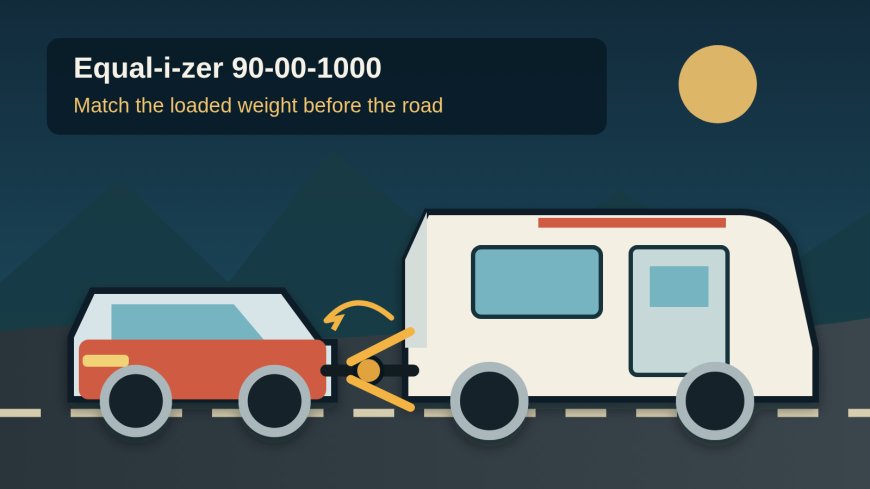
The Equal-i-zer 90-00-1000 is a strong choice for a conventional travel trailer whose actual loaded tongue weight fits the 1,000-pound limit and whose loaded trailer stays within 10,000 pounds. It combines weight distribution with friction-based sway resistance, allows normal backing, and does not require a separate friction bar. The catch is that it needs careful sizing and setup. It is heavy, can be noisy, requires space on the A-frame, and the package does not include a hitch ball.[1][2][3]
Buy it if you tow the same travel trailer regularly, can confirm the loaded weights, and want an integrated weight-distribution and sway-control system. Skip it if your measured tongue weight may exceed 1,000 pounds, your tow vehicle or trailer maker forbids this type of hitch, your A-frame cannot accept the brackets, or you expect a quick universal bolt-on accessory.
This is a research-based review. RVCamping.info did not purchase, install, or physically test this hitch.
The model reviewed
This review covers the Equal-i-zer 4-Point Sway Control Hitch, model 90-00-1000, with the standard adjustable shank. Equal-i-zer rates this model for a maximum 1,000-pound tongue weight and 10,000-pound trailer weight.[1] The matched Amazon listing is ASIN B004TR8F5C and identifies the same 90-00-1000 package, including the standard shank but not the hitch ball.[3]
That package boundary matters. Equal-i-zer also sells similarly rated configurations without a shank or with a preinstalled ball. Do not assume that a shared 10K/1K rating means the boxes contain the same parts.
As an Amazon Associate, RVCamping.info earns from qualifying purchases. If you buy through an Amazon link in this article, we may earn a commission at no additional cost to you.
Check the Equal-i-zer 90-00-1000 on Amazon
The verdict in one sentence
The 90-00-1000 earns its place on a properly matched travel-trailer setup, but it is a poor candidate for "buy now, measure later."
What the hitch does, and what it cannot do
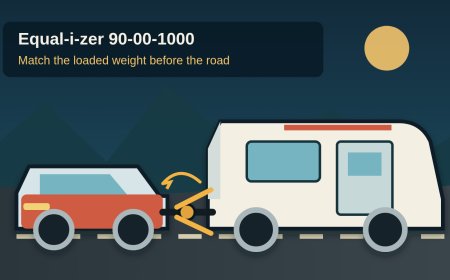
A conventional trailer's tongue pushes down behind the tow vehicle's rear axle. A weight-distribution hitch uses spring bars to return some of the resulting load toward the tow vehicle's front axle and the trailer axles. In this system, steel-on-steel friction at the head sockets and L-brackets also resists trailer yaw. Equal-i-zer calls those four contact areas its four-point sway control.[2]
That friction can help resist sway; it cannot repair a bad combination. The manufacturer's own manual says no hitch setup guarantees that sway will be avoided. Loading, tire condition and pressure, speed, road conditions, weather, and tow-vehicle compatibility still matter.[1]
It also does not raise any rating. The lowest applicable limit still wins: tow-vehicle payload, axle ratings, receiver ratings, trailer GVWR, coupler, hitch ball, and the hitch itself. If the truck's receiver allows a lower distributed tongue weight than 1,000 pounds, this hitch does not turn it into a 1,000-pound receiver.
The compatibility test to do before buying
1. Use loaded weights, not brochure dry weight
The hitch should be sized to the trailer as it will travel. The current manual tells owners to load the tow vehicle and trailer for setup, including propane, water, generators, ATVs, and other cargo.[1] An etrailer answer illustrates the same trap: a 725-pound dry tongue figure did not include propane, water, or other cargo, so the reviewer recommended moving from 1,000-pound to 1,200-pound bars for that particular trailer.[5]
Our practical rule is conservative: if a loaded trip could put the tongue near 1,000 pounds, weigh the rig before choosing this model. A three-pass public-scale check can confirm axle loading and how much front-axle weight the hitch restores. A tongue scale can help with loading, but it does not replace the truck and trailer rating labels.
2. Confirm the receiver and vehicle instructions
Read the tow vehicle owner's manual and the label on the receiver. Some vehicles specify a weight-distributing limit; others have instructions for suspension modes or front-axle load restoration. Equal-i-zer's setup target is 50% to 100% front-wheel-well restoration, but the manual explicitly defers to the vehicle manufacturer's exact limit.[1]
Auto-leveling suspension needs special attention. Equal-i-zer says to disable it temporarily during initial setup and then follow the vehicle instructions. Its manual warns that four-corner auto leveling can reduce the measured distribution effect and provides a separate procedure.[1]
3. Measure the trailer A-frame
The clamp-on brackets belong 27 to 32 inches behind the center of the coupler, at equal distances on both frame rails. Battery trays, propane hardware, wiring, plumbing, a V-nose, or an underslung coupler can occupy that space. The manual permits an inverted bracket arrangement for some bottom-mount or obstructed layouts, but it may require moving equipment or getting model-specific guidance.[1]
Once hitched, there must be at least three inches from the end of each spring arm to the center of its L-bracket. The standard 12-inch shank also needs enough clearance for the tow vehicle, trailer, spare tire, and safety chains through tight turns.[1]
4. Budget for the missing ball and serious torque tools
Model 90-00-1000 includes the standard shank, hitch head, matched spring arms, brackets, pins, and setup hardware. It does not include the ball.[3] The manual specifies a ball with a 1 1/4-inch threaded shank no longer than 2 3/8 inches, with a rating at least as high as the trailer's gross weight. Equal-i-zer's matching 2 5/16-inch 10,000-pound ball calls for 430 lb-ft on the nut.[1]
The two shank bolts require 320 lb-ft. Those figures are beyond many household torque wrenches, and a thin-wall socket is required for the ball. Paying a qualified hitch shop for ball installation and initial setup is sensible if the tools or procedure are unfamiliar.
Setup is part of the product
This is not a one-time assembly followed by guesswork. The current procedure starts on level ground with travel-ready loading and correct tire pressures. The installer sets ball height and head angle, mounts the A-frame brackets, then measures the tow vehicle's front wheel opening in three conditions: uncoupled, coupled without distribution, and fully hitched with the spring bars engaged.[1]
Equal-i-zer defines 50% to 100% front-height restoration as its normal target unless the tow vehicle specifies otherwise. Too little restoration can leave the front axle light; too much can unload the rear axle and reduce traction, especially on slick pavement. Adjustment comes from the head spacer washers and L-bracket height, followed by another round of measurements.[1]
A scale check after the tape-measure setup is worthwhile. Verify that no axle, tire, receiver, hitch, or trailer rating is exceeded. Recheck after a major loading change, a new tow vehicle, a different trailer, or moving heavy cargo.
What independent use reports add
A TripSavvy reviewer reported minimal lateral movement while towing in wind, interstate traffic, and mountain conditions. The same account also called out two less glamorous details: finding and installing the correct ball was troublesome, and the hitch produced substantial noise until the head sockets were greased and the angle readjusted.[4]
That is one experience, not a controlled comparison, but the tradeoff is believable because it matches the mechanism and the manufacturer's maintenance instructions. Equal-i-zer says to grease the ball and the friction surfaces where the sockets meet the hitch head before each trip. It specifically says not to lubricate the spring arms or L-brackets, where friction contributes to sway resistance.[1]
Expect clunks, creaks, and groans during slow turns, especially when the system is new or heavily loaded. Treat a new or worsening sound as an inspection prompt rather than dismissing every noise as normal.
Daily hitching and inspection
Before each departure:
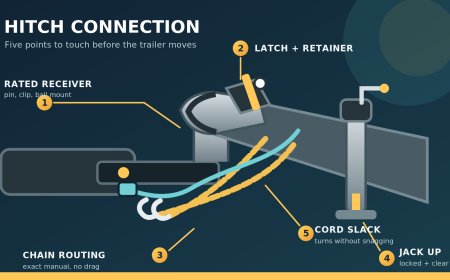
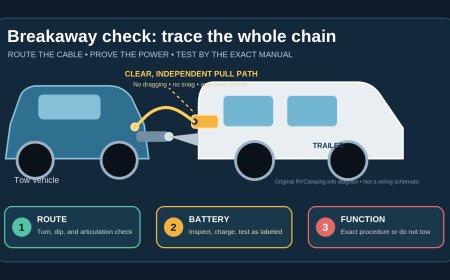
- Confirm the receiver pin, spring-arm socket pins, L-pins, coupler latch, safety chains, breakaway cable, and electrical plug are secured.
- Check the spring arms, brackets, hitch head, ball, pins, and fasteners for unusual wear, damage, or movement.
- Verify tire pressures and look for a cargo change that could alter tongue weight.
- Use the tongue jack to lift the coupled truck and trailer enough to load the bars with less force. Keep hands and body out of the lever's path.
- Retract the jack completely, test the trailer brakes and lights, and do a slow brake check before road speed.
The manual calls for checking all hardware before each trip. It lists 60 to 100 lb-ft for the socket bolts, 65 lb-ft for the link-plate bolts, 75 lb-ft for the L-bracket bolts, and 320 lb-ft for the shank bolts.[1] Use the current manual for the exact procedure; this article is not a substitute for it.
Backing, steep transitions, and rough ground
The hitch can remain connected for normal backing and turns. That convenience is real, but it has a boundary. Equal-i-zer warns owners to disengage weight distribution before severe grade transitions, such as backing from a level street into a steep uphill driveway. It also warns against towing with the system engaged through severe dips, very rough roads, or boat-launch transitions that can over-stress the spring arms and head.[1]
Walk the route when an entrance looks sharp. Removing bar tension for one awkward transition takes less time than repairing a bent bracket, overloaded receiver, or damaged trailer frame.
Who should buy it
The 90-00-1000 makes sense for an owner who:
- tows a conventional travel trailer with a measured, travel-ready tongue weight comfortably within 1,000 pounds;
- stays within the trailer, receiver, tow vehicle, axle, tire, coupler, and ball ratings;
- has usable A-frame space 27 to 32 inches behind the coupler;
- wants integrated friction sway resistance and weight distribution;
- will measure, torque, inspect, lubricate, and readjust the system when the load or vehicle changes.
Who should skip it
Choose another rating or another hitch architecture if:
- the loaded tongue weight can exceed 1,000 pounds;
- the trailer's loaded weight can exceed 10,000 pounds;
- the receiver or vehicle manual does not approve the setup;
- the A-frame or mounted equipment prevents correct bracket placement;
- you need a lighter hitch head or a system designed around different frame geometry;
- you are unwilling to tolerate friction noise or carry out the maintenance that friction hardware needs.
The last point is not cosmetic. This hitch works by putting loaded steel surfaces in controlled contact. If quiet operation is a top priority, compare other systems before buying rather than trying to silence this one with grease in places the manual says to keep dry.
Bottom line
The Equal-i-zer 90-00-1000 is not a magic anti-sway device. It is a capable, mature weight-distribution system with useful built-in sway resistance. Its best feature is also its demand: the system rewards a careful match and careful setup. Confirm the loaded tongue weight, read the truck and trailer instructions, measure the bracket zone, and plan for the missing ball and high-torque installation. If those pieces fit, it is a sensible long-term hitch. If any one of them does not, moving to the right model is safer than forcing this one to work.
Sources
- Equal-i-zer 6K–14K owner’s manual (EQINS2407)
- Equal-i-zer hitch product page: model 90-00-1000
- Amazon listing: Equal-i-zer 90-00-1000 (ASIN B004TR8F5C)
- TripSavvy hands-on Equal-i-zer review (archived January 13, 2026)
- etrailer Q&A on loaded tongue weight and Equal-i-zer bar sizing (archived November 21, 2019)
What's Your Reaction?