




Can you fill an RV tank from that campground spigot? Check three things first
Before filling an RV fresh-water tank, verify that the exact outlet is potable, campground rules allow a tank fill, and the hose setup preserves backflow protection.

Can you fill an RV tank from that campground spigot? Check three things first
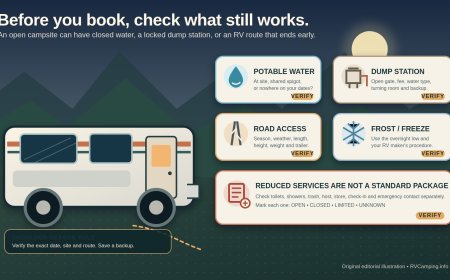
A campground faucet can deliver drinking-quality water and still be the wrong place to fill an RV tank. The park may reserve that outlet for bottles, prohibit hose connections, or direct RVs to a separate fill station. A second faucet nearby may be non-potable water meant only for rinsing at the dump station. The threads do not tell you which is which.
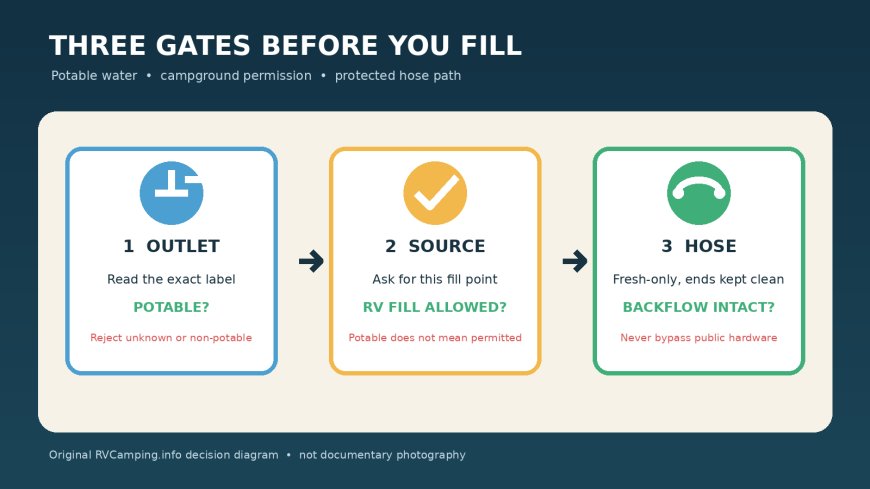
Before uncapping the fresh-water hose, verify three separate facts: the water is potable now, this exact outlet is approved for an RV tank fill, and your hose setup will not create a contamination path. CDC tells RV users to confirm with campground management that water is safe to drink before connecting and to use a safe drinking-water source when filling for dry camping.[1] That is the starting point, not the entire check.
This guide is about choosing and using a fill outlet. It does not repeat the separate jobs of sanitizing the RV fresh-water tank or setting safe campground water pressure.
Potable, permitted and usable are different answers
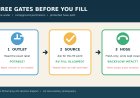
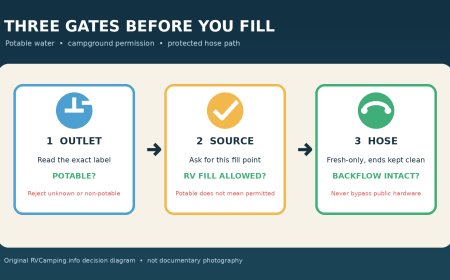
Treat the fill decision as three gates:
| Gate | What you need to know | What does not prove it |
|---|---|---|
| Water quality | Is the water from this outlet currently designated safe for drinking? | Clear appearance, no odor, a blue handle or a nearby restroom |
| Permission and purpose | Does the campground allow an RV tank to be filled here, today? | Potable labeling by itself, hose threads or a faucet icon on a map |
| Connection safety | Can you fill with dedicated potable gear while preserving the park's backflow protection? | A filter, pressure regulator or improvised adapter |
All three must pass. Navajo National Monument shows why. Its campground page says potable water is available at Sunset View for cooking and small containers, then expressly tells visitors not to use that water to fill RVs.[4] The water-quality gate passes; the bulk-fill permission gate does not.
The reverse mistake is worse: assuming a convenient threaded tap must be drinking water. Indiana's campground rules require potable water for drinking and other domestic uses, but they also address separate campground water stations, dump stations and backflow controls.[3] Campground layouts can put water outlets with different purposes in the same general service area. Read the label on the exact outlet, not the sign at the entrance.
Read the outlet before touching it
Stop far enough away to inspect the fixture without setting clean hose ends on the ground. Look for a permanent label such as "potable water," "drinking water," "non-potable," "unsafe for human consumption," "washdown" or "flush only." Check nearby boards, registration material and current notices for boil-water, do-not-drink or do-not-use instructions.
Use the wording literally:
- Potable or drinking water: the source may be suitable to drink, but you still need permission to fill an RV tank from this outlet.
- Non-potable, unsafe, rinse or flush only: do not send it into the fresh tank. A consumer filter does not convert that label into approval. CDC notes that many filters sold to improve taste do not remove germs.[1]
- No label, damaged label or conflicting signs: treat the source as unverified. Ask staff to identify the approved fill point.
- Advisory posted: follow the operator's exact instruction. "Boil water" and "do not use" are not interchangeable. Do not invent an RV treatment plan from a partial notice.
Color is a clue at best. Handles, hydrants and hoses get replaced. Location is also unreliable: a potable fill may be near a dump station, while a restroom-area spigot may be intended only for small containers or maintenance.
Ask one precise question: "May I fill my RV's fresh-water tank today from this exact outlet, and is it currently approved as drinking water?" Point to the fixture or give its loop and pedestal number. If staff directs you to another station, use that one. If no responsible person or current notice can answer, do not fill.
The small fitting on the spigot may protect the whole campground
A cross-connection is an actual or possible connection between drinking-water plumbing and non-potable plumbing. Backflow is unintended reverse flow through that connection. EPA warns that untreated water can cause chemical or microbiological contamination when it flows backward into a distribution system, including when supply pressure falls below pressure in connected plumbing.[2]
For an RV fill, the risk is not abstract. A hose end submerged in a tank neck, bucket or contaminated puddle can create a path toward the supply. A Y-adapter can leave the drinking-water outlet connected at the same time to a black-tank flush. Waste-side gear attached to a potable spigot can create another route.
The vacuum breaker or backflow device on a campground faucet belongs to the campground's plumbing protection. Do not remove it because it drips briefly, makes the hose awkward to attach or reduces clearance. Do not tape over its vent, defeat a pin or replace it with a fitting that merely looks similar. EPA says device and program requirements vary by state and municipality.[2] Campground staff or the water-system operator must resolve a missing, broken or leaking device.
Indiana provides a useful official example rather than a nationwide rule. Its campground code requires a pressure vacuum breaker on a water station with a threaded faucet, requires separation between water and sanitary dumping stations, and prohibits direct physical connections between potable and non-potable systems.[3] Those details explain why campers should not rearrange public plumbing. The exact hardware rules at another campground may differ.
A pressure regulator controls pressure; it is not automatically backflow protection. A sediment or carbon filter performs only the functions stated on its label. Neither one proves the source is potable or the outlet is approved for filling.
Use a fill setup that cannot be confused with sewer gear
Carry a hose identified by its manufacturer for potable-water use and reserve it for the fresh-water system. Color alone is not a rating. Keep its ends capped or coupled as the hose maker allows, in a clean bin separate from the sewer hose, black-tank flush hose, dump gloves and rinse adapters.
Before filling:
- Wash or sanitize your hands before handling clean couplings.
- Verify the exact outlet's label, current status and permission with the campground.
- Inspect for sewage residue, damaged threads, insects, debris, a submerged fixture, standing wastewater or visibly altered backflow hardware.
- If anything is questionable, report it and request another approved outlet. Do not scrub, spray chemicals into or repair public plumbing.
- Keep caps and hose ends on a clean tray or in the fresh-water bin, never on the soil, dump apron, sewer cap or pedestal base.
- Follow the campground's directions for any initial flushing and runoff. If none are posted, ask rather than sending water across a campsite or dump area.
- Connect the dedicated potable hose without removing the outlet's protection. Support heavy components so they do not lever against the faucet.
- Keep the discharge end above the tank opening when the RV's fill design allows. Do not submerge it or wedge it against a dirty fill-port exterior.
- Stay with the fill. Stop for a new advisory, persistent discoloration, debris, unusual odor, sewage evidence, a failed connection or unexpected discharge from the backflow device.
- Shut off, disconnect without dropping either end, drain the hose as directed, protect the couplings and return it to the clean bin.
CDC separates source safety from onboard maintenance: first make sure incoming water is safe, then follow the RV maker's instructions for draining, disinfecting and flushing the tank and plumbing.[1] A recently sanitized tank does not make an unverified source safe. A verified source does not clean a neglected tank.
When the answer is no
Do not fill from an outlet marked non-potable, unsafe, washdown or flush-only. Do not fill when a campground prohibits tank filling, even if it allows visitors to take drinking water in small containers. Do not connect during a do-not-use notice. Do not improvise around a missing or damaged backflow device.
Also reject the fill when:
- staff cannot confirm the exact outlet and there is no current authoritative sign;
- the hose would have to cross sewage, standing water or active traffic;
- your only available hose or fitting has been used on the waste side;
- a potable hose end contacted sewage, animal waste, floodwater or an unknown liquid;
- the outlet is visibly fouled or sits in pooled wastewater;
- a campground employee asks you to use a source whose posted label says otherwise, unless the operator first corrects the conflict and clearly identifies the approved outlet.
Move to a separately verified backup source. Bottled water can cover drinking and cooking until a proper fill is available. Do not taste-test unknown water, rely on odor, or assume an inline filter will handle an unspecified hazard.
If you suspect a backflow or cross-contamination event, stop using the connected water and notify campground management. Record the outlet, time and setup without dismantling public equipment. EPA's response guidance for water systems includes eliminating the cross-connection, controlled flushing or cleaning, sampling and testing after corrective work.[2] Those are operator-level actions, not a camper's do-it-yourself recipe. Ask the campground or water authority for instructions, and use the exact RV manufacturer's procedure for any affected onboard system.
The practical fill card
Keep this six-line check in the fresh-water bin:
- Outlet: exact faucet identified by sign or staff.
- Source: currently potable, with no conflicting advisory.
- Permission: RV tank filling allowed here and now.
- Protection: outlet and backflow hardware intact; nothing removed or bypassed.
- Gear: potable-only hose and fittings clean, separated and kept out of liquid.
- Stop rule: any unknown, conflict or contamination means no fill.
The useful distinction is simple. "Potable" describes water quality. It does not automatically describe what a particular faucet is for, whether the campground permits a bulk RV fill, or whether your connection is sanitary. Verify the outlet, the source and the hose path separately. Then fill.
Sources
What's Your Reaction?