















Your Campsite Is Booked. Is the Dump Station? A Call Sheet for RV Campers
A same-property verification framework for checking dump-station status, operating dates, access, fees, payment, and backups before an RV stay.

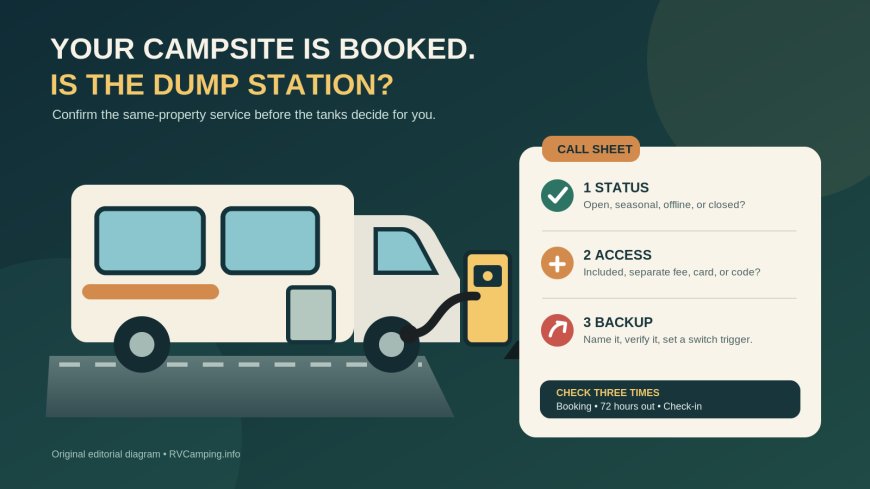
Your campsite is booked. Is the dump station? A call sheet for RV campers
By Romana | Information checked October 18, 2026

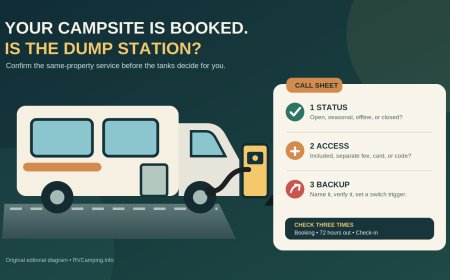
A campsite confirmation proves that you have a place to stay. It does not prove that the property's dump station will be open, included in the camping fee, usable by your rig, or operating on your departure morning.
Official campground pages show why that distinction matters. Juniper Campground at Bandelier keeps some loops open year-round, but its dump station is seasonal and shuts down when its water is turned off.[2] Hoh Rainforest Campground can operate outside its summer reservation season, weather permitting, while its former dump station is listed as permanently closed.[3] At Pismo State Beach, the dump station has its own $10 card payment and is not included in the campsite price.[4]
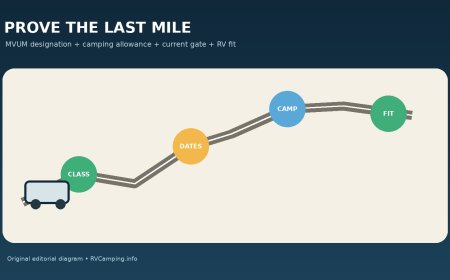
The fix is not another pin on a dump-station route. It is a same-property service check: identify the exact station attached to the campground, confirm its current operating status, record how access and payment work, then set a backup before the tanks force a bad decision.
Treat the station as a separate service
Campground pages often bundle a station into an amenity list. That list answers only one question: does the property describe a dump station somewhere? Five details still need answers.
| Field | What you need to establish |
|---|---|
| Status | Open now, seasonal, temporarily offline, or permanently closed |
| Date fit | Expected to operate on both arrival and departure dates |
| Access | Registered campers only, day visitors allowed, gate or lane restrictions |
| Transaction | Included, separate fee, payment method, and whether a receipt or code is needed |
| Physical use | Exact location, hours, potable-water status, rig approach, and exit direction |
Bryce Canyon makes several of those distinctions on one official page. Its only park dump station operates from spring through fall, closes when freezing nights arrive, and supplies potable water only when temperatures allow. Campers with an in-park reservation use it without an added station fee; other visitors pay $5. The page also names two nearby alternatives.[1]
That is a useful model for reading any listing. “Dump station: yes” is not a complete answer. The working answer is closer to: “expected open on October 3, registered camper access, no added fee, water subject to temperature, south end of North Campground, two outside backups recorded.”
Build a one-page call sheet
Put the station on the same trip sheet as the reservation number. Use the official park or campground page first, then check alerts, reservation notices, and current-conditions pages. Record the page title and the date you checked it. If the pages disagree or use stale seasonal language, call the office listed for that property.
Use these fields:
- campground name, exact loop, and reservation number;
- station name and whether it is inside the campground, elsewhere on the property, or nearby;
- status wording copied in short form: open, seasonal, offline, indefinite closure, or permanent closure;
- expected operating dates and hours;
- who may use it and whether campground registration changes the fee;
- amount, payment method, kiosk instructions, and any gate or access code;
- whether rinse water and potable fill water are available, treating those as separate services;
- lane direction, length or turning concern, and a safe waiting area if a line forms;
- the staff member or recorded line used to confirm the answer, plus date and time;
- one primary backup and one fallback that do not depend on the same water or sewer system.
Do not write “station available” in the status box. That phrase becomes useless the moment temperatures drop or a pump fails. Write the condition that would change the plan: “closes after freezing nights,” “water off mid-October,” or “call on departure morning.”
Ask questions that produce a usable answer
A short call beats a long conversation if the questions are specific. Start with your stay dates rather than asking whether the campground “has a dump.”
I have a campsite reservation for [dates] in [loop]. Is the dump station on this property operating for RVs on those dates? Is it included with the campsite, or do I pay separately? What payment does the station accept? Where is the entrance, and can I use it after checkout? Is potable fill water operating there? If the station is down, which alternative does staff currently direct RVs to?
Then repeat the answer back. “So the campground is open, but the station is off after October 15, correct?” That catches a common mismatch between overnight availability and utility availability.
Ask who controls the service. A public campground may be reservable through one system while a concessioner, utility contractor, or self-pay vendor controls the station. Pismo is a clean example: camping reservations run through ReserveCalifornia, while the dump station uses a separate Sani-Star card transaction.[4] A campsite receipt is not the same thing as a station payment record.
Recognize the three failure patterns
The campground outlasts the station
Juniper's year-round loops do not make its dump station year-round. Recreation.gov describes a winter shutdown that starts around the middle of October and lasts until roughly the middle of April; neither tank filling nor dumping works during that period. Potable spigots in the campground loops are described as available year-round.[2]
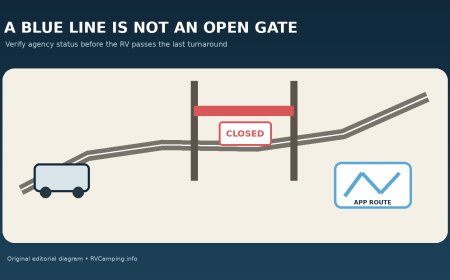
This is exactly why “the water is on” needs a location attached to it. Loop drinking-water service does not prove that the dump lane can operate. Confirm the station itself.
The campground is open but the station is gone
Hoh's listing says the campground operates year-round outside the reservation season, weather permitting. The same page says the RV dump station is permanently closed. Its paid alternatives are Bogachiel State Park on a 23-mile northbound run and Kalaloch Campground after a 33-mile drive south. The listing also provides a recorded status line updated twice daily.[3]
A saved campground reservation cannot revive a closed utility. The useful response is to reduce tank use before arrival, arrive with capacity, and confirm the named alternative rather than assuming yesterday's mileage note still reflects an open station.
The station is on the property but outside the reservation price
Pismo State Beach places a fee-based station inside the North Beach Campground entrance, yet California State Parks says campsite prices do not include station use. The published process is a $10 self-pay transaction by credit or debit card.[4]
That detail affects departure. A camper who planned to use cash, packed away the wallet, or assumed the campsite receipt opened the station can create a delay with a full holding tank. Put the payment method on the call sheet before the rig is hitched.
Set the backup before you need it
A backup is not “find something on the way.” Give it an address, operator, current status source, payment method, opening window, and maximum detour you are willing to accept. Call a commercial alternative if its website does not state that public dumping is available. A campground office, fuel stop, wastewater plant, and RV park can each have different access rules.
Use two levels:
- Primary backup: close enough to use after checkout without changing the travel day materially.
- Fallback: farther away but confirmed independently, preferably on a different sewer or water system.
Bryce Canyon's page does this well by naming alternatives about two miles north of the park.[1] Hoh's alternatives are much farther away, so tank capacity becomes part of the stay plan rather than a departure errand.[3]
Also decide the trigger for switching plans. Examples include no staff confirmation by 48 hours before arrival, a forecast freeze when the station is temperature-dependent, a closure alert, a payment system outage, or a holding tank reaching the margin your own monitor and usage history tell you not to exceed. Do not wait for an overflow risk.
Recheck at three points
When booking: capture the amenity page, identify whether the station is part of the campsite transaction, and save two alternatives.
Two or three days before arrival: review the official alert and current-condition pages. Call when the status is conditional, dated, contradictory, or missing. Update the call sheet instead of relying on an old screenshot.
At check-in: ask whether the station is operating now, where the lane begins, when it closes, and whether checkout changes access. A paper sign or staff update can be newer than the booking page.
For a departure-day dump, check again before retracting slides and disconnecting utilities. If the station is down, use the backup while the tanks still leave room for delay. Never use a storm drain, vault toilet, campsite drain, or unapproved sewer connection as an improvised substitute.
The reservation and the service are two records
Keep the campground confirmation and the dump-station confirmation as separate lines in the trip plan. One is an overnight booking. The other is an operating utility with its own season, equipment, access rules, and sometimes its own payment.
The final call sheet should let another adult in the RV answer six questions without opening a browser: Is it open? On our dates? For our rig? At what cost? With what payment? Where do we go if it fails? If any answer is blank, the dump plan is not confirmed yet.
Sources
- RV Dump Station — Bryce Canyon National Park — Seasonal trigger, camper and non-camper fees, water note, location, and nearby alternatives. Updated August 15, 2026; retrieved October 18, 2026.
- Juniper Campground — Bandelier National Monument — Year-round loop operation, seasonal dump-station water shutdown, separate loop water, and contact information. Retrieved October 18, 2026.
- Hoh Rainforest Campground — Olympic National Park — Permanent station closure, year-round weather-dependent camping, recorded status line, and named alternatives. Retrieved October 18, 2026.
- Pismo State Beach — California State Parks — Separate dump fee, card-only self-payment, station location, and campground reservation process. Page status checked October 17, 2026; retrieved October 18, 2026.
What's Your Reaction?