














Yellowstone RV Camping: Madison vs Grant Village vs Bridge Bay
An exact-fit and route-focused comparison of Yellowstone's Madison, Grant Village, and Bridge Bay campgrounds, with dated 2026 seasons and changing-service warnings.

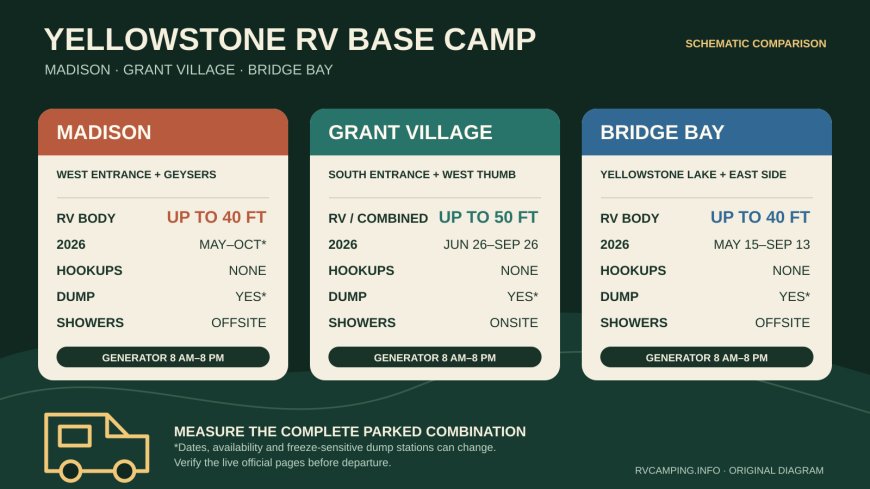

Yellowstone RV camping: Madison vs Grant Village vs Bridge Bay
By Romana | Information checked October 18, 2026
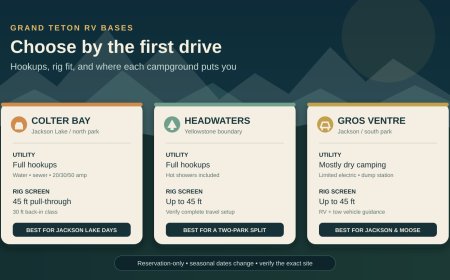
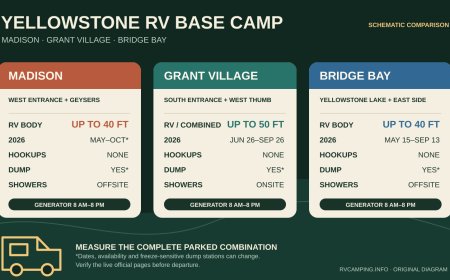
Madison, Grant Village, and Bridge Bay are all dry campgrounds, but they solve different Yellowstone routing problems. Madison is the west-side and geyser-basin base with the longest 2026 season. Grant Village is the strongest fit for a longer rig and the only one of the three with showers and laundry at the campground complex. Bridge Bay puts a dry-camping RV beside Yellowstone Lake and the marina, with easier access to Lake Village and the east side of the Grand Loop.[1][3][4][5]
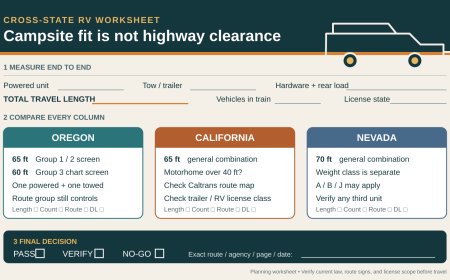
The catch is that a campground-level length number is not a site assignment. For Bridge Bay and Madison, the NPS comparison table lists a 60-foot maximum for RV plus vehicle, while the concessioner's detailed pages say the RV itself can be no longer than 40 feet and describe inventory beyond 40 combined feet as scarce.[1][3][5] Grant Village publishes 50 feet in both places.[1][4] Measure the entire arrangement, enter it accurately during booking, and treat the confirmed equipment category as the limit. Do not assume a 40-foot motorhome plus a towed car fits because the table contains a 60.
Quick comparison for an RV decision
| Decision point | Madison | Grant Village | Bridge Bay |
|---|---|---|---|
| Best route fit | West Entrance, Old Faithful, and the geyser basins | South Entrance, West Thumb, and the south lake | Yellowstone Lake, Lake Village, marina, and east-side days |
| 2026 published season | May 1-Oct. 17 on NPS table; concessioner page says through Oct. 18 | June 26-Sept. 26 | May 15-Sept. 13 |
| NPS RV + vehicle maximum | 60 ft | 50 ft | 60 ft |
| Detailed concessioner RV limit | RV up to 40 ft; 40+ combined sites limited | RV up to 50 ft; 50-ft combined sites limited | RV up to 40 ft; 40+ combined sites limited |
| Campsite hookups | None | None | None |
| Dump station | Yes; freezing can close it early or late | Yes; freezing can close it early or late | Yes; freezing can close it early or late |
| Showers/laundry | Not onsite; nearest listed at Canyon | At nearby camper-services building; two showers per paid night | Not onsite; nearest listed at Fishing Bridge RV Park |
| Generator rule | RV/combination sites only, 8 a.m.-8 p.m., 60 dB at 50 ft | Same | Same |
| 2026 standard rate | $38 plus tax | $45 plus tax | $38 plus tax |
These are planning specifications, not live inventory. Opening dates, closing dates, dump-station operation, rates, site categories, and vacancies can change. Search the reservation system again with your dates and exact equipment before committing to the route.
Rig fit: use total deployed length, not the model name
The booking rule is more demanding than a motorhome badge or trailer box length. Yellowstone National Park Lodges tells campers to provide the combined length of the RV and every other vehicle, including a truck plus trailer or a motorhome plus towed vehicle. It also says the trailer measurement should reflect the unit when fully open. Arriving with equipment different from the reservation can leave the campground unable to accommodate it.[3][4][5]
A useful worksheet has four numbers:
- the motorhome's bumper-to-bumper length, or the trailer's full travel/deployed length;
- the tow vehicle or towed vehicle length;
- the combined parked length required by the reservation category; and
- the width needed after slides, steps, and awnings are deployed.
The published length is only the first pass. All three campground pages warn that RV sites may be pull-through or back-in, may not be level, and have limited width for slide-outs.[3][4][5] Bring leveling equipment within the RV manufacturer's limits, but do not plan to fix a too-short or too-narrow site at check-in.
For a rig near the boundary, Grant Village is the clearest candidate. Its detailed page allows RVs up to 50 feet and says the limited largest category accommodates a 50-foot combined length.[4] Madison and Bridge Bay are murkier: each detailed page caps the RV at 40 feet, even though the NPS summary table shows a 60-foot RV-plus-vehicle maximum.[1][3][5] That distinction can work for a shorter RV with a separate vehicle; it does not publish permission for an RV body over 40 feet. Save the equipment confirmation from the reservation and call the official reservations office if the category wording does not match the actual setup.
Seasonal timing: Madison gives the widest window
Madison is the shoulder-season choice. The NPS campground table publishes a 2026 season of May 1 through October 17, while the current concessioner page says May 1 through October 18.[1][5] That one-day disagreement is exactly why changing availability needs a label rather than a promise. On October 18, the two official pages did not agree on the final operating day. Confirm status directly before traveling, especially for the closing weekend.
Grant Village had the shortest and latest-starting 2026 window, June 26 through September 26.[1] Its elevation is about 7,800 feet, and its dump station may be unavailable when freezing temperatures arrive.[4] The campground may be the best service fit while open, but it is not the fallback for a May or October trip.
Bridge Bay's published 2026 season was May 15 through September 13.[1] The concessioner also notes that some loops can remain unavailable early in the season because of potential bear activity.[3] An open campground therefore does not mean every loop or every large-rig category is on sale.
For all three, reserve first and build the route second. The NPS says Yellowstone campsites generally require advance reservations and fill far ahead; it also warns that dump stations can close below freezing.[1] None of these three should be treated as a drive-up solution for a long combination.
Hookups and services: all three require a dry-camping plan
There are no electric, water, or sewer hookups at Madison, Grant Village, or Bridge Bay.[3][4][5] The NPS identifies Fishing Bridge RV Park as the park's only campground with water, sewer, and 50-amp electric hookups.[1] A reservation at one of the three comparison campgrounds therefore requires enough battery, propane, fresh-water capacity, and waste-tank capacity for the stay.
Each campground has flush toilets, cold running water, dishwashing stations in most restroom buildings, and a dump station.[3][4][5] Water access near a site is not a campsite connection. Plan to fill through an approved potable-water point and do not count on leaving a hose attached.
Grant Village has the strongest campground service package. Its camper-services building has public showers and laundry, and the standard campground rate includes two showers per night, excluding group campsites.[4] Bridge Bay directs campers to Fishing Bridge RV Park for the nearest laundry and showers.[3] Madison directs them to Canyon Campground.[5] Those offsite errands consume driving time and parking capacity, so they matter more than they appear in an amenity checklist.
Generator constraints change the value of solar and batteries
The same rule applies at all three concessioner campgrounds: generators are allowed only at RV or combination sites, only from 8 a.m. to 8 p.m., and only at 60 decibels or less when measured from 50 feet. They are prohibited at tent-only sites. Quiet hours run from 10 p.m. to 6 a.m.[3][4][5]
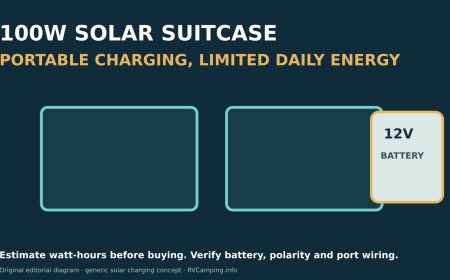
That leaves a two-hour evening gap when quiet hours have not started but generator operation has ended. An RV that needs overnight heat controls, a CPAP, refrigeration, or other electrical loads must carry enough battery capacity to bridge the night without generator help. High-elevation cold can also increase furnace use. Solar may help in open sites, but trees, clouds, latitude, and short shoulder-season days make it a supplement rather than a guaranteed daily refill.
Book an RV or combination category if generator use is part of the plan. A tent-only reservation does not become generator-eligible because the camper arrives in a vehicle.
Route implications: choose the side of the park you will use most
Madison reduces the first and last miles for a West Entrance itinerary. The NPS average is 30 minutes from the West Entrance to Madison Junction, then 35-45 minutes from Madison Junction to Old Faithful.[2] That makes Madison the natural base for repeated days in the Upper, Midway, and Lower geyser basins. It also avoids dragging a long combination across more of the Grand Loop on arrival from West Yellowstone.
Grant Village is the logical south-gate base. NPS averages are 50 minutes from the South Entrance to Grant Village, 40 minutes from Old Faithful to Grant Village, and 45 minutes from Grant Village to Lake Village.[2] From Madison Junction to Grant Village via Old Faithful, the published segments total about 75-85 minutes before wildlife, weather, construction, or stops. Grant works well for West Thumb and a Grand Teton-linked trip, but it adds distance to west-entrance errands and northern park days.
Bridge Bay favors lake and east-side plans. It sits beside Yellowstone Lake near Bridge Bay Marina, while the campground page places showers, laundry, and additional services at nearby Fishing Bridge.[3] The NPS average from the East Entrance to Lake Village is 60 minutes and from Lake Village to Canyon Village is 35 minutes.[2] Bridge Bay therefore makes more sense than Madison for an itinerary centered on the lake, Hayden Valley, or Canyon, provided the RV can dry camp and fit the assigned category.
Do not confuse the park's road limit with campsite fit. Yellowstone allows recreational vehicles up to 75 feet on park roads, but many roads have steep grades and sharp curves.[2] A legal 70-foot combination can still be too long for all three campground reservations. Road legality gets the rig to the registration building; the site category determines whether it can stay.
Which campground should you book?
Choose Madison when west-side access and a May-to-October operating window matter more than onsite showers. It is the practical match for Old Faithful-heavy itineraries and arrivals through West Yellowstone, but RVs over 40 feet should not infer eligibility from the NPS 60-foot combined figure.
Choose Grant Village when the equipment needs the clearest 50-foot fit, the trip enters from the south, or onsite showers and laundry will reduce service runs. Its tradeoff is a shorter season and a location that adds time to northern and western destinations.
Choose Bridge Bay for Yellowstone Lake, the marina, Lake Village, and east-side touring. It has the same dry-camping and 40-foot RV-body limits described at Madison, plus a shorter 2026 season. Its showers and laundry require a separate stop at Fishing Bridge RV Park.
Before payment, recheck three things on the live official pages: the operating dates for the intended year, the available equipment category for the complete rig, and any current road or service notice. Availability and seasonal services are changing information. The dimensions of the RV are not.
Sources
- Camping in Yellowstone National Park - National Park Service - Official 2026 dates, rates, campground service table, RV-plus-vehicle limits, reservation guidance, and hookup warning. Retrieved October 18, 2026.
- Directions and transportation - Yellowstone National Park Service - Official average drive times, road-planning cautions, and the park road length limit for recreational vehicles. Retrieved October 18, 2026.
- Bridge Bay Campground - Yellowstone National Park Lodges - Official operator details for rig measurement, RV length, dry-camping services, dump station, generator use, and nearby showers. Retrieved October 18, 2026.
- Grant Village Campground - Yellowstone National Park Lodges - Official operator details for the 50-foot limit, showers, laundry, hookups, dump station, and generator use. Retrieved October 18, 2026.
- Madison Campground - Yellowstone National Park Lodges - Official operator details for 2026 dates, rig measurement, RV length, services, dump station, and generator use. Retrieved October 18, 2026.
What's Your Reaction?