














How level does an RV refrigerator need to be? Start with the model number
Use the exact refrigerator data label and manual to separate parked absorption guidance, travel operation, compressor installation, and safe RV leveling.

How level does an RV refrigerator need to be? Start with the model number
By Romana | October 18, 2026
“Three degrees one way, six degrees the other” gets repeated as if it were the rule for every RV refrigerator. It is not. The right limit belongs to the refrigerator model in your RV, and the instructions may be numeric, qualitative, or concerned with installation rather than a parked operating angle.
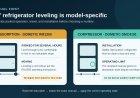
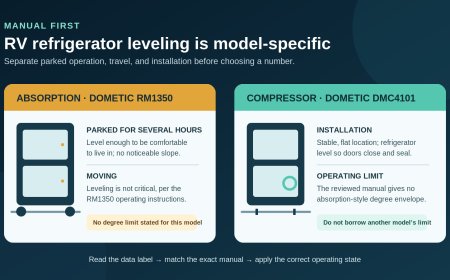
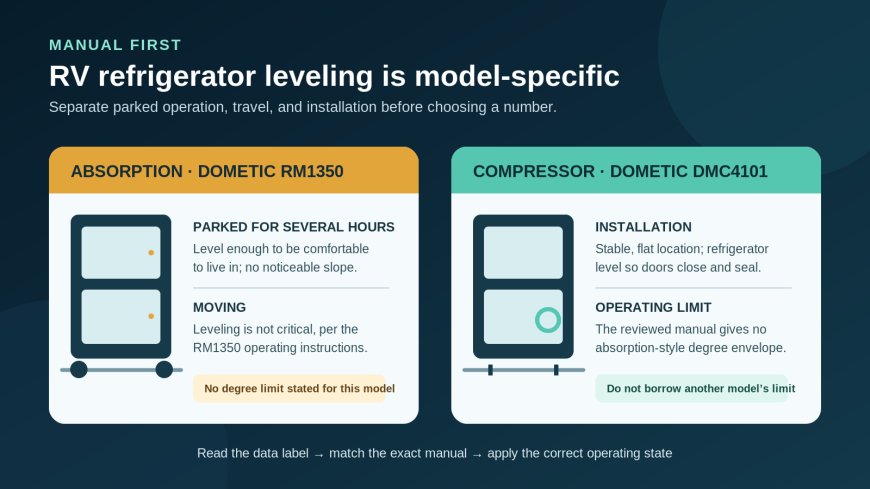
This article uses one exact absorption refrigerator as the main case: the Dometic RM1350. Its operating instructions do not give a degree limit. They say the RV should be level enough to be comfortable to live in, with no noticeable slope in the floor or walls, when parked for several hours with the refrigerator running.[1] That wording, not a borrowed number, is the RM1350 rule.
A compressor refrigerator is a different machine. The Dometic DMC4101, used here for comparison, has installation-level instructions intended to keep the unit stable and its doors sealing correctly. Its manual does not publish the RM1350’s parked absorption guidance or an equivalent travel-versus-stopped degree limit.[2]
First, identify what is actually installed
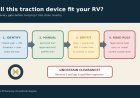
Open the refrigerator and photograph the data label. Record the full model and serial number, including every suffix. Then match that identity to the manual title and model list. Do not identify the refrigerator by the RV’s year, a dealer listing, cabinet size, door count, or a control panel that looks familiar.
For this worked example, the target is Dometic RM1350. The manufacturer’s operating document also covers RM1350SL variants, so an owner should still compare the complete label with the document before applying it. A nearby model number is not close enough for a safety or operating limit.
Also identify the cooling technology:
- An absorption refrigerator circulates a heated refrigerant solution and may offer LP gas plus electric operating modes. Gravity and the cooling-unit tubing matter to operation.
- A compressor refrigerator uses a motor-driven compressor. Its installation may still need to be level for stability, door alignment, drainage, noise, and cooling performance, but that does not make an absorption refrigerator’s angle limit transferable.
If the label is missing or unreadable, stop looking for a generic angle. Ask the RV maker or refrigerator manufacturer to identify the installed unit from build records or the refrigerator serial information.
The Dometic RM1350 rule while parked
Dometic calls leveling a requirement for proper operation of the RM1350 absorption refrigerator. The manual’s practical test is that the vehicle is comfortable to live in, without noticeable sloping of the floor or walls.[1]
The time and operating state matter. Dometic says the RV should be leveled when it is parked for several hours with the refrigerator operating. The stated reason is to avoid a loss of cooling.[1] This is not permission to run indefinitely on any slope that feels tolerable, nor does it create a universal number that can be entered into every leveling app.
A sensible RM1350 campsite decision therefore has three checks:
- Confirm the label says RM1350 or a specifically covered RM1350SL variant.
- Confirm the refrigerator will be operating while the RV remains parked for several hours.
- Level the RV until there is no noticeable slope in the occupied space, using the RV and leveling-system instructions.
If the site cannot be brought within that manual language without questionable blocking, excessive jack travel, or lifting wheels, move to a more suitable site or turn the refrigerator off using its documented procedure. Protecting the refrigerator never justifies making the RV unstable.
Moving is not the same as parked
The RM1350 manual says leveling is not critical while the vehicle is moving because the rolling and pitching motion carries the liquid across both sides of level rather than letting it collect in the evaporator tubing.[1] That statement answers only the leveling question. It is not blanket approval to operate the refrigerator on any energy source during travel.
Travel operation also depends on the RV, refrigerator, fuel system, route restrictions, tunnels, ferries, fueling rules, and the instructions for the installed appliances. Follow those documents. Never treat “leveling is not critical while moving” as “LP gas is allowed everywhere while driving.”
A traffic stop is not automatically the same as camping for several hours. The RM1350 wording is tied to a vehicle parked for several hours with the refrigerator operating.[1] If a delay turns into an extended stationary wait on a slope, use the manual’s parked guidance rather than pretending the RV is still in normal motion.
Why the familiar 3° and 6° numbers still appear
Those numbers are real for some models. They are simply not the RM1350 instruction.
Norcold’s 2021 N4000-series manual covers named absorption models N4104, N4141, and N4150. It specifies operation within 3 degrees off level side to side and 6 degrees front to back, measured while looking at the refrigerator’s front. It warns that operation beyond those limits can damage the cooling system and create a risk of injury or property damage.[3]
That manual also says the refrigerator should be level when the vehicle is stopped and that performance during travel is not usually affected.[3] The numeric limits are therefore a valid example of model-family guidance. They are not evidence that Dometic silently intended the same numbers for the RM1350.
Orientation is another reason not to quote numbers loosely. Norcold defines side to side and front to back from the refrigerator’s front, which may not match the RV’s longitudinal and lateral axes. A refrigerator installed along a sidewall can swap the direction an owner assumes. Read the reference orientation in the exact manual before translating a degree into blocks, inches, or app readings.
Compressor refrigerators: level installation, different operating question
Dometic identifies the DMC4101 as a DMC-series refrigerator and gives it 12-volt power specifications. In the installation section, the manual requires a level floor and a level refrigerator in a sturdy enclosure.[2] It warns that poor leveling during installation can keep the doors from closing or sealing correctly and can lead to cooling, frost, or moisture trouble. The positioning procedure calls for a stable, flat location, adjustment of the leveling feet, and at least four hours upright before startup.[2]
Those are concrete requirements, but they are not a published campsite operating-angle envelope. The DMC4101 manual reviewed for this article does not state that the RV must meet the RM1350’s “comfortable to live in” test whenever parked for several hours. It also does not publish the Norcold N4000 series’ 3-degree/6-degree operating limit.[2]
Do not turn that absence into “a compressor fridge can run at any angle.” Use the DMC4101 installation instructions, keep the RV within the limits of its chassis and leveling equipment, and investigate doors that do not seal, unusual noise, or poor cooling. If an owner needs an allowable operating angle for a specific situation, Dometic should answer for the exact model and installation.
Level the RV without creating a larger hazard
Refrigerator guidance does not override the leveling-system manual. Lippert’s Ultra Level instructions call for solid, level ground, clear jack landing areas, load-distribution pads on very soft surfaces, and people and pets clear while the system operates.[4] The manual also says never to lift the coach completely off the ground because wheels losing contact creates an unstable, unsafe condition.[4]
Apply these boundaries:
- Park and secure the RV according to its owner’s manual before leveling.
- Use wheel chocks, blocks, jack pads, stabilizers, and hydraulic or electric levelers only as their manufacturers direct.
- Do not use stabilizer jacks as lifting jacks unless their manual explicitly says they are designed for that job.
- Do not stack makeshift materials or crawl under an RV supported only by leveling equipment.
- Keep tires on the ground when the leveling-system manual requires it.
- Relocate if safe leveling is not possible within the equipment instructions.
A refrigerator does not need to be “perfectly level” unless its own manual says so. Chasing a centered bubble beyond the model’s requirement can add unnecessary setup work and tempt owners into unsafe jack or block arrangements.
A model-specific refrigerator leveling card
Keep a short record with the RV manuals:
| Field | What to record |
|---|---|
| Refrigerator manufacturer | From the data label |
| Full model and suffix | Example: Dometic RM1350, not “Dometic four-door” |
| Cooling technology | Absorption or compressor |
| Manual title, form number, revision | Match the exact model list |
| Parked operating requirement | Quote or summarize the model manual accurately |
| Travel statement | Record separately from parked operation |
| Reference orientation | Refrigerator front, RV front, or another defined view |
| Leveling-system safety limits | From the exact jack, stabilizer, or trailer manual |
| Unresolved questions | Manufacturer or qualified RV technician contact and answer |
For the Dometic RM1350, the card should say that parked operation for several hours calls for leveling until the RV is comfortable to live in with no noticeable slope. It should not say “3°/6°” unless Dometic provides that limit for the exact installed variant in controlling documentation.[1]
For a Dometic DMC4101, the card should preserve the level-installation and door-seal instructions without relabeling them as an absorption-style parked operating limit.[2]
The useful question is not “How level must an RV fridge be?” It is “What does the manual require for this model, in this operating state?” The label and manual settle that question more reliably than campground folklore.
Sources
- Dometic, RM1350 & RM1350SL Operating Instructions (manufacturer manual, mirrored by Forest River) — Model-specific absorption leveling guidance for parked and moving operation.
- Dometic, DMC4081 & DMC4101 Installation and Operation Manual, Revision C (November 2024) — Compressor refrigerator identity, installation leveling, door-seal warning, positioning, and startup instructions.
- Norcold, N4000 Series Installation and Owner’s Manual, Part No. 639972B (January 19, 2021; manufacturer manual mirrored by Forest River) — Model-family absorption limits and separate travel statement.
- Lippert Components, Ultra Level Motorized Leveling Owner’s Manual (manufacturer manual mirrored by Forest River) — Leveling-system ground, clearance, pad, and wheel-contact safety guidance.
What's Your Reaction?