




Your reserved campground changed: build a backup RV route before departure
A route-and-reservation worksheet for choosing a rig-compatible backup campground, setting a switch point, and responding when the primary closes or access changes.


By Romana
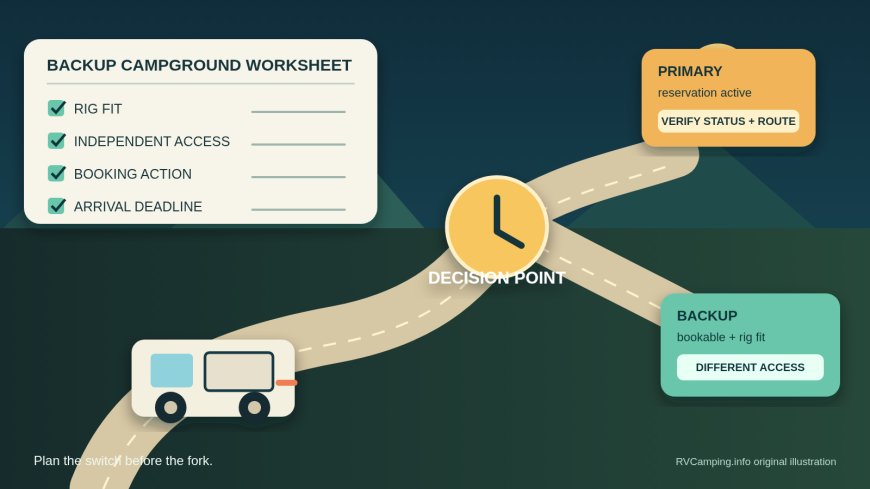
A campground reservation is only one part of an RV arrival plan. The other part is a route that still works if the campground closes, a gate or approach road changes, the booked loop loses services, or the operator cancels the stay. Build that fallback before departure: choose a second campground that fits the complete rig, verify a genuinely different access route, record how and when it can be booked, and set a decision point before the two routes separate.
This worksheet is for an ordinary trip disruption, not a wildfire evacuation. If officials order an evacuation or close an area for immediate safety, follow their directions rather than trying to preserve the itinerary. It also is not a first-come camping strategy. The backup here must have a defined reservation path or confirmed same-day inventory process; “maybe there will be a site” is not the plan.
A reservation does not freeze the access conditions
A campground can remain open while one road, loop, amenity, or nearby attraction changes. The opposite can happen too: the road may be open while the campground is closed. Check the reservation record, campground page, managing unit’s alerts, and the official road source as separate items.
Great Basin National Park gives fall campers a blunt example. Several named campgrounds may close for winter weather as early as September; the park says affected reservations are canceled and refunded and tells travelers to prepare another overnight option.[1] Mt. Hood National Forest likewise warns that conditions can shift quickly and points visitors to forest alerts, closure orders, district offices, and road information. Its examples include storms, construction, debris, snow, and seasonal gates, not one single hazard.[2]
That distinction matters. “Reservation active” answers whether a booking exists. It does not prove that your planned entrance is open, that the site still has the listed services, or that your RV can use a detour.
Pick a backup that does not share the same weak link
Start with the failure you are trying to survive. If both campgrounds use the same one-lane forest road, bridge, mountain pass, or entrance gate, the second pin is not much of a backup. Look for separation in at least one useful direction:
- a different approach highway or branch point;
- another managing unit or operator;
- a lower elevation or later operating season;
- a different utility setup, such as dry camping when the primary depends on water or power;
- a location on the onward route rather than deeper into the affected area.
Then apply the normal RV fit screen. Record the maximum combination length, site length, width, overhead clearance, grade, surface, turning room, hookup type, generator limits, and whether the tow vehicle must fit on the same pad. Do not let a shorter drive override an obvious rig mismatch.
Access instructions deserve their own field. Recreation.gov’s listing for Chilhowee Campground warns RV drivers not to follow GPS onto Benton Springs Road and directs them to Forest Service Road 77 instead; the recommended approach still includes seven miles of narrow, winding road.[5] A backup route copied from a navigation app can fail even when the campsite itself fits.
Decide whether to reserve, watch, or replace
For each candidate, write one of three statuses:
- Reserved backup. Use this only when overlapping reservations are allowed, you understand the cancellation cost, and you have a calendar reminder to release the unused site promptly.
- Bookable backup. Inventory is open, the site fits, and you have saved the exact booking page, site number, price, and latest time you are willing to book.
- Search lead. The campground might work, but a missing fit, access, season, or booking fact keeps it out of the operational plan.
Do not assume Recreation.gov’s general policy settles the question. Its standard rules say individual facility terms take precedence, and cut-off windows vary by location.[3] Recreation.gov also says the participating agencies and individual facilities set their own booking details and rules.[4] Read the specific campground page and the checkout terms that apply to the exact reservation.
If the primary is still usable but the trip no longer suits you, that is normally a traveler cancellation, not an agency closure. Recreation.gov’s general camping policy describes fees for ordinary and late cancellations. It separately says emergency closures receive fee refunds and notification attempts.[3] Save the notice before acting, but do not promise yourself a closure refund unless the operator has actually closed the facility or approved the request under its local policy.
Put the switch before the fork
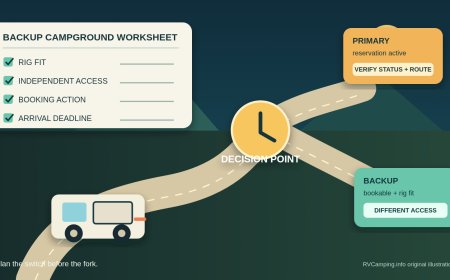
A useful decision point is the last practical place where the rig can still reach either campground without a difficult turnback. It might be a fuel stop before two highways split, the last town with dependable mobile service, or a wide junction before the primary’s final forest road.
Choose it on the map, then write a clock time beside it. Work backward from the backup’s arrival requirement:
Switch deadline = backup’s latest workable arrival time − remaining drive time − setup and delay margin
Use your own conservative towing or motorhome pace and add time for fuel, food, grades, construction, and the slower final approach. This is not a reason to drive faster. If the primary has not been confirmed by the switch deadline, take the route that preserves a legal overnight stay.
A decision point after the fork is too late. So is a backup whose office closes before your realistic arrival. If late arrival is permitted, save the gate, packet, site-post, and check-in instructions before leaving service.
Use this route-and-reservation fallback worksheet
Complete one row from official pages and confirmation records. Blank cells are unresolved work, not permission to assume.
| Field | Primary campground | Backup campground |
|---|---|---|
| Facility and managing unit | ||
| Exact site or acceptable site range | ||
| Reservation number / booking link | ||
| Status: reserved, bookable, or lead | ||
| Complete rig length and height accepted | ||
| Pad, turn, grade, and surface notes | ||
| Hookups, water, dump, generator limits | ||
| Official approach road and entrance coordinates | ||
| Shared road, gate, bridge, or pass | ||
| Alerts / closure page | ||
| Latest booking or change time | ||
| Cancellation and no-show cost | ||
| Check-in window and late-arrival method | ||
| Operator phone saved offline | ||
| Last verified: date, time, source |
Now add the switch strip:
| Decision item | Written answer |
|---|---|
| Last place with fuel and reliable signal | |
| Route fork or no-easy-turnback point | |
| Primary status that triggers the switch | |
| Time by which that status must be known | |
| Backup booking action and confirmation method | |
| Person responsible for booking while the driver is parked | |
| Safe stop if neither campground can be confirmed |
The final line matters. It should be a legal overnight option that does not depend on occupying a highway shoulder, closed entrance, trailhead, or full campground. It may be a commercial campground, an RV-legal overnight location with explicit permission, or a route reset to a town where you can stop safely and search again.
Recheck in layers, not once
Use a short verification rhythm:
- One week out: review facility notices, reservation terms, rig fit, and both routes. Replace a weak backup.
- Forty-eight hours out: confirm the primary and backup status, services, check-in method, and approach roads. Download pages, maps, and reservation records.
- Departure morning: check the managing unit’s alert page and the road authority. Make sure the Recreation.gov profile has a current phone number and email; account contact details are used for reservation and closure updates.[4]
- At the decision point: stop safely, check the primary one last time, and either continue or execute the saved booking action.
Record what changed and where the information came from. A banner on the facility page, a manager’s email, and a road closure from the responsible agency carry more weight than an old map pin or an undated campground review.
If the primary closes after you leave
Do not drive to the locked gate just to confirm what the official notice already says. Pull over somewhere suitable for the rig. Save the closure message, cancellation email, reservation number, and any refund instructions. Book or activate the backup only after checking that its route and arrival window still work.
If the backup has also failed, widen the search from the safe stop. Change one variable at a time: distance, hookup level, number of nights, or direction of travel. Do not trade away length fit or legal access simply because the original schedule is slipping.
A useful fallback is specific enough to execute without improvising: one campground, one suitable site class, one official route, one switch point, one deadline, and one booking action. That is the difference between a backup campground and another hopeful pin on the map.
Sources
- Alerts & Conditions — Great Basin National Park — National Park Service; campground closure, refund, and alternate-overnight guidance. Accessed September 22, 2026.
- Current Conditions — Mt. Hood National Forest — U.S. Forest Service; alerts, closures, changing conditions, district contacts, and road access. Accessed September 22, 2026.
- Rules and Reservation Policies — Recreation.gov; facility-specific precedence, cut-off windows, cancellations, and emergency closures. Accessed September 22, 2026.
- Frequently Asked Questions — Recreation.gov; account notifications and facility control of local reservation rules. Accessed September 22, 2026.
- Chilhowee Campground — Recreation.gov and Cherokee National Forest; official RV approach warning and route direction. Accessed September 22, 2026.
Source credit: National Park Service, U.S. Forest Service, and Recreation.gov. This article provides general trip-planning information. Confirm current facility status, route restrictions, reservation terms, and rig fit before travel.
What's Your Reaction?