













Egg safety at an RV campsite: from the store to leftovers
Keep eggs safe from the grocery case to an RV breakfast with cooler targets, cracked-shell decisions, cooking guidance, a serving clock and leftover rules.

Egg safety at an RV campsite: from the store to leftovers
By Romana
Category: Cooking
Eggs travel well only when the cold chain, shell and clock all stay intact. Buy a sound refrigerated carton, carry it at 40°F or below, cook shell eggs until the white and yolk are firm, and chill cooked egg dishes before the campsite serving clock runs out.
The short answer: Open the carton before buying and reject cracked eggs. Move the carton straight into a refrigerator or ice-packed cooler at 40°F or below. At camp, discard an egg with a crack of unknown age, keep raw egg off ready-to-eat food, cook individual eggs until the yolk and white are firm, and take egg dishes to 160°F. Refrigerate cooked eggs and egg dishes within two hours, or within one hour when the air temperature is above 90°F.[1][2]

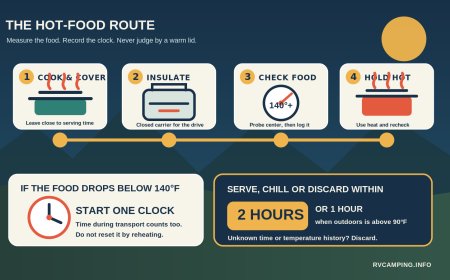
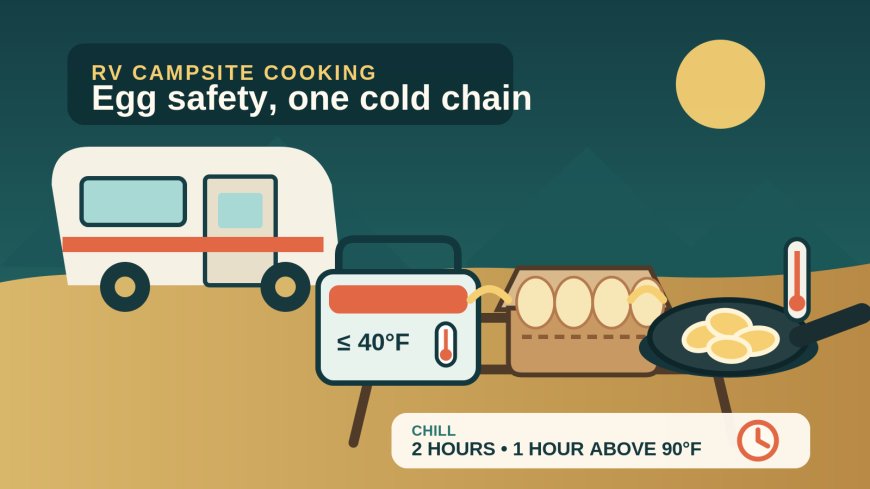
Build the breakfast around a cold chain and one serving clock. Illustration: RVCamping.info.
The campsite plan in five moves
The simplest routine is also the easiest to hand to another cook:
- Inspect. Buy eggs from a refrigerated case. Open the carton and check every visible shell.
- Chill. Put the carton in verified cold storage at 40°F or below.
- Contain. Keep the carton protected from crushing and separate any raw-egg mess from food that is ready to eat.
- Cook. Use the correct doneness test for the food in front of you.
- Clock. Serve now, hold safely, or refrigerate promptly.
Those five verbs matter more in a small RV galley than a complicated packing list. They also create useful handoff points. The person who buys breakfast can report that the shells were intact. The person loading the cooler can report its thermometer reading. The cook can mark the serving time on a phone.
Shop for an intact cold carton
FDA advises buying eggs only from a refrigerator or refrigerated case, opening the carton, and checking that the shells are clean and uncracked.[1] Do this before the carton enters the cart. A cardboard lid hides the one defect that matters most here.
Make eggs one of the last cold items you pick up, then drive them to cold storage instead of leaving them in a parked vehicle during another errand. FDA says to store eggs promptly in a clean refrigerator at 40°F or below and to use a refrigerator thermometer.[1]
For an RV trip, the practical handoff is store case to travel cooler to campsite refrigerator:
- Pre-chill the cooler if possible.
- Load the carton level rather than on its side.
- Place it in a rigid, lidded food-safe bin or another protected space so a shifting drink bottle cannot crush it.
- Add enough ice, gel packs or frozen water bottles to keep perishables below 40°F.[3]
- Put a thermometer where it can be read quickly.
- Keep the cooler in the passenger area or another air-conditioned space while driving, then move it into shade and limit lid openings at camp.[1]
The bin is an RV packing tactic, not a federal requirement. It should protect the carton without insulating it from the cooler's cold air. If the same cooler also carries raw meat, use sealed secondary containers and arrange them so meat juices cannot reach the egg carton or ready-to-eat food.
Use the original carton in cold storage
FDA recommends storing eggs in their original carton; USDA says to keep that carton in the coldest part of the refrigerator rather than the door.[1][2] The carton protects the shells, keeps the date and handling label with the food, and gives each egg its own pocket.
A small RV refrigerator deserves a real thermometer. A lit control panel or a cold-feeling shelf does not prove that the food compartment is holding 40°F or below. Read the thermometer after the refrigerator has stabilized, after a travel day and after any propane, shore-power or battery change that could interrupt cooling.
Keep the carton level and away from the door shelf, where movement and repeated warm-air exposure work against the plan. Do not wash the eggs before storing them. USDA says home washing is unnecessary and may increase contamination risk because wash water can be drawn through shell pores.[2]
FDA's best-quality window for shell eggs is three weeks in the original carton. Hard-cooked eggs, peeled or still in the shell, should be used within one week.[1] Those are refrigerator timelines, not permission to keep a carton in an unmonitored cooler for a week.
What to do with a cracked egg
A crack is a decision point, not a cosmetic flaw. USDA says bacteria can enter through shell cracks and tells shoppers never to purchase cracked eggs.[2]
Use this campsite rule:
- Cracked in the store: leave the carton behind or choose another one.
- Cracked during hard cooking: USDA says the egg is safe; finish cooking and handle it like any other hard-cooked egg.[2]
- A crack appears during packing or transit and you know exactly when it happened: the federal page archived for this article does not give a consumer salvage procedure for that situation. The low-risk RV choice is to discard the egg rather than carry a leaking raw egg through a crowded cooler.
- You discover a dried leak or a crack of unknown age: discard it. You cannot reconstruct when the barrier failed or whether the cooler stayed cold enough from the shell's appearance.
Do not wash a cracked egg and return it to the carton. Do not use smell as a safety test, and do not let one leaking egg coat the other shells. Bag the damaged egg for disposal, wash hands, and clean the affected bin or cooler surface with hot, soapy water before it touches other food. FDA calls for hands, utensils, equipment and work surfaces to be washed before and after contact with raw eggs.[1]
For routine cooking, crack each egg into a small clean cup before adding it to the skillet or mixing bowl. That is an editorial workflow, not a USDA rule. It catches shell fragments and keeps one bad egg from being mixed into the whole batch. Wash the cup or swap it before it is used for cooked food.
Cook the food, not one universal number
Egg safety does not have one temperature instruction for every preparation.
For fried, poached and other individual shell eggs, federal consumer guidance says to cook until both yolk and white are firm. A scramble should have no runny egg left.[1] For a frittata, quiche, breakfast casserole or another egg dish, check the center with a food thermometer and reach 160°F.[2][4]
The distinction matters over a camp stove. A browned bottom or set edge does not tell you the temperature at the center of a thick skillet. Insert a clean thermometer into the coolest central section without touching the pan. Check more than one spot if the dish is deep or the burner heats unevenly.
Recipes served raw or undercooked need a different ingredient. FDA recommends pasteurized shell eggs or pasteurized egg products for foods such as homemade Caesar dressing or ice cream when the egg will remain raw or undercooked.[1] This is especially important for children, older adults, pregnant people and people with weakened immune systems, who face greater risk of severe Salmonella illness.[1]
A runny-yolk breakfast is outside the conservative federal method quoted here. If firm yolks are not the meal you want, use a labeled pasteurized product and follow its package directions rather than assuming an ordinary clean-looking shell is germ-free.
Start one serving clock
Cooked eggs and egg dishes should be served immediately or kept under temperature control.[1][2] At a campsite, write the finish time on a phone timer or a piece of tape on the serving container. Everyone then works from the same clock.
The discard deadline is two hours out of refrigeration. It drops to one hour when the air temperature is above 90°F.[1][3] The shorter limit can apply even when breakfast is served in morning shade; use the measured air temperature, not the season or how comfortable the picnic table feels.
The clock is cumulative. Time on the stove edge, picnic table and cleanup counter all belongs to the same interval. Moving a warm platter into shade does not restart it.
For a group breakfast, put out a small portion and keep the reserve cold. FDA recommends keeping cold egg dishes on ice when they will remain out longer than two hours and serving smaller platters that can be replenished.[1] A shallow pan nested in clean ice works better than trusting a large bowl to stay cold on its own. Keep meltwater from entering the food.
If you are not actively keeping the food cold, refrigerate it before the deadline. When the safe interval has passed, discard it instead of reheating it as a rescue.
Cool and store leftovers in an RV refrigerator
FDA says to refrigerate leftover cooked egg dishes and use them within three to four days. A large hot batch should be split among shallow containers so it cools quickly.[1] USDA gives the same three-to-four-day window for cooked egg dishes.[2]
In an RV, shallow containers solve two problems: they cool faster and fit without blocking most of the refrigerator's airflow. Portion a deep breakfast casserole instead of pushing the hot skillet into a packed refrigerator. Cover the containers, label them with the cook date, and confirm that the refrigerator is still at 40°F or below.
Hard-cooked eggs have a different limit: use them within one week.[1] Egg salad made from those eggs does not inherit a fresh seven-day clock; once it becomes a prepared leftover, use the storage guidance for that prepared food and the earliest-expiring ingredient.
Reheat a refrigerated egg dish to 165°F before serving. Both FDA's egg guidance and the federal safe-temperature chart give 165°F for reheated egg dishes or leftovers.[1][2][4] Check the center. In a microwave, stir or rotate when possible, allow any package-directed standing time, and verify the temperature in more than one place.
Discard leftovers when their time or temperature history is missing. A container with no label after several shared breakfasts is not a puzzle worth solving.
A one-bin egg kit for the next trip
Keep these items together so breakfast does not depend on finding gear in three cabinets:
- appliance thermometer for the cooler or refrigerator;
- tip-sensitive food thermometer for egg dishes and reheating;
- rigid lidded bin sized for the carton;
- clean small cup for cracking one egg at a time;
- shallow leftover containers and date labels;
- soap, potable water and paper towels for raw-egg cleanup;
- enough cold sources for the travel cooler.
The useful part is the sequence. Check shells before paying. Verify cold storage before loading. Decide how doneness will be measured before lighting the burner. Start the serving clock when cooking ends. Label leftovers before the cook walks away.
Source note: RVCamping.info adapted FDA, USDA FSIS and FoodSafety.gov consumer guidance into an original RV workflow. The protected carton bin, one-egg cup, handoff checks, timer and one-bin kit are editorial planning tools, not federal requirements or claims based on hands-on product testing.
Sources
- What You Need to Know About Egg Safety | FDA (FDA consumer guidance; live page archived locally on September 20, 2026; content current March 5, 2024)
- Shell Eggs from Farm to Table | USDA FSIS (USDA FSIS consumer guidance; Wayback snapshot archived September 12, 2026)
- Pack Food Safety on Your Next Hike or Camping Trip | USDA FSIS (USDA FSIS camping guidance; Wayback snapshot archived September 12, 2026; page updated August 30, 2022)
- Cook to a Safe Minimum Internal Temperature | FoodSafety.gov (FoodSafety.gov federal temperature chart; Wayback snapshot archived September 12, 2026; page reviewed November 21, 2024)
What's Your Reaction?