







The generator was outside. Then the RV's CO alarm sounded.
A cold-weather campsite failure shows what to do when an RV CO alarm sounds after a portable generator is moved too close: leave, call 911, wait, then correct the exhaust setup.

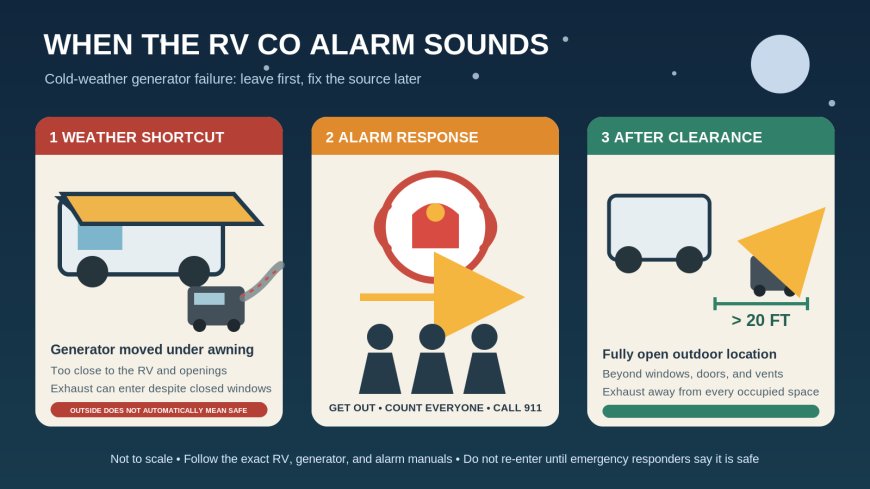
The generator was outside. Then the RV's CO alarm sounded.
By Romana | October 23, 2026 | Tips and Trends
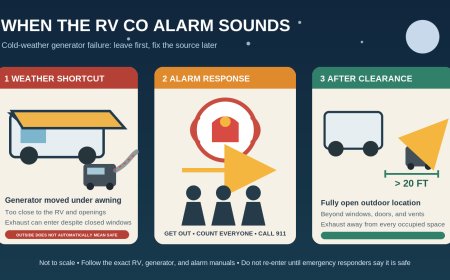
It is 24°F at a dry campsite when sleet starts blowing sideways. The portable generator had been well out from the RV, but someone drags it under the edge of the awning to keep it dry. The furnace is cycling, every window is shut, and the exhaust now has a short path toward the rig. Forty minutes later, the carbon-monoxide alarm gives its CO pattern.
The first job is not deciding whether the furnace or generator caused it. Everyone gets outside, accounts for every person and pet, moves clear of the exhaust path, and calls 911. CPSC says not to ignore a CO alarm: get outside immediately, then call 911. NPS fire guidance gives the same evacuation-and-call response.[1][3]

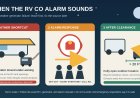
The useful sequence is leave, call, wait for clearance, then correct the source. Original RVCamping.info safety diagram; not to scale.
If a CO alarm sounds or anyone may have symptoms, move to fresh outdoor air and call 911. Do not re-enter to open windows, silence the alarm, stop an appliance, or retrieve gear. Wait for emergency responders to say the RV is safe.
The cold-weather shortcut that breaks the setup
The dangerous move in this scenario is easy to rationalize. The generator is still outdoors, the muffler appears to point away, and the awning is open on three sides. But "outside" is not enough.
CPSC calls for portable generators to run outdoors at least 20 feet from the house, with exhaust directed away from the home and other buildings. CDC uses the stricter phrase "more than 20 feet" from windows, doors, and vents.[1][2] At a campsite, apply that protection to your RV, neighboring rigs, tents, cabins, and any other occupied structure. This is a conservative campsite application of federal household guidance.
The Honda EU2200i manual illustrates why the improvised weather fix fails. It says to operate the generator outside, far from openings, with exhaust directed away from occupied structures; it also says not to cover the generator with boards or a tent.[4] The exact manual for the generator in use controls wet-weather operation. If rain, snow, site boundaries, or cord length leave no compliant location, the generator stays off.
Cold weather adds another trap. Campers close windows to retain heat, then treat a cracked window as the emergency remedy. An open window is not a substitute for source control, distance, or evacuation. It may even be an opening through which nearby exhaust enters. The NPS has documented a cold, windy camping incident in which a propane lantern produced enough CO in a pop-up trailer to trigger the detector despite the occupants' assumption that the fabric provided ventilation.[3]
When the detector sounds, leave the windows alone
A working alarm buys warning time. It does not assign the source, measure every part of the RV, or make it safe to remain inside.
Use this short response:
- Leave by the nearest safe exit. Take people and pets who are directly in your path, but do not delay to collect belongings.
- Gather in fresh air away from the generator, its exhaust, the RV's appliance outlets, idling vehicles, and neighboring combustion equipment.
- Count everyone and call 911. Say that an RV carbon-monoxide alarm sounded and report any symptoms.
- Stay out until responders give clearance. Do not go back because the alarm stopped or the door has been open.
Headache, dizziness, weakness, upset stomach, vomiting, chest pain, and confusion are common CO-poisoning symptoms, according to CDC. A sleeping or impaired person may not notice symptoms before being overcome.[2] Tell the dispatcher about possible exposure even if the symptoms could be mistaken for fatigue, altitude, a virus, or a cold night.
Do not make ventilation a precondition for escape. Opening a door on the way out is different from remaining inside to operate fans, cranking several windows, or returning to "air it out." Ventilation comes after evacuation and under responder direction. It also cannot make an unsafe generator location acceptable.
The alarm's exact manual still matters, but it does not outrank escape. For the cited SAFE-T-ALERT 25 Series, the CO response includes calling emergency services, moving to fresh air, accounting for everyone, and not re-entering until responders have arrived, the space has been aired out, and the alarm is back to normal.[5] Other models may use different signal patterns and controls, so keep the correct manual accessible outside the RV.
Do not cross the exhaust plume to save the generator
In the scenario, the generator is still running near the awning. Nobody should walk back through suspected exhaust to shut it down. Tell dispatchers and responders where it is, what fuel it uses, and how long it has been operating. If a shutoff can be reached only by approaching the machine or returning toward the RV, leave it to trained responders.
The same rule applies to the furnace, water heater, stove, and built-in generator. Do not remain in the RV to switch appliances off while an alarm is active. CO has no useful warning smell, and a quiet alarm after occupants leave does not prove the source has cleared.
An automatic generator CO shutoff does not change the response. Honda states that its CO-MINDER cannot prevent every CO danger.[4] If a generator stops itself, do not reset it in place and resume charging. Leave the area, respond to any RV alarm or symptoms, and correct the setup only after clearance.
After responders clear the RV, rebuild the campsite plan
Clearance to enter is not permission to restart everything. Keep the suspected equipment off until the source and contributing conditions have been evaluated. Give the responder or technician a simple timeline: when the generator moved, wind direction, which appliances were running, when the alarm sounded, observed symptoms, and whether another engine or generator was nearby.
Before any future portable-generator run:
- find a fully open location that meets CPSC's at-least-20-foot building guidance and CDC's more-than-20-foot separation from windows, doors, and vents;
- direct exhaust away from every RV, tent, vehicle, building, and occupied area;
- recheck after the wind shifts, a neighbor arrives, a window opens, or snow forces anyone to consider moving the unit;
- use only the weather arrangement permitted by the exact generator manual; and
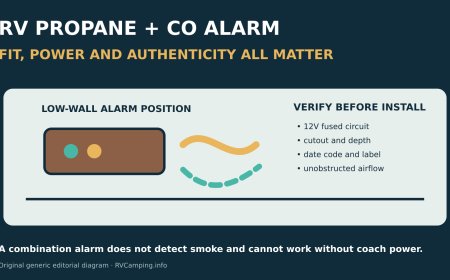
- test the installed RV CO alarm on its own schedule and replace it by its model-specific deadline.
The SAFE-T-ALERT manual used here calls for weekly tests while the RV is in use and says a failed alarm cannot warn of hazardous CO.[5] That interval is model-specific, not a universal schedule. Use the instructions for the alarm actually installed in the RV.
The cold-weather lesson is narrow. A generator that started in a safe place can become unsafe after the campsite changes. When the alarm announces that prevention failed, fresh air and an emergency call come before ventilation, shutdown, or diagnosis.
Evidence note: CPSC and CDC provide the generator distance and emergency-response guidance; NPS supplies the cold-weather camping context; the Honda and SAFE-T-ALERT manuals provide model-specific generator and detector limits. Campsite-wide application is RVCamping.info's conservative editorial advice.
Sources
- CPSC: What to Know About Generators and Carbon Monoxide — placement, exhaust direction, symptoms, alarms, and emergency response (reviewed October 23, 2026).
- CDC: Carbon Monoxide Poisoning Basics — symptoms, generator distance, openings, and detector guidance (reviewed October 23, 2026).
- National Park Service Fire Prevention 52: Carbon Monoxide, A Breath of Death — cold-weather camping incident, detector value, evacuation, and 911 guidance (reviewed October 23, 2026).
- Honda EU2200i Generator Owner's Manual — outside operation, exhaust direction, enclosure limits, and CO-MINDER limitations (2023 manual; reviewed October 23, 2026).
- SAFE-T-ALERT 25 Series RV Combination CO and Gas Alarm Manual — RV detector test schedule and CO-alarm response (2023 manual; reviewed October 23, 2026).
What's Your Reaction?