







Milk on the move: an RV dairy cold-chain plan
Keep milk and dairy at 40°F or below through RV travel and outages with thermometer checks, a cooler transfer plan and product-specific discard calls.

Milk on the move: an RV dairy cold-chain plan
By Romana
Category: Cooking
Milk is often the first grocery to expose a weak RV cold chain. It rides in a warm vehicle, lands in a refrigerator that is still pulling down to temperature, then gets moved again when shore power drops. The safe plan is built around measured temperature and known time, not whether the carton still feels cool.
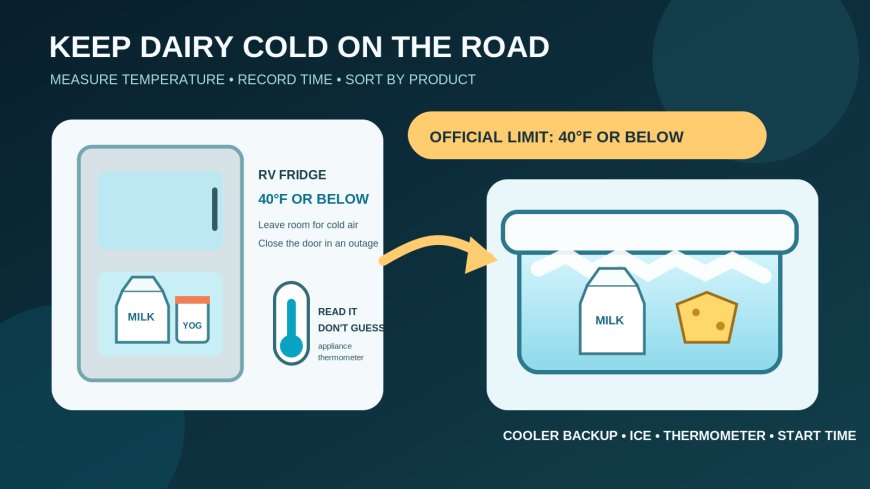
The short answer: Keep milk and refrigerated dairy at 40°F or below. During travel, use a cooler with ice or frozen gel packs and verify it with an appliance thermometer. During an outage, keep the RV refrigerator closed. Federal guidance says an unopened refrigerator protects food for up to four hours; if cooling will be off longer, move dairy to a cooler that can hold 40°F or below. After more than four hours without power or another cold source, discard milk, cream, yogurt, sour cream and soft cheese.[1][2][3]

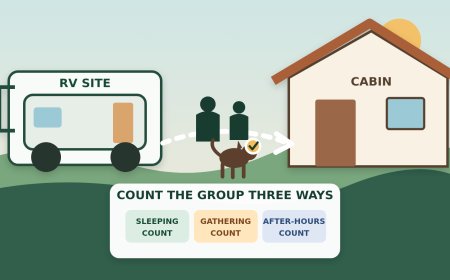
One thermometer reading and a written time are more useful than squeezing a carton. Original illustration by RVCamping.info.
Official limits and the planning buffer
The federal safety line is 40°F or below for refrigerated milk and milk products.[1][5] That is the official limit used throughout this guide. FDA also gives two hours as the general ceiling for perishable food left out of refrigeration, reduced to one hour when outdoor air is above 90°F.[1][2]
RVCamping.info's practical recommendation is to aim for 35°F to 38°F while the equipment is running normally. That range is not a second federal standard. It is an operating buffer for door openings, fuel stops and the warm groceries added at resupply. Do not lower the setting so far that milk freezes, and do not treat a 38°F reading as proof that every item had a safe history.
Put an appliance thermometer inside the food compartment. A thermostat setting, a green status light and cold air at the door do not report the food-storage temperature. FDA says refrigerator controls often do not show the actual temperature and recommends a freestanding appliance thermometer.[1]
Give dairy a departure check
Start with cold food and cold equipment. Chill milk, half-and-half, yogurt, cottage cheese and other refrigerated dairy at home before loading. If the RV refrigerator has been off, bring it down to temperature before transferring groceries. Adding a gallon of milk to a warm cabinet and expecting the refrigerator to catch up during the drive creates an avoidable gap.
Use this three-reading handoff:
- Record the home refrigerator or store-cooler handoff time.
- Read the travel cooler when it is loaded.
- Read the RV refrigerator after it has stabilized at the campsite.
The record is an editorial tool, not an agency requirement. Its job is to preserve the two facts needed later: how cold the dairy was and when it changed storage.
For a cooler, surround the food with ice, frozen gel packs or frozen water bottles. FDA says cold food in a cooler should remain at 40°F or below.[2] Place the thermometer where it can be read without emptying the cooler. Milk cartons and yogurt cups should stay sealed against meltwater, and glass jars need a rigid pocket where they cannot knock together.
A separate drink cooler is worth the space on a hot travel day. FDA specifically suggests separating drinks from perishables because the beverage cooler gets opened repeatedly.[2] If there is only one cooler, place same-day drinks at the top and keep the dairy grouped lower among cold sources.
Load the RV refrigerator for air, not capacity
A compact refrigerator still needs air movement. FDA advises against overpacking because cold air must circulate around refrigerated food.[1] Leave space around interior vents and avoid pressing a milk jug against a wall that is prone to freezing. Keep cartons upright in a bin that can contain a leak without sealing them inside an insulated bag.
The door is convenient but gets warm air every time it opens. Our practical setup is to give milk and other frequently used dairy a stable shelf location, then stage only the amount needed for breakfast or coffee. Return it promptly instead of leaving the full carton on the counter.
Check the thermometer after a long drive, after switching energy sources and after loading warm groceries. These are editorial checkpoints, not federally mandated intervals. They target the moments when an RV refrigerator is most likely to lose ground.
Run a closed-door outage plan
When cooling stops, write down the time and shut the door. USDA says a closed refrigerator can keep food safe for as long as four hours. If the outage will last longer, the agency advises transferring food to a cooler with enough ice or frozen gel packs to maintain 40°F or below.[3]
Do not confuse the four-hour refrigerator-outage allowance with the two-hour warm-food rule. The four-hour figure assumes the refrigerator stays closed. The two-hour limit applies when perishable food has been above 40°F; outdoor service drops to one hour above 90°F.[1][2][4] The limits do not add up to six hours.
Prepare the transfer before opening the refrigerator:
- set the cooler beside the door;
- add the cold sources and thermometer;
- label the cooler with the outage start time;
- make one quick dairy transfer; and
- close both lids.
That sequence is a practical recommendation. The official requirements behind it are the temperature, time and closed-door limits.[1][2][3]
If the start time is unknown, a thermometer reading taken after discovery cannot reconstruct the earlier hours. Do not taste milk or yogurt to decide. An ordinary smell also cannot prove that a perishable stayed safe.
Sort dairy by product, not by one blanket rule
Federal outage charts do not treat every dairy product alike. After exposure above 40°F for more than two hours, FoodSafety.gov says to discard milk, cream, sour cream, buttermilk, evaporated milk, yogurt and eggnog. It also puts soft cheeses, shredded cheeses and low-fat cheeses in the discard column.[4]
The same chart permits butter, margarine, processed cheese, hard cheeses such as Cheddar, Swiss and Parmesan, and grated Parmesan or Romano sold in a can or jar to be kept.[4] This is a chart-specific outage decision, not permission to ignore a package that says “keep refrigerated,” contamination, mold or damaged packaging.
Use four bins when the power returns:
- Discard: fluid milk and cream, yogurt, sour cream, soft cheese, low-fat cheese and shredded cheese when the applicable limit was exceeded.
- Chart says keep: butter, margarine, qualifying hard cheese and processed cheese, provided nothing else made the item unsafe.
- Verify the label: shelf-stable cartons and specialty cheeses whose storage directions depend on whether the package is unopened.
- Unknown history: discard refrigerated perishables when time and temperature cannot be established.
The sorting bins are RVCamping.info's presentation of the federal item-by-item chart. They do not change the chart's decisions.
Frozen dairy has different calls
Do not move frozen dairy into the refrigerator decision. FoodSafety.gov says thawed milk that still has ice crystals and feels refrigerator-cold may be refrozen, although texture can suffer. Milk held above 40°F for more than two hours goes in the discard column.[4]
Ice cream and frozen yogurt are stricter: the federal chart says to discard them even when ice crystals remain.[4] Soft and semi-soft cheese with ice crystals may be refrozen with possible texture loss, while hard cheese may be refrozen even after thawing under the chart's conditions.[4]
These distinctions are easy to miss during a hurried cleanup. Print or save the federal chart before traveling where cell service is weak.
Buy less risk at the next resupply
A smaller carton can be safer operationally than a large one if it will be finished before repeated warm handoffs. That is a planning choice, not a federal package-size rule. Match the quantity to verified cold space, trip length and the people who will use it.
At a farm stand or local shop, check that milk and dairy are made from pasteurized milk. FDA notes that interstate milk is pasteurized but some locally sold cheeses may not be, and tells consumers to check the label.[5] This is separate from temperature control: pasteurization does not make an opened refrigerated product shelf-stable.
Before pulling away from the store, answer five questions:
- Is the refrigerator already at 40°F or below?
- Is there enough cooler capacity for a failure during this leg?
- Can cold air circulate around the new groceries?
- Is the thermometer visible without unloading the shelf?
- Who will record the time if cooling stops?
Milk should not become the mystery item in the back of the RV refrigerator. Give it a measured handoff, leave the refrigerator room to work, and make outage decisions by the product-specific federal chart.
Evidence note: The 40°F limit, two-hour and hot-weather one-hour limits, closed-refrigerator four-hour allowance, cooler guidance and dairy-specific outage decisions are federal consumer guidance. The 35°F to 38°F operating target, three-reading handoff, shelf setup, transfer sequence, sorting bins and resupply checklist are RVCamping.info recommendations intended to make those limits easier to follow. They are not additional government rules or results of hands-on refrigerator testing.
Sources
What's Your Reaction?