






Camp chili without the temperature guesswork: cook, hold, cool and reheat
A measured RV campsite workflow for cooking meat chili, holding it hot, cooling leftovers in shallow portions and reheating one meal safely.

Camp chili without the temperature guesswork: cook, hold, cool and reheat
By Romana
Category: Cooking
Camp chili is forgiving about spice and beans. It is not forgiving about an undercooked meat base, an unheated pot on the picnic table, or several hot quarts squeezed into a compact RV refrigerator. Build the food-safety plan before opening the meat package: choose the correct cooking endpoint, decide whether dinner will be served at once or held hot, and reserve enough cold space to divide leftovers.
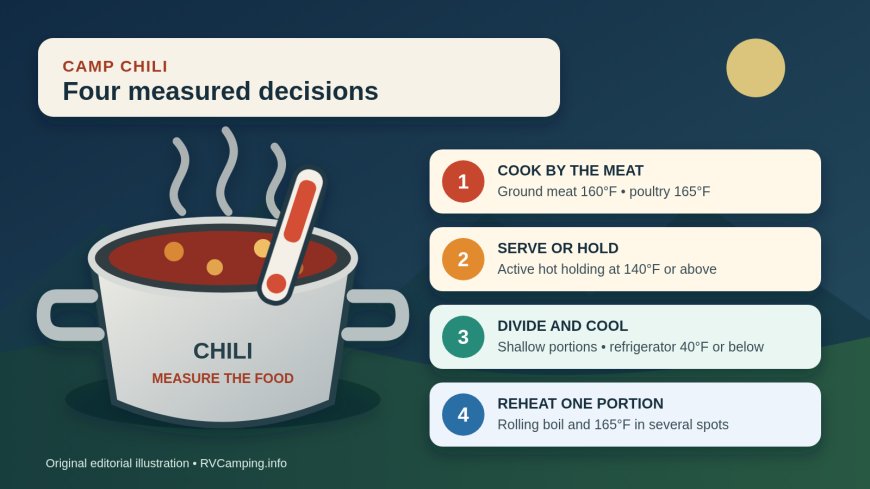
The short answer: Cook chili made with ground beef, pork, veal or lamb to at least 160°F; use 165°F when it contains ground poultry. Measure the food, not the burner or pot.[1] If service is delayed, keep the chili at 140°F or above. Otherwise, the refrigeration deadline is two hours, but it contracts to one hour once outdoor heat exceeds 90°F.[2][3] Split leftovers into shallow containers, keep them at 40°F or below, and reheat them to 165°F. USDA also directs consumers to bring reheated soups, sauces and gravies to a rolling boil.[3][4]

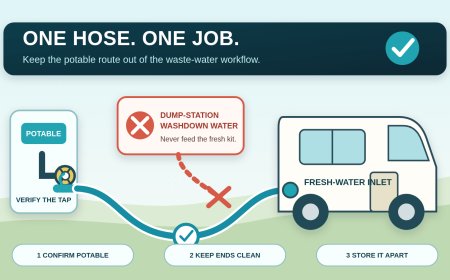
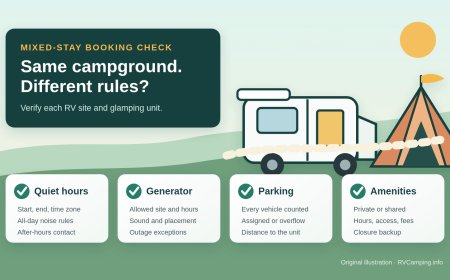
One pot, four measured decisions. Original editorial illustration by RVCamping.info.
Pick the cooking number from the meat, not the recipe name
There is no special federal “chili temperature.” The safe minimum follows the raw ingredient in the pot. USDA lists 160°F for ground beef, pork, veal and lamb, and 165°F for all poultry, including ground chicken or turkey.[1] A beef-and-turkey chili therefore uses the higher poultry endpoint.
Brown color is not the test. Crumbled meat can look done while a dense pocket remains cooler, especially on a small RV burner with a narrow flame. Stir from the bottom, break up clumps, and put a clean food-thermometer probe into several thick areas without touching the pot. Continue cooking if any checked area is below the endpoint for that meat.
A meatless chili made from canned beans and vegetables does not inherit a raw-ground-meat cooking number. It still needs clean handling, a prompt service plan and the same holding, cooling and reheating controls once cooked. If a recipe includes another raw animal food, use the applicable federal safe-minimum chart rather than borrowing 160°F from beef chili.[1]
Set up the RV galley so the raw route ends at the stove. Keep the meat package and raw utensil away from toppings, bowls and the clean ladle. Wash hands, the thermometer probe and contaminated surfaces before they rejoin the clean side. In a cramped kitchen, portioning spices and chopping ready-to-eat toppings before the raw package opens avoids touching cabinet pulls and seasoning jars with raw-meat hands.
Decide between serve-now and hold-hot
Once the chili has reached its cooking endpoint, choose a branch. Serve it promptly, or move it into active hot holding. USDA says hot food should remain at 140°F or above and cold food at 40°F or below.[3] A heavy Dutch oven retains heat, but retained heat is not the same as verified hot holding.
For delayed service, use equipment that can maintain the food at 140°F or warmer. Preheat the holding appliance if its instructions call for that, keep the lid on between servings, stir before checking, and measure the chili itself. A slow cooker dial, warming tray light or generator hum does not report the temperature in the center of the food.
Wind and repeated serving can cool the top and edges unevenly. Check more than one place after stirring. If the food falls below 140°F, note when verified holding ended. The campsite clock includes all time without temperature control, including the walk to a neighboring site and time spent on the table. FDA and USDA consumer guidance allow two hours of that exposure in ordinary conditions. Above 90°F outdoors, the limit is one hour.[2][3]
Do not keep topping an old serving pot with fresh hot chili. Use a smaller serving vessel and replace it cleanly from the controlled batch. That keeps the reserve pot closed and gives each portion a simpler time and temperature history.
Make the leftover decision before dinner
A six-quart pot and a three-cubic-foot refrigerator are a bad surprise at cleanup. Before cooking, place the empty storage containers on the intended RV shelf. They should fit without warm stacking and without blocking the door or crowding every cold item. Confirm the appliance thermometer reads 40°F or below.
If the batch will not fit as several shallow portions with room for cold air, change the meal plan. Cook less, invite more diners, or arrange a verified-cold overflow cooler with enough ice or frozen packs. “We will find room later” is not a cooling method.
Start one written clock when active hot holding ends. FDA gives perishable food a two-hour window before refrigeration in ordinary outdoor conditions; when the air is hotter than 90°F, only one hour remains.[2] Time on the picnic table, RV counter and cleanup station is cumulative. Shade may help comfort, but it does not stop the clock.
Cool the chili as portions, not as a pot
USDA's consumer advice is to turn a large leftover batch into multiple shallow portions so heat leaves faster. It specifically warns that a large pot of soup takes too long to cool. Campers may refrigerate hot portions immediately or first remove heat with a cold-water-and-ice bath, then refrigerate them.[4]
Use this RV sequence:
- Set clean, shallow, leak-resistant containers on a stable surface before service ends.
- Ladle only food that is still inside the applicable time limit.
- Make meal-size portions rather than one deep family-size tub.
- Put the containers into the refrigerator with space around them. Do not stack them while warm.
- If the compact refrigerator needs help, place the containers in a clean ice-water bath first. Keep bath water below the rim, stir the food with a clean utensil, replenish ice as it melts, then refrigerate promptly.
- Label each container with the food and cook date. Verify that cold storage stays no warmer than 40°F.[3][4]
Federal consumer pages use the practical word “shallow” but do not give one universal container depth for every RV appliance and batch. This guide does not invent one. The aim is to replace a deep heat-holding mass with smaller portions that the available cold system can cool promptly.
FDA's 2024 cooling fact sheet for food employees describes the Food Code's measured two-stage process. The first stage takes cooked time/temperature-control food from 135°F down to 70°F, with two hours allowed. The second stage allows four more hours to reach 41°F or colder.[5] That is a retail food-service benchmark, not permission for a family campsite pot to sit out for six hours. Campers should still follow the consumer one- or two-hour refrigeration deadline above. The Food Code benchmark is useful only as evidence of whether an actively managed cooling setup is removing heat fast enough.
Discard chili that already exceeded the consumer time limit. An ice bath or refrigerator cannot erase an undocumented afternoon on the table.
Reheat one meal, not the whole supply
Take out only the portion the group will eat. USDA sets 165°F as the measured reheating target for leftovers and also tells cooks to boil sauces, soups and gravies.[4] For thick chili, use both instructions: stir frequently, bring it to a rolling boil, and verify at least 165°F in several places.
On an RV stove, scrape the bottom as you stir so the dense center and cooler edges trade places without scorching. In a microwave, cover with a vent, pause to stir and rotate, then check several spots. Steam around the rim does not prove the center is ready.
Serve the reheated portion immediately or return it to verified holding at 140°F or above.[3][4] Avoid warming the entire stored batch and cooling it again. Every extra cycle adds handling and asks the small refrigerator to repeat the hardest job.
USDA gives refrigerated leftovers a three-to-four-day storage window.[4] That window assumes continuous refrigeration. If the RV refrigerator lost cooling, the cooler ran out of ice, or nobody can establish how long the chili was warm, the label date alone does not make it safe.
The chili control card
Write these fields on tape and put it on the lid or serving stand:
- Meat: beef/pork/veal/lamb → 160°F; poultry or mixed with poultry → 165°F.[1]
- Cook check: time _ / thick-area readings , _ , °F.
- Service branch: served now / held at 140°F or above.[3]
- Holding ended: _; discard-or-refrigerate deadline: _.[2][3]
- Cold plan: shallow containers / ice-water bath / verified cooler; storage at 40°F or below.[3][4]
- Reheat: rolling boil plus 165°F in several spots.[4]
- Cook date: ____; use within three to four refrigerated days.[4]
The card gives the next cook a history instead of a mystery. If a blank matters to the keep-or-discard decision, do not fill it with a guess.
Evidence note: Temperatures and time limits come from the federal sources below. RVCamping.info created the chili control card, shelf-fit check and serve/hold/cool branch as editorial aids; they are not agency forms. FDA Food Code cooling limits are labeled as retail food-service benchmarks and are not substituted for USDA/FDA consumer guidance.
Sources
- USDA FSIS, “Safe Minimum Internal Temperature Chart” (archived federal page accessed September 15, 2026; reviewed for this package September 21, 2026).
- FDA, “Handling Food Safely While Eating Outdoors” (accessed September 21, 2026).
- USDA FSIS, “Danger Zone (40°F–140°F)” (federal page archive reviewed September 21, 2026).
- USDA FSIS, “Leftovers and Food Safety” (archived federal page accessed September 15, 2026; reviewed for this package September 21, 2026).
- FDA, “Cooling Cooked Time/Temperature Control for Safety Foods and the FDA Food Code: for Food Employees” (July 2024 fact sheet; accessed September 21, 2026).
What's Your Reaction?