












The smoker needs two thermometers: a campsite pork handoff
Follow one campsite pork roast from a 40°F cooler through a 225–300°F smoker, a measured safe finish, clean service and prompt leftover cooling.

The smoker needs two thermometers: a campsite pork handoff
By Romana | October 23, 2026 | Cooking
The requested marinade guide stops at the 90-day duplicate gate. RVCamping.info already published a September 10 meat workflow that covers refrigerated marinating, reserved sauce, boiled used marinade, raw drips, cooking temperatures and leftovers. This replacement follows a different failure point: the hours between a cold pork roast entering a campsite smoker and cooked slices reaching the table.
Picture one four-pound pork loin roast in a thermometer-equipped food cooler. Dinner is at six. The cook has a smoker, a clean serving pan and two thermometers, but no spare afternoon if the fire runs cool. The safe plan begins before the lid opens: the roast is fully thawed, the smoker is hot, and nobody is expecting color or elapsed time to settle the meal.

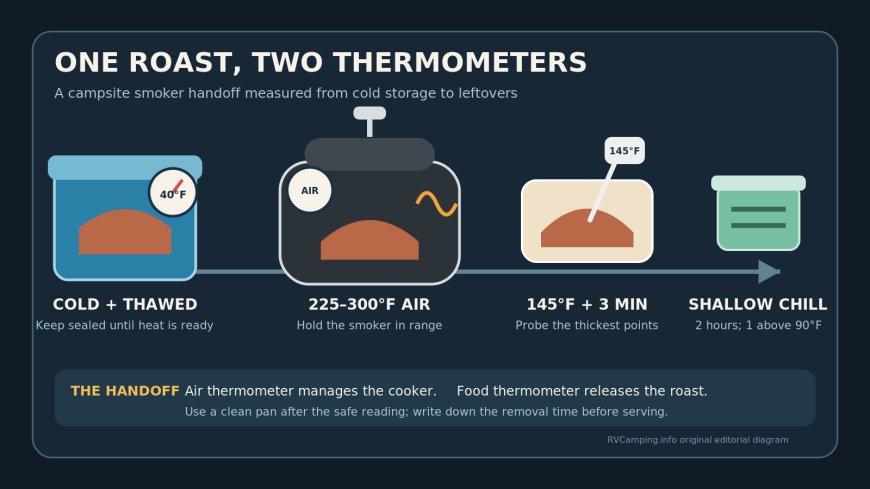
One handoff, two readings: smoker air controls the cooking environment, while the food probe decides when the roast is safe. Original RVCamping.info diagram.
Build heat before raw food leaves the cooler
USDA says meat and poultry must be completely thawed before smoking. A frozen center can spend too long warming through the 40–140°F range because smoking cooks slowly. The agency permits refrigerator, cold-water and microwave thawing, with immediate cooking after cold-water or microwave thawing.[1]
For this campsite dinner, thaw the roast in the RV refrigerator before the trip or while the refrigerator is holding 40°F or below. Keep it wrapped in the food cooler until the smoker is assembled, lit and stable. FDA advises keeping cold outdoor food at 40°F or below and raw meat securely wrapped so its juices cannot reach cooked or ready-to-eat food.[3]
Set the smoker outdoors where its manufacturer and the campground allow it. Use equipment made for cooking, not a galvanized can or another improvised chamber; USDA warns that containers not intended for food can introduce chemical residue.[1] Put the smoker’s air thermometer at grate level near the roast position. A lid gauge several inches away may not report the same environment the food will occupy.
Preheat until the grate-level reading is within 225–300°F. USDA specifies that range throughout smoking, not merely at startup.[1] Only then should the raw-food handler lift the roast from its sealed container and move it directly to the rack.
That handoff is where jobs split. The person who touches the package and raw roast closes the raw container, removes it from the clean side of the table and washes with soap and water for at least 20 seconds. CDC says hands should be washed after handling uncooked meat and that raw food needs its own plate or cutting board.[4] A second person can close the smoker and start the log without touching the raw tray.
Give each thermometer one question
The air thermometer answers, “Is the smoker still operating in its cooking range?” The food thermometer answers, “Has the center of this roast reached its safe minimum?” They are not substitutes.
Wind, a fading charcoal bed or a nearly empty fuel cylinder can pull the smoker below its target while the roast’s surface continues to look cooked. Check the grate-level air reading each time fuel is tended, and record the time if it leaves 225–300°F. Restore the cooking environment promptly. If the heat history becomes unknown for a long period, do not invent a recovery from the color of the meat. The safe choice is to discard when the time-and-temperature history cannot be established.
Keep the lid closed between planned checks. Cooking time depends on the meat’s size and shape, its distance from the heat, the coals and the weather; USDA says smoking can take four to eight hours and calls thermometer monitoring imperative.[1] That makes a published “minutes per pound” estimate a planning hint, not the finish line.
For the food reading, insert the probe into the thickest part of the loin without touching bone, the rack or a pocket of fat. Check more than one nearby point before calling it done. FoodSafety.gov sets 145°F plus a three-minute rest for whole cuts of pork, beef, veal, goat and lamb. Ground meat and sausage require 160°F, while poultry requires 165°F.[2] Those other temperatures belong on the campsite card because a different package cannot inherit the pork roast’s number.
Do not create a gap with partial cooking
A tempting shortcut is to warm the roast in the RV microwave, carry it across the site and finish it later when the smoker settles down. USDA permits partial cooking only when food moves immediately from the microwave or stove into the hot smoker. Holding partially cooked meat for later allows surviving bacteria to multiply.[1]
“Immediately” should be literal in the campsite workflow. The smoker must already be at 225–300°F, the route must be clear, and the cook must carry the food straight from the first heat source to the rack. If the smoker is not ready, keep the fully thawed raw roast cold. Do not start the first cooking step.
This replacement article deliberately does not revisit marinade handling. The September 10 canonical meat guide already owns that question, including reserved clean sauce and the condition under which raw-contact marinade may be boiled. Repeating those controls here would create another URL for the same reader decision.
The clean pan appears only after the reading passes
Place the clean serving pan, clean tongs and foil on the clean end of the table before the smoker opens for the final check. The pan that carried raw pork does not come back. FDA warns that a raw-meat platter or utensil can spread bacteria to cooked food unless it has first been washed in hot, soapy water.[3]
When every checked center point reaches at least 145°F, transfer the roast with the clean tongs and start the three-minute rest. The rest is part of the safe minimum for a whole pork cut, not optional waiting for appearance.[2] Keep the roast protected from dust and insects, but do not send it back into a raw-contact container.
Slice after the rest and serve what the group will eat. If the meal will be delayed, keep cooked food at 140°F or hotter rather than letting the roast drift between the smoker and the table. FDA’s outdoor guidance uses 140°F as the hot-holding boundary.[3]
End with a clock the next cook can understand
The leftover clock starts when the roast leaves active cooking or hot holding. FDA says perishable food must be refrigerated within two hours, shortened to one hour when the outdoor temperature is above 90°F. It also recommends shallow containers for faster cooling.[3] USDA’s smoking guidance says to refrigerate smoked meat and poultry within two hours of removal, cut it into smaller portions or slices, use shallow containers and use it within four days or freeze it.[1]
Write the removal time on the container or the campsite log. Slice the amount being saved, divide it among shallow containers and move it to a refrigerator or cooler verified at 40°F or below. A deep foil pan full of warm slices is not a cooling plan. If cold-storage space cannot take the leftovers without losing 40°F, save less food.
The handoff now has a readable record:
- COLD: roast held at 40°F or below and fully thawed.[1][3]
- HOT SMOKER: grate-level air reading stable at 225–300°F before loading.[1]
- NO GAP: any partial cooking moves immediately into the hot smoker.[1]
- DONE: whole pork cut reaches 145°F in the thickest points, followed by a three-minute rest.[2]
- CLEAN PAN: cooked food never returns to raw-contact gear.[3][4]
- CHILL: shallow portions enter 40°F-or-below storage within two hours, or within one hour above 90°F.[1][3]
A smoker asks for patience, but food safety cannot depend on patience alone. The grate thermometer keeps the long cook inside a known environment. The food thermometer ends the cook. The written times make the last handoff visible after the person tending the fire has walked away.
Evidence note: USDA FSIS supplies the complete-thawing rule, approved smoker materials, 225–300°F operating range, immediate partial-cook handoff, two-thermometer method and smoked-meat cooling guidance. FoodSafety.gov supplies safe minimum internal temperatures. FDA and CDC support outdoor cold holding, separation, clean serving gear, handwashing and leftover timing. The single-roast handoff and six-line campsite record are original RVCamping.info planning tools.
Sources
- Smoking Meat and Poultry — USDA Food Safety and Inspection Service — thawing, smoker setup, 225–300°F chamber monitoring, partial cooking, safe finish temperatures and prompt chilling (reviewed October 23, 2026).
- Cook to a Safe Minimum Internal Temperature — FoodSafety.gov — 145°F plus rest for whole cuts, 160°F ground meat and 165°F poultry (reviewed October 23, 2026).
- Handling Food Safely While Eating Outdoors — U.S. Food and Drug Administration — cooler temperature, separation, clean platters, hot holding and one- or two-hour refrigeration limits (official page archived October 23, 2026).
- Preventing Food Poisoning — Centers for Disease Control and Prevention — handwashing, raw-food separation and temperature-led cooking and chilling (official page evidence reviewed October 23, 2026).
What's Your Reaction?