












RV shore-power extension cords and adapters: where safe use stops
A decision framework for RV extension cords and adapters: check manual permission first, respect 30A/50A limits, stop for heat or damage, and leave pedestal repairs to campground staff.

RV shore-power extension cords and adapters: where safe use stops
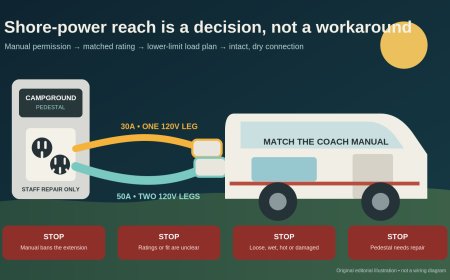
An empty site can put the pedestal just beyond the RV's factory shore cord. That does not make the nearest heavy-looking cable a safe extension. Start with the exact coach manual. If it says not to add an extension cord, the answer is no, even if a cord is sold as “RV grade.” The 2026 Winnebago Revel manual, for example, expressly prohibits attaching an extension cord to its utility cord and warns that poor connections or an improperly sized cord can lead to fire.[2]
Adapters need the same discipline. They can change the physical connection, but they do not upgrade the source, raise the rating of a cord, cure a worn receptacle or make a prohibited setup acceptable. A 50-amp RV connected through an approved 30-amp adapter still has only 30 amps available from that pedestal.[3]
The short answer
Use the RV's supplied shore cord directly to a matching campground receptacle whenever possible. Before adding anything, check all of these:
- The RV, inlet, cord, electrical-management device and adapter manuals permit the proposed arrangement.
- Every cord set or adapter is factory assembled, listed or certified for its stated use, rated for the source and load, intended for outdoor exposure, and has an intact equipment-grounding path.
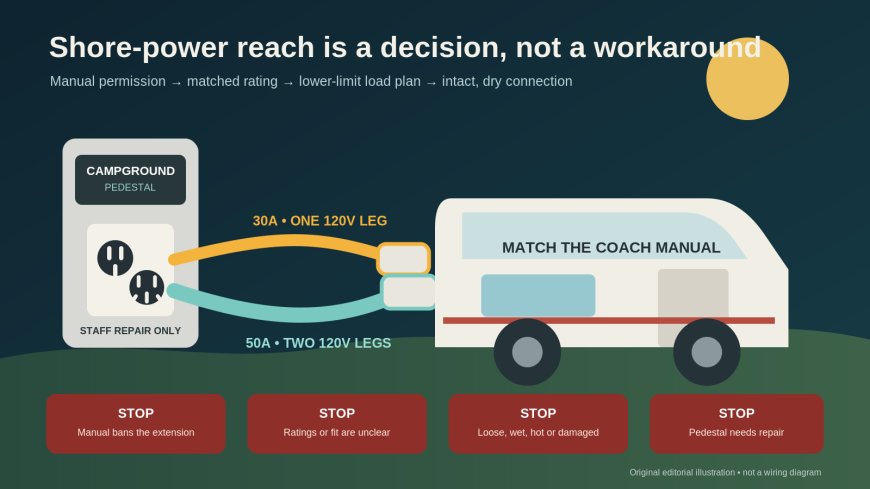
- The source voltage and connector are correct: a typical 30-amp RV system is one 120-volt leg with a 30-amp total limit; a typical 50-amp RV system uses two 120-volt legs at up to 50 amps per leg.[1]
- The smallest supply or component rating becomes the operating ceiling. Manage the coach loads to that lower limit.
- Every connection is dry, clean, fully seated and supported, with the cable deployed as its manual directs and protected from traffic, water, sharp edges and pinch points.
Stop if the manual bans the setup, the campground bans it, the ratings are unclear, an adapter would place a lower-rated cord behind a higher-rated supply without a manufacturer-approved protective arrangement, or any part is loose, damaged, wet inside or heating. Do not improvise a plug, remove a ground pin, build a homemade adapter or open the pedestal.
First boundary: the coach manual can say no
There is no universal “buy this gauge and you are safe” rule for an RV hookup. The coach maker may prohibit extension cords altogether. Winnebago does so for the 2026 Revel and specifies a 110/125-volt, 30-amp supply for that coach.[2] That prohibition controls for the Revel even though another RV maker or cord manufacturer may allow a different product on a different installation.
Jayco's 2026 towable manual illustrates the other side of the boundary. It describes 30-amp and 50-amp systems, directs owners to extend the entire factory cord between the RV and source, and says to plug into the appropriate 30- or 50-amp receptacle.[1] It does not create blanket permission to add an extension. Owners still need the model-specific manual, the component packet and any cord-reel or inlet instructions.
Treat a campsite reach problem as a parking or site-assignment problem before treating it as a shopping problem. The Illinois Department of Public Health advises parking close enough to avoid an extension and notes that some campgrounds forbid them.[5] Ask staff whether the RV can be repositioned without leaving the pad, blocking a road or violating the site's rules. If the factory cord cannot reach legally and the manual does not authorize an extension, request another site.
Know what 30 amp and 50 amp mean
The labels are not interchangeable sizes of the same service.
A 30-amp RV connection is normally a 120-volt service with one hot leg. Jayco limits the covered 30-amp system to 30 amps total. A 50-amp RV connection normally receives a 120/240-volt source and uses two 120-volt legs, each limited to 50 amps in the covered system.[1] That is why a 50-amp coach has far more potential capacity than a 30-amp coach; it is not merely another 20 amps.
This distinction changes how you manage an adapter:
- 50-amp RV on a 30-amp pedestal: an equipment-approved adapter may make the connection possible, but the pedestal still supplies only 30 amps total. Southwire says a limited number of appliances can operate before the pedestal breaker trips in this arrangement.[3] Set any configurable shore-input limit correctly and avoid stacking large loads such as air conditioning, electric water heating and cooking appliances.
- 30-amp RV on a 50-amp pedestal: do not assume that physical fit proves protection. Southwire says using its 30-amp Surge Guard through a 30-to-50-amp adapter is not recommended.[3] Follow the coach, adapter and protection-device instructions as a complete set. If they do not explicitly support the arrangement, use the matching 30-amp outlet or ask for another site.
- 15/20-amp household-style source: this is a still smaller source, not “slow 30 amp.” Use only an arrangement the RV and power-equipment makers permit, set the input limit where the coach provides that function, and expect to run only a restricted group of loads. Do not defeat a GFCI that trips.
An adapter is not a transformer unless it is explicitly designed and labeled as one. It does not repair polarity, create a missing ground, stabilize voltage or turn one 30-amp leg into normal 50-amp service.
If an extension is permitted, match the whole chain
Permission comes first. Then verify the product, not just its color or plug shape.
Choose a complete factory-assembled RV cord set whose plug and connector match the intended RV service and whose label covers the full current and voltage involved. It must be suitable for outdoor use and should carry certification from a recognized testing laboratory. CPSC tells consumers not to use an extension cord that lacks a recognized laboratory listing because unlisted or counterfeit cords can create shock or fire risk.[4]
Do not use a household orange cord as a substitute for a 30-amp RV cord, and do not use a 30-amp extension in a 50-amp path. Do not join extensions end to end. Each added junction is another place for poor contact, water entry, mechanical strain and heat. A “dogbone” adapter also adds a junction; use only the exact arrangement approved in the manuals rather than stacking adapters until the shapes fit.
Length matters because a longer run adds resistance and voltage drop, but this article does not prescribe a universal wire gauge or maximum length. Those details belong to the exact cord listing and equipment instructions. The Illinois guidance recommends avoiding extensions, keeping the normal cord run short, and moving to larger conductors when a longer cord is used under its stated framework.[5] That older state brochure is useful as a conservative warning, not permission to override a current coach prohibition or product label.
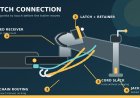
Fully lay out the cord as directed. Jayco tells owners covered by its 2026 manual to extend the entire length of the shore cord before connecting.[1] Do not leave surplus cable tightly coiled in a compartment, bury a connection under rugs or mats, or route the cable where a tire, leveling jack, slide mechanism, door or lawn equipment can crush it.
Connection sequence without live improvisation
Use the sequence in the exact manuals. A conservative owner-level check looks like this:
- Turn off large RV loads. Put the pedestal breaker off before making or breaking the connection if the equipment instructions allow you to operate it.
- With the system de-energized, inspect the pedestal face, shore cord, extension, adapters and portable power protector. Confirm every label and rating.
- Test the matching pedestal outlet only with a listed RV tester or electrical-management system designed for that service. Jayco says not to connect when its specified check reports reverse polarity or open ground.[1]
- Connect and lock the RV end as its inlet manual directs. Add only the permitted cord or adapter chain, with every plug fully seated and mechanically supported.
- Keep all junctions off wet ground and out of pooled water. Do not wrap a questionable connection in a bag and call it weatherproof.
- Energize at the pedestal, wait for the power-protection device to complete its check, and bring loads on gradually while staying below the lowest rating in the chain.
A visual pass is not electrical certification. It only catches obvious reasons to stop. Never probe a live pedestal, remove its cover or tighten its receptacle unless you are authorized and qualified to service campground equipment.
Stop-use conditions
Switch off large loads and de-energize at the pedestal breaker if it is safe to do so. Keep the RV disconnected when you find:
- a manual or label that prohibits the proposed extension or adapter;
- no readable voltage, amperage, outdoor-use or certification marking;
- a cut, crushed, abraded, brittle, taped or spliced cable;
- a bent, missing, loose, pitted or heat-discolored blade or contact;
- a cracked, swollen, melted or separating plug body or failed strain relief;
- a plug that will not seat fully, lock normally or remain supported;
- water inside a connector, corrosion or a failed weather seal;
- a hot-plastic smell, smoke, sparking, buzzing, crackling or visible arcing;
- repeated breaker trips, an EMS fault, flicker or voltage that falls outside the equipment's accepted range;
- warmth that grows at any plug, adapter, protector, inlet or cable section.
Do not keep resetting a breaker or touching the connection to see whether it gets hotter. Do not trim blades, bend contacts back, replace a plug end at the campsite, splice the cable or make a neutral-ground bond. Tag damaged owner equipment “DO NOT USE” and have the full mating pair inspected, since damage may be present on both sides of a connection. For a closer owner-visible inspection routine, use our separate shore-power cord heat-damage check; this guide stays focused on whether an extension or adapter belongs in the hookup at all.
The campground pedestal boundary
Guests may operate the normal user-accessible breaker and plug into an intact receptacle according to campground rules. The boundary stops at diagnosis and repair.
If the receptacle is loose, scorched, cracked, wet inside or cannot hold the plug firmly, leave the breaker off and notify campground staff. Illinois public-health guidance specifically tells campers to report loose or damaged campground electrical equipment and not use it.[5] Winnebago likewise tells Revel owners to contact park attendants when shore power fails so staff can check the source fuse or breaker.[2]
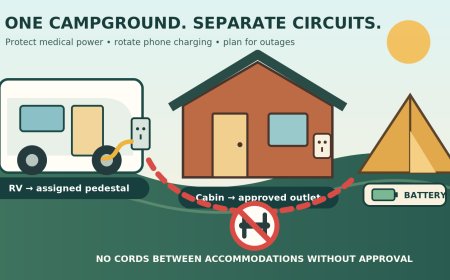
Do not remove the pedestal face, replace its receptacle, tighten its terminals, dry its interior, bypass a failed outlet, share another site's box or string a cord across a road. Ask for qualified maintenance or a different site. If there is smoke, active melting, fire, a shock or a tingling RV frame, keep people away and call campground staff or emergency services as conditions require.
A practical decision card
Use the direct connection when the factory cord reaches, the matching outlet passes the equipment-prescribed check, and every connection is dry, intact and firm.
Consider one approved adapter only when every relevant manual allows the exact source-to-RV arrangement, the adapter is listed for it, and you can operate below the lower available current.
Consider one extension only when the RV manual permits it and the extension is a listed, outdoor-rated, factory cord set that matches the complete service. Deploy and protect it exactly as instructed.
Stop and move or change sites when permission, rating, grounding, fit, condition or weather protection is uncertain. Convenience is not evidence that the connection is safe.
Source credit: This guide was developed from current RV owner manuals, RV power-equipment guidance, U.S. Consumer Product Safety Commission material and Illinois public-health guidance. It is an owner-level safety framework, not a wiring or repair procedure.
Sources
What's Your Reaction?