





Will your whole RV setup fit the campsite? Do the length math before booking
A practical way to compare RV, trailer and tow-vehicle measurements with campsite, driveway and overflow-parking rules before booking.

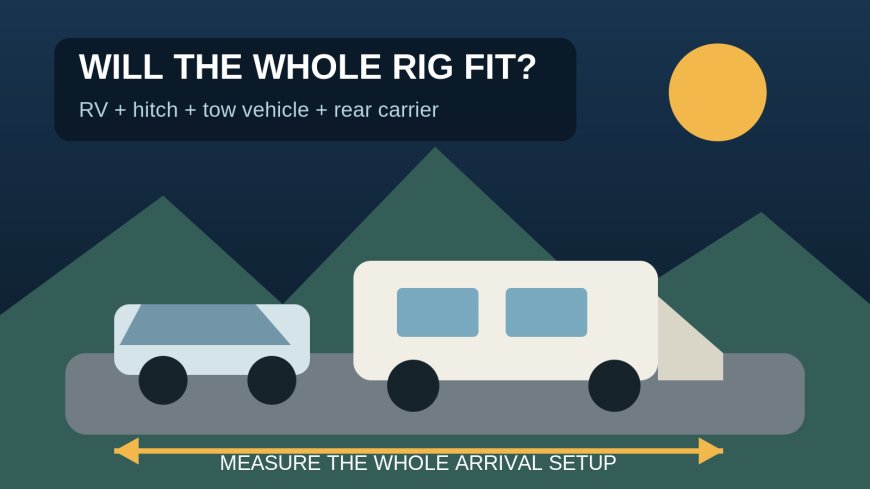
A campsite marked "35 feet" can mean several different things. It may describe the longest RV the site accepts, the paved driveway, or an overall combination that includes a tow vehicle. Treating those numbers as interchangeable is how a reservation turns into a tight backing job, an overflow-parking scramble, or a refusal at the entrance.
The safer approach is to build a measurement card for your travel configuration, then compare it with the exact site's rules. This is desk-researched planning guidance, not a measurement of any campground or vehicle.
Start with the configuration you will actually arrive in
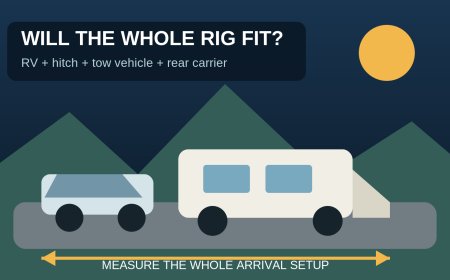
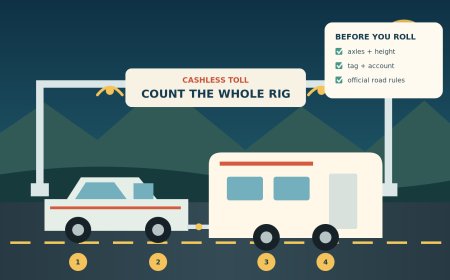
Write down the travel length, not only the RV's brochure length. For a motorhome towing a car, that means the motorhome, tow bar and car. For a travel trailer or fifth wheel, record the truck and trailer as a combination as well as the trailer by itself. California State Parks defines trailer length as the distance from the rear bumper through the hitch tip, but individual parks can impose a combined vehicle-and-trailer rule.[3] That distinction matters.
Measure height and width too. Include rooftop air conditioners, antennas in travel position, mirrors and any rear-mounted rack. These dimensions help with the road and campground approach even when the booking screen asks only for length.
Create two numbers:
Do not add guessed safety margins to the number you enter. Record the real measurement, then look separately for enough working room.
Read the label beside the number
A site listing should tell you whether a number is "RV max length," "vehicle length," "driveway length" or something else. If it does not, ask. The National Park Service says Belle Campground's few larger spaces accept connected RV-and-towed-car combinations no longer than 35 feet.[1] That is much stricter than a rule based only on trailer body length.
Cottonwood Campground in Theodore Roosevelt National Park publishes site-by-site maximum vehicle lengths and identifies the parking layout as back-in, parallel or pull-through.[2] The wide spread among those numbers is a useful warning: a campground's general RV limit does not prove that every site works for the same rig.
Oregon State Parks offers an unusually clear example at Wallowa Lake. It tells campers that every tire from the RV and tow vehicle must stay within the parking pad unless the tow vehicle goes to designated overflow parking. Its example adds a 25-foot trailer to a 22-foot tow vehicle and calls for at least a 47-foot site.[4]
Use a four-line fit check
Before paying, copy the exact listing into your notes and answer four questions.
1. What does the published length measure?
Look for a definition on the campground page, reservation listing and booking policy. Save a screenshot or PDF of the site details. If one page says "maximum RV" and another says "driveway," call the campground and ask which number controls for your setup.
2. Must the tow vehicle remain on the pad?
A trailer may fit while the truck does not. Find the vehicle count, overflow-parking rule and any extra fee. Overflow parking is a plan only when the park confirms that it is open, large enough and available to your reservation type.
3. Can you use the site's entry geometry?
Pull-through is not a promise of an easy exit. Check the direction of travel, curve, trees, posts, neighboring vehicles and where the utility pedestal sits. A long straight pad can still be awkward if the approach turn is tight. Satellite imagery may help you form questions, but current campground staff and posted restrictions should decide the booking.
4. Will every wheel stay where the rules require?
Some campgrounds protect vegetation by requiring tires, stabilizers and equipment to remain on the developed surface. California State Parks warns that equipment too long for the reserved campsite may not be permitted, and its statewide table also shows that trailer and motorhome limits can differ at the same park.[3]
A worked example
Suppose the trailer measures 27 feet from rear bumper to hitch tip. The truck is 20 feet long, and the connected gap does not reduce the measured end-to-end length. Your arrival length is about 47 feet. A listing that says "trailer maximum 30 feet" may accept the trailer, but it does not answer where the truck goes. A listing that says "40-foot total driveway" does not hold the connected combination.
You now have useful questions for the campground:
- Does the stated 30-foot limit apply only to the trailer?
- Can the truck park beside the trailer without leaving the developed pad?
- Is overflow parking allowed for the tow vehicle, and is it guaranteed?
- Does the site have a fixed obstacle or sharp entry that reduces usable space?
Get the answer in writing when possible. Record the staff member, date and exact site number when the answer comes by phone.
Do not let a pull-through badge settle the decision
Pull-through sites reduce backing, but they can have short usable sections, curved lanes or a one-way exit that points away from your next route. A back-in site with a clear apron may work better for a shorter trailer and truck parked elsewhere. Site type is one input; dimensions and rules control.
The same caution applies to motorhomes with a towed car. Ask whether disconnecting before the site is required, where that can be done without blocking traffic, and where the car must park after arrival. Never plan to unhitch or disconnect in a travel lane.
Save a booking evidence card
Keep one note with:
- exact site and campground;
- arrival date;
- RV or trailer length entered in the booking form;
- full connected length, height and width;
- published site/driveway limit and its definition;
- allowed vehicle count;
- overflow-parking answer and fee;
- pull-through or back-in designation;
- confirmation number and cancellation deadline;
- campground phone number;
- screenshot date.
Recheck the official page shortly before departure. Conditions and site assignments can change, and a saved screenshot documents what you relied on without overriding current safety instructions.
The booking rule worth remembering
Compare like with like. Trailer length belongs against a defined trailer limit. Full arrival length belongs against a combined-length or driveway rule. If the operator does not define the number, pause the reservation and ask. Ten minutes of measurement is cheaper than discovering at dusk that the trailer fits but the truck does not.
Sources
- National Park Service: Belle Campground (retrieved September 20, 2026).
- National Park Service: Cottonwood Campground (retrieved September 20, 2026).
- California State Parks: Maximum Trailer and RV Lengths (retrieved September 20, 2026).
- Oregon State Parks: Wallowa Lake State Park (retrieved September 20, 2026).
What's Your Reaction?