





California chain controls for RVs: the motorhome-or-trailer decision guide
At a California R1, R2 or R3 control, a motorhome and a towable combination can get different answers. Use the posted level, rig configuration, drive axle and trailer brakes to decide whether to install or turn back.

California chain controls for RVs: the motorhome-or-trailer decision guide
A California chain-control sign does not ask whether the RV owner feels confident in snow. It asks what vehicle or combination is at the sign, which wheels drive it, whether a trailer has brakes, and which control level is posted.
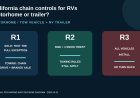
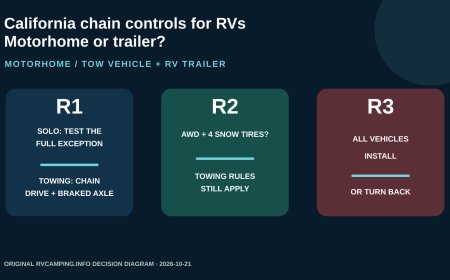
That distinction matters most at R1. A qualifying passenger vehicle or light-duty truck can receive an exception when it is under 6,000 pounds gross weight and has snow tires on at least two drive wheels. A vehicle towing a trailer does not get to use that exception: Caltrans says every towing vehicle must have chains on one drive axle, and a trailer with brakes must have chains on at least one trailer axle.[1]
For RV travel, use a two-column decision: "motorhome traveling alone" or "tow vehicle plus trailer." Do not blend the answers.
First decision: proceed, install, or turn back
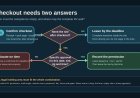
Before the chain-up area, answer five questions from documents and the rig itself:
| Check | Motorhome traveling alone | Towable RV combination |
|---|---|---|
| Posted control | R1, R2 or R3 | R1, R2 or R3 |
| Drive layout | Front-, rear-, all- or four-wheel drive | Tow vehicle's drive layout |
| Weight or class | Confirm the classification and weight relevant to an R1 exception | Towing status controls the R1 chain requirement |
| Braked trailer | Not applicable unless another vehicle is being towed | Identify whether the trailer has brakes and the axle arrangement |
| Equipment fit | Correct device for the exact tire, axle and chassis clearance | Correct sets for the tow vehicle and, when braked, a trailer axle |
Proceed only when the posted level, required placement and equipment instructions all agree. Install when the rule requires it and the devices are approved for the exact rig. Turn back or wait somewhere legal when the devices do not fit, a required set is missing, the owner documentation prohibits the planned placement, or staff directs the vehicle not to enter.
Caltrans and CHP retain authority to keep a vehicle out when its traction devices do not meet California requirements.[2] Possessing a box labeled for the tire size is not a guarantee that the device clears brake lines, suspension parts or bodywork on a particular chassis.
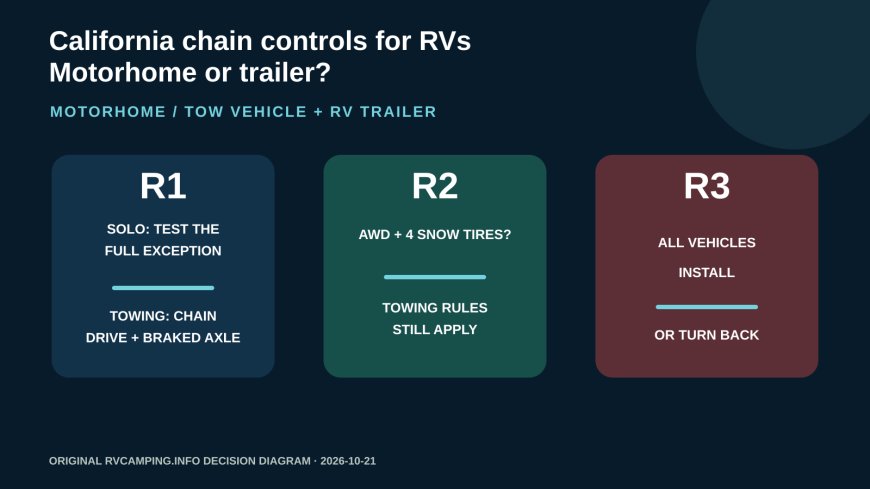
R1: the towing branch changes the answer
Caltrans defines R1 as chains required on all vehicles except passenger vehicles and light-duty trucks under 6,000 pounds gross weight that have snow tires on at least two drive wheels. Vehicles using that snow-tire exception still must carry chains.[1]
A motorhome driver should not assume that "RV" means passenger vehicle, light-duty truck or automatic exemption. Check the registration and applicable weight information. If the vehicle does not fit every part of the stated R1 exception, plan on chains. If the status is unclear at the control, ask the officer or Caltrans worker rather than arguing from the shape of the coach.
The towable branch is simpler and stricter. Caltrans says all vehicles towing trailers must have chains on one drive axle. If the trailer has brakes, it must also have chains on at least one axle.[1][2] Four-wheel drive on the tow vehicle does not erase those towing provisions.
That produces three practical R1 examples:
- A solo motorhome that cannot establish the complete passenger/light-duty, weight and snow-tire exception should be ready to install on the drive axle.
- A pickup pulling a travel trailer needs traction devices on one drive axle of the pickup, even if the pickup otherwise looks like an R1-exempt vehicle.
- A pickup pulling a braked travel trailer also needs a set on at least one trailer axle.
Do not count the trailer's breakaway cable or electric brake controller as proof that the correct trailer devices are aboard. Confirm the brake-equipped axle and device placement before departure.
R2: AWD may exempt a solo rig, not its cargo list
At R2, Caltrans requires chains or traction devices on all vehicles except four-wheel- or all-wheel-drive vehicles with snow-tread tires on all four wheels. Even those exempt vehicles must carry traction devices in a chain-control area.[1]
For a solo motorhome, the R2 decision is literal. Two-wheel drive means install. Four- or all-wheel drive still needs qualifying snow-tread tires on all four wheels to use the exception, and suitable devices must remain in the RV.
For a towable RV, do not stop reading at the AWD exception. Caltrans' separate towing instruction says vehicles towing trailers must chain one drive axle, and braked trailers must chain an axle.[1][2] Build the combination plan from the towing rules, not from the tow vehicle's badge.
R3: every vehicle installs
R3 has no drivetrain exception. Caltrans says chains or traction devices are required on all vehicles.[1] This is not the moment to discover that a low-clearance motorhome cannot accept the device that was purchased, or that only one set was packed for a braked trailer combination.
R3 conditions can also be a sensible turn-back point even when the equipment is technically complete. Chain-control permission is not a command to continue. Visibility, grade, traffic, driver experience, campsite access and the ability to remove the devices later all belong in the decision.
Map every required set before the trip
Write a device map and keep it with the registration:
- Record every tire size exactly as mounted. A motorhome can have different front and rear sizes; a trailer may not match the tow vehicle.
- Mark the drive axle or axles. CHP advises that chains go on drive wheels and tells drivers to know whether a vehicle is front- or rear-wheel drive.[3]
- For a towable, mark whether the trailer has brakes and which axle or axles carry them.
- Read the motorhome chassis, tow-vehicle and trailer manuals for clearance limits and permitted device types.
- Assign each physical bag or container to a tire and axle. "Truck chains" and "trailer chains" are better labels than two identical black bags.
- Dry-fit each set under safe, snow-free conditions, then repack all fasteners, tensioners and repair links.
Caltrans uses "chains" broadly for tire traction devices that meet the state requirement, and its accessible requirements sheet lists examples such as link chains, cable chains and textile devices. It also warns that less conventional devices can be restricted because of local conditions.[2] The vehicle manual and California acceptance both matter; satisfying only one is not enough.
The flat-tow complication
A motorhome pulling a car is towing. Do not apply the solo-motorhome branch just because the rear vehicle is not a camping trailer. The Caltrans wording covers vehicles towing trailers, while the exact requirements for a particular flat-towed vehicle or dolly can depend on its configuration and brakes.
Before the route, ask Caltrans or CHP a configuration-specific question: "For an R1, R2 and R3 control, what traction devices and axle placement apply to this motorhome towing this car on all four wheels (or on this dolly), with these brakes?" Keep the answer with the equipment plan. If the configuration cannot be resolved before the pass, do not improvise at the checkpoint.
Use the chain-up area, not a traffic lane
CHP says to move out of vehicle lanes, park off roadways, freeways and access ramps, and stay out of the path of snow-removal equipment when chaining up.[4] A wide shoulder is not automatically a safe or legal chain-up site. Follow signs and directions to the designated area.
Commercial chain installers may be present. CHP says they are licensed workers, not state employees; they must display a permit, post fees and provide a receipt, and they may not sell chains.[4] Arrive with the correct equipment. An installer can fit devices you own, but should not be the procurement plan.
After installation, stop at the first safe opportunity allowed by the device instructions to inspect fit and tension. Follow the device and vehicle speed limits, and remove devices where directed after the control ends. A loose cross chain can damage an RV before the driver hears it over the coach interior.
A checkpoint card for the visor
Use this short card when the signs appear:
- Current road and control level: ___
- Configuration now: solo motorhome / motorhome towing / tow vehicle plus trailer
- Drive axle: ___
- R1 exception established, if applicable: yes / no / not applicable
- Trailer brakes and axle: ___
- Required sets and assigned tires: ___
- Manual-compatible devices aboard: yes / no
- Designated chain-up area ahead: ___
- Safe decision: install / wait / reroute
Check current road conditions before leaving and again before the climb. CHP advises carrying correctly sized, working chains plus a flashlight and repair links, and allowing extra time for winter travel.[3]
The most expensive mistake is bringing one answer for two different rigs. A motorhome by itself and the same motorhome towing a vehicle are different configurations. So are an unbraked small trailer and a braked travel trailer. Re-run the decision whenever the combination changes.
Editorial note: This planning guide summarizes the cited California agency material archived October 21, 2026. Posted controls, officer directions, current conditions and the exact vehicle manuals govern. It is not legal advice and does not claim firsthand checkpoint experience.
Sources
What's Your Reaction?