









Lava Flow Campground or a reserved RV park? The Craters of the Moon choice
Decide whether to try first-come Lava Flow Campground or reserve outside Craters of the Moon using a simple flexibility, hookup and fallback test.

Lava Flow Campground or a reserved RV park? The Craters of the Moon choice
Lava Flow Campground puts an RV inside Craters of the Moon, near the visitor center and park trails. It is also a 42-site, first-come campground with no hookups and no reservable individual sites.[2] That combination makes it a good destination for a flexible, self-contained traveler and a poor single point of failure for a rigid itinerary.
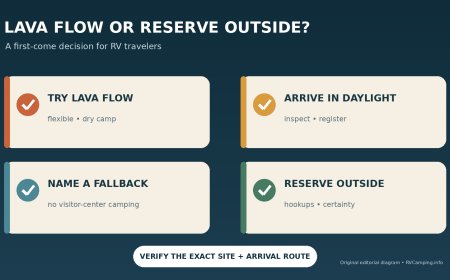
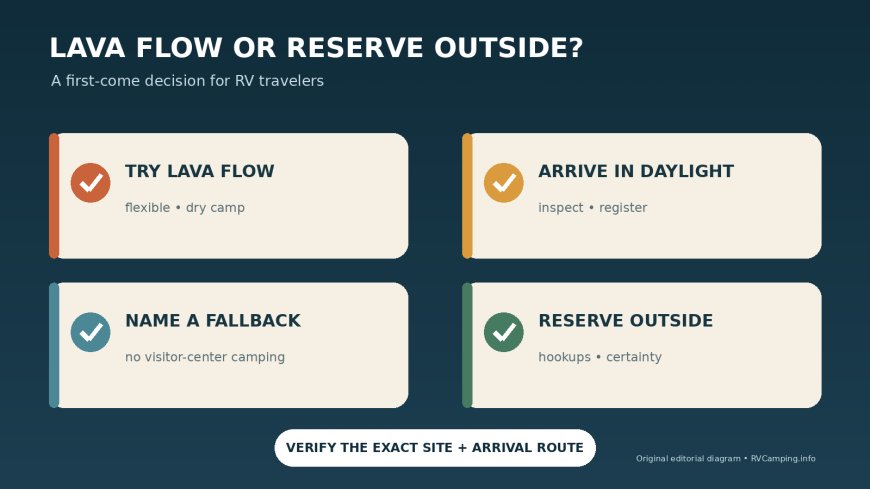
The decision is not simply "inside the park or outside." It is whether you can absorb an unsuccessful arrival. If you can reach the campground early, dry camp, and move to a known fallback without losing the trip, try Lava Flow. If you need hookups, have a large rig with uncertain site fit, or must know where you will sleep, reserve outside the monument and visit by day.
The choice in one table
| Question | Try Lava Flow | Reserve outside |
|---|---|---|
| Can the night remain unconfirmed until arrival? | Yes | No |
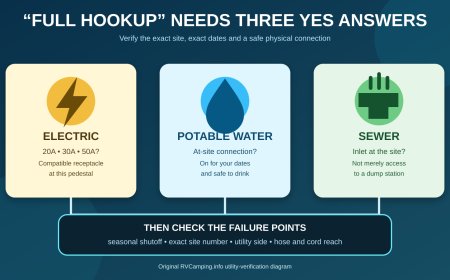
| Can the RV dry camp without hookups? | Yes | No or not comfortably |
| Is a same-day fallback already identified? | Yes | No |
| Does the party need a guaranteed large-rig site? | No | Yes |
| Is walking access to the visitor center area worth the uncertainty? | Yes | No |
Recreation.gov says some Lava Flow sites accommodate large RVs, but it does not publish that as a guarantee for every site. It also states that the campground has no hookups.[2] A large RV is therefore not excluded by category, yet its driver should not build a fixed travel day around an unspecified first-come pad.
What Lava Flow actually provides
The campground sits near the visitor center and popular trails. The National Park Service lists seasonal water and flush toilets, year-round vault toilets near the entrance station, and a charcoal grill and picnic table at each site.[1]
There are several operational details worth knowing before arrival:
- Individual sites cannot be reserved and are first come, first served.[2]
- To claim a site, leave an item there, register at the automated fee machine promptly, and place the receipt in the campsite-post box.[1]
- The fee machine accepts credit cards, not cash or checks.[1]
- Wood fires are prohibited; charcoal is allowed in the provided grills.[1]
- A site normally allows no more than eight people, two tents, and two vehicles.[1]
- Vehicles must stay on paved roads, and camping is prohibited at the visitor center and Loop Road parking areas.[1]
On the page archived for this article, the park's current-conditions notice listed Lava Flow as open to vehicles at $8 per night, or $4 with a Senior or Access pass. That notice also bars cars and RVs from spending the night at the visitor center.[4] Treat that price and status as a dated snapshot. Check again on travel day.
The hidden cost of "first come"
A first-come site has no cancellation policy and no reservation fee, but the camper pays in uncertainty. The real cost appears when a full campground forces a tired driver to improvise after dark.
At Craters of the Moon, the usual bad fallback is specifically prohibited: the visitor center and Loop Road parking lots are not overflow camping.[1] A sound plan names an alternate campground before the RV reaches the entrance. It also records how far that fallback is, its latest check-in procedure, its current availability, and whether the rig fits.
The current-conditions page warns that mobile reception within the park is quite limited.[4] Save the park pages, fallback address, phone number, and route offline. Do not wait for a failed campsite search to begin browsing.
The nearby reserved-base option
The NPS maintains a regional camping list and tells readers to contact each campground for current information because availability and amenities may change seasonally.[3] On the version updated September 28, 2026, two Arco-area RV parks were listed 18 to 19 driving miles from the visitor center. Both entries showed full hookups, pull-through sites, a dump station, and a listed 90-foot maximum length.[3]
Those entries are planning leads, not an NPS guarantee of private-business inventory or a substitute for the campground's own confirmation. Call or book directly, verify the exact site, and ask what the stated maximum measures. Still, they establish a practical shape for Plan B: sleep roughly 18 to 19 miles away with a confirmed pad and make Craters of the Moon a day visit.
A reserved outside base is the cleaner choice when:
- electrical service is medically or operationally important;
- the RV needs a site dimension that Lava Flow does not publish in advance;
- arrival will be late;
- the trip has no spare travel day;
- seasonal water uncertainty would make dry camping impractical;
- the driver does not want to relocate after checking for an opening.
The outside stay gives up the simplicity of waking inside the monument. In return, it separates sightseeing from the overnight gamble.
Season changes the answer
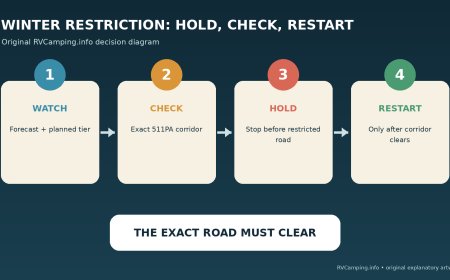
Lava Flow vehicle access follows the Loop Road. The NPS says the campground generally closes to vehicles when the road closes in November and reopens in April or May, depending on conditions.[1] Water and flush toilets are seasonal even when other parts of the site remain usable.[1]
The current-conditions page is the decision source close to departure. At the October 20 archive point, it said drinking water was available only at the visitor center while vault toilets were available around the clock at Lava Flow and several Loop Road locations.[4] That is not the same as a working campground water system.
Before committing to Lava Flow, answer four dated questions:
- Is the campground open to vehicles today?
- Is potable water available at the campground, or only at the visitor center?
- Is the Loop Road open for the intended visit?
- Is the current fee machine operating, and can you pay by card?
A yes from last season does not answer any of them.
Build a no-drama arrival plan
If trying Lava Flow
Arrive with the fresh-water tank and batteries ready for a hookup-free night. Carry a payment card. Keep the RV's length, height, width, and turning needs handy, because "some sites" fitting large RVs does not identify which open site will work.[2]
Set a turnaround time before arrival. For example: inspect legal vacancies in daylight, and if no suitable pad is available by the predetermined time, leave for the named fallback. The point is not the exact hour; it is deciding before fatigue and darkness narrow the choices.
Do not detach a tow vehicle, block a road, or occupy a site with gear until the full combination can be placed legally. The park requires vehicles to remain on paved roads.[1]
If reserving outside
Confirm the exact campsite rather than relying on a campground-level maximum. Ask about total combination length, tow-vehicle parking, check-in hours, hookups, and any late-arrival process. Save that confirmation offline.
Plan the monument as a day trip. The NPS lists Arco-area options about 18 to 19 miles from the visitor center, so an outside base adds driving but not necessarily a second travel day.[3] Keep the RV at the reserved site if a smaller vehicle makes the park visit easier.
Who should choose which
Try Lava Flow if the RV can dry camp, the schedule is flexible, daylight arrival is realistic, and a verified fallback is ready. The campground's location and low dated fee make the uncertainty worthwhile for many short, adaptable stays.[1][4]
Reserve outside if the overnight location must be certain, hookups matter, arrival will be late, or the rig needs a known pad. That is not settling for a lesser trip. It is buying certainty and using the monument for the part it can reliably provide: the daytime visit.
The risky choice is not Lava Flow. The risky choice is arriving at a non-reservable campground with no legal second answer.
Editorial note: Status, fees, water service and private-campground details can change. Official NPS and Recreation.gov pages were reviewed and archived October 20, 2026. This article does not claim firsthand campsite inspection or current vacancy information.
Sources
What's Your Reaction?