





"Full hookup" is a label: verify the three RV utilities before you book
Turn a full-hookup label into a dated exact-site record for compatible electricity, potable water and sewer before booking an RV campsite.

"Full hookup" is a label: verify the three RV utilities before you book
By Romana | Information checked October 20, 2026
An RV campsite marked "full hookup" may look like the easy booking. It should put electricity, water and sewer at the site. The trouble starts when a reservation system uses a broad site class, the campground turns water off for freezing weather, the electric pedestal lacks the service your rig needs, or the sewer connection sits where your hose cannot reach.
Do not shop by the label alone. Turn every candidate into a three-line utility record: electric, potable water and sewer. Then add an exact-site line for season, physical reach and current operation. Five minutes of checking can prevent a stay built around carrying water, rationing tank space or moving to the dump station.
Start with the strict definition, then verify the listing
Washington State Parks gives a clean distinction. Its partial-hookup sites have electricity, often have water and do not include sewer. Its full-hookup sites add electricity, water and sewer to the standard site.[1] Texas Parks and Wildlife uses the same three-part shorthand on its statewide campsite directory: full hookup means water, electric and sewer.[2]
That is a useful working definition, but it is not universal enough to end the research. Colorado Parks and Wildlife uses "and/or" while listing pressurized water, wastewater and power connections in its full-hookup amenity class.[3] The wording itself is a warning: a category page may describe a family of sites rather than promise all three services at the pad you selected.
Use this booking rule:
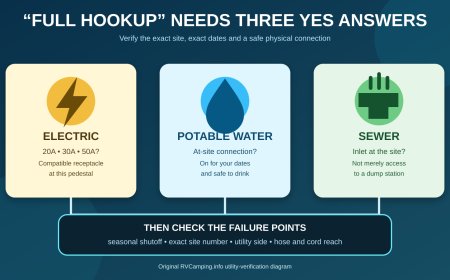
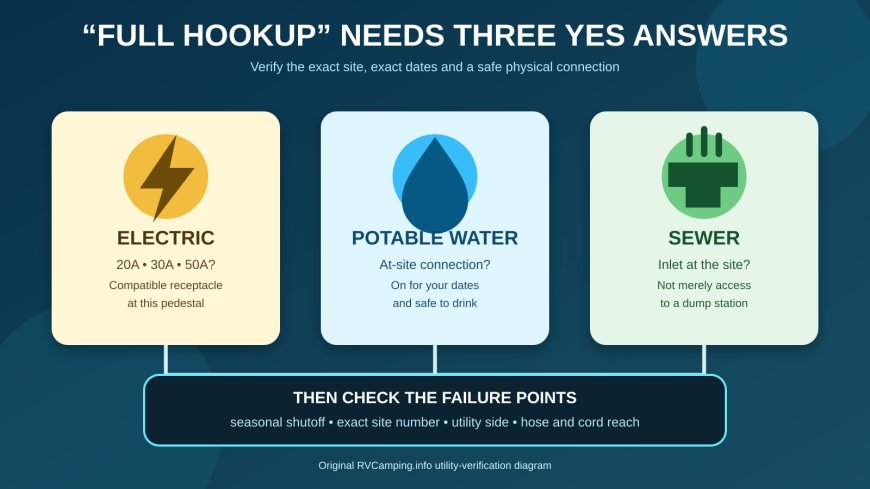
A full-hookup claim is not verified until the exact site's record separately confirms potable water, sewer and an electrical service compatible with the RV for the stay dates.
If one line is missing, treat it as unknown. Do not convert a dump station into a sewer hookup, a shared hydrant into site water, or a nearby electrical outlet into RV service.
Build the utility record
Copy this block into the trip notes for each campsite candidate:
| Utility | Exact-site answer | What still needs confirmation |
|---|---|---|
| Electric | 20A, 30A, 50A, combination pedestal, or none | Receptacle for the rig, operating dates, site number, safe adapter policy |
| Potable water | Pressurized connection at site, shared hydrant, fill station, or none | Potability, thread/connection, seasonal shutoff, current advisory |
| Wastewater | Sewer inlet at site, dump station only, portable service, or none | Inlet location, hose reach, thread/seal rule, operating hours, closure |
| Exact site | Site number and loop | Pad dimensions, utility side, obstructions, elevation difference |
| Dates | Arrival through departure | Freeze shutdowns, repairs, alerts, loop closures |
A booking page that shows three amenity icons may still need a call. Ask the agent to read the site record rather than answer from memory about the campground as a whole.
Electricity: match the rig, not the word "electric"
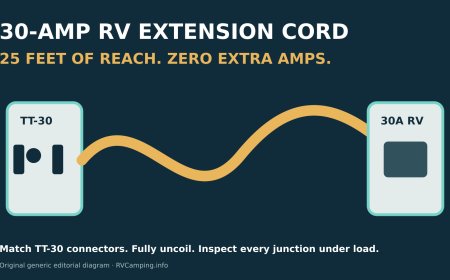
"Electric hookup" does not identify the receptacle. Record whether the exact pedestal has 20-, 30- or 50-amp service and whether those outlets are simultaneously present. A 50-amp RV owner may accept a 30-amp site with the proper RV adapter and a reduced load plan, but that is a deliberate compromise, not a full-power stay.
List the loads the group plans to run at once. Air conditioning, electric water heating, cooking appliances and space heating can make a reduced-service site impractical even if an adapter physically connects the cord. Use the RV and energy-management-system manuals for the final electrical setup. The campground listing only establishes what the pedestal claims to provide.
Ask four questions:
- Which receptacles are on the exact site's pedestal?
- Is the advertised amperage available for the reserved dates?
- May the RV use a listed RV adapter if the native receptacle differs?
- Where is the pedestal relative to the expected cord side and parking position?
Bring no homemade adapter or household extension cord into the plan. If the site's service does not fit the rig and its approved equipment, choose another site.
Water: separate a site connection from campground access
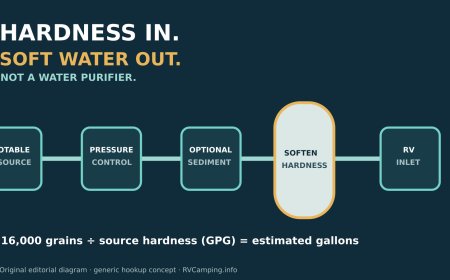
A potable-water spigot somewhere in the campground is not a pressurized water hookup at the campsite. A fill station can load the fresh tank before parking, but it does not support a city-water hose during the stay. A shared hydrant may prohibit threaded hoses or may exist only for containers.
For an at-site connection, verify:
- the listing says water hookup for the exact site;
- the supply is designated potable;
- the water will be on for the entire reservation;
- no current advisory changes use;
- the connection is reachable with the RV parked fully on its pad;
- the campground allows the pressure regulator, potable-water hose and backflow equipment specified for the setup.
Season is the part most likely to disappear from a generic amenity list. Washington warns that water at full-hookup sites may be unavailable during winter because of freezing temperatures.[1] Chatfield State Park in Colorado says full-hookup camping operates from roughly mid-April to mid-October, pending warm weather, while electric-only sites are available year-round. Its water hookups are shut off around mid-October and return in early April, again depending on temperatures.[4]
A winter reservation at an RV site can therefore be valid while the water component is not. The correct fallback is explicit: arrive with the fresh tank prepared, use the park's currently approved fill point, or choose another campground. Do not assume the nearest frost-proof hydrant is available for filling.
Sewer: an on-site inlet is not the dump station
A full sewer hookup means the campsite has a wastewater connection intended for that site. A campground dump station is a shared facility that requires moving the RV or using an allowed portable transfer method. The two arrangements change tank strategy, departure time and accessibility.
Confirm the exact site's sewer listing, then ask:
- Which side of the pad holds the inlet?
- How far is it from the normal RV outlet position?
- Is the inlet above or below the parking surface?
- Does the park require a threaded or sealed connection?
- Are sewer elbows, supports or other equipment required or prohibited?
- Is the sewer currently open, or is the site being sold at a reduced utility level?
Do not solve a short hose by parking beyond the pad, blocking the road or stretching a line across a walking route. The site must work while the entire RV and any tow vehicle remain where the reservation permits.
If the answer is "dump station only," calculate tank capacity for the stay. Record the station's hours, current status and whether water for rinsing is available. A dump station icon on a campground page belongs in the campground-services row, not in the exact-site sewer row.
Site geometry can defeat all three hookups
A utility may exist and still be unusable from the only legal parking position. Long motorhomes, rear sewer outlets, passenger-side water inlets and slides can change reach. Trees, bollards and a sloped shoulder can prevent repositioning.
Review the exact-site diagram or photographs for:
- back-in versus pull-through orientation;
- pedestal and hydrant side;
- sewer inlet position;
- pad length after the tow vehicle is parked;
- slide and awning clearance;
- a route that keeps hoses and cords out of traffic and the living area.
Photographs are clues, not measurements. Ask the campground for approximate utility distances when the layout is unusual. Carry equipment that the RV manufacturer and campground permit, but do not build a reservation around maximum-stretch assumptions.
Read the price and the utility status separately
A full-hookup rate does not prove that all services will operate every night. Conversely, a campground may reduce the rate when seasonal water is off while leaving the site class unchanged. Save the listing as it appeared at purchase and keep any written qualification from staff.
Before paying, capture:
- site number and loop;
- equipment type and maximum length accepted;
- electric receptacles;
- at-site potable water;
- at-site sewer;
- seasonal or repair exceptions;
- total price and fees;
- the cancellation deadline.
Recheck alerts shortly before departure. Pipes freeze, pumps fail and sewer work closes loops. When a missing utility is essential for medical, sanitation or heat needs, decide in advance which failure means moving to a different campground.
Use a two-level fallback, not wishful thinking
Give each utility a site fallback and a trip fallback.
| Utility loss | Site fallback | Trip fallback |
|---|---|---|
| Correct electric service unavailable | Operate within a verified lower-amperage plan if the RV allows it | Move to a confirmed compatible site |
| At-site water unavailable | Use carried tank water or a confirmed potable fill point | Rebook where water is operating |
| At-site sewer unavailable | Stay within tank capacity and use an open dump station | Shorten the stay or move to a sewer site |
A fallback must fit the people and the rig. "We will conserve" is not enough for a week with a small black tank. "We will run on battery" is not enough when someone relies on powered medical equipment. Put a number on tank capacity, battery endurance or the extra drive before accepting the compromise.
The call that settles the booking
Use a question that forces each utility onto its own line:
For RV site [number] on [dates], please confirm separately: (1) which 20-, 30- or 50-amp receptacles will be available at the pedestal; (2) whether the site has its own operating potable-water connection; and (3) whether the site has its own operating sewer inlet rather than access only to a dump station. Please note any seasonal shutoff, repair, utility-side or hose/cord-distance issue that affects this exact site. If any service fails before arrival, how will the campground notify us and what change or refund options apply?
Save the reply with the reservation. At arrival, inspect before connecting. If the pedestal, water fitting or sewer inlet is damaged, missing or different from the confirmed record, stop and contact staff. Do not open utility covers, modify park hardware or move into another site without authorization.
"Full hookup" is a useful search filter. It is not the finished answer. The finished answer is a dated, exact-site record with three separate yeses: compatible electricity, operating potable water and an on-site sewer connection that the parked RV can safely reach.
Sources
- Fees and campsite descriptions — Washington State Parks — Official definitions for standard, partial-hookup and full-hookup campsites, plus the winter water caveat. Accessed October 20, 2026.
- Campsites — Texas Parks and Wildlife Department — Official statewide campsite classes distinguishing full hookup, water-and-electric and no-hookup sites. Accessed October 20, 2026.
- Camping and campsite classes — Colorado Parks and Wildlife — Official statewide description of electric and full-hookup amenity classes. Accessed October 20, 2026.
- Chatfield State Park - Camping & Lodging — Colorado Parks and Wildlife — Official example of seasonal full-hookup operation and temperature-dependent water shutoff. Accessed October 20, 2026.
What's Your Reaction?