








Leaving the RV for a day trip? Know when an unattended campsite becomes vacant
A paid site and an occupancy tag do not create unlimited absence rights. Before a day trip, verify the campground's unattended-property clock, first-night rule and re-registration process.

Leaving the RV for a day trip? Know when an unattended campsite becomes vacant
The paper clipped to a campsite post tells other campers that a site is occupied. It does not promise that the site can sit empty for any length of time. National Park Service guidance says frontcountry campgrounds commonly use a card or paper to show the current occupant's checkout date and tells arriving campers not to remove or replace someone else's occupancy tag.[1]
That tag protects an active claim from casual campsite theft. The local campground rules still decide how long the property may be unattended, whether someone must occupy the site the first night, when another night must be registered, and when a reservation becomes a no-show.
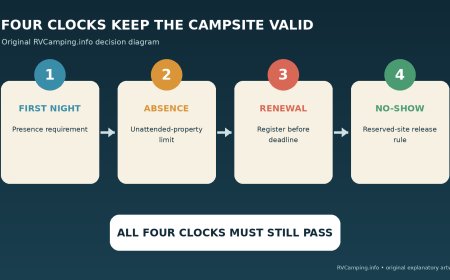
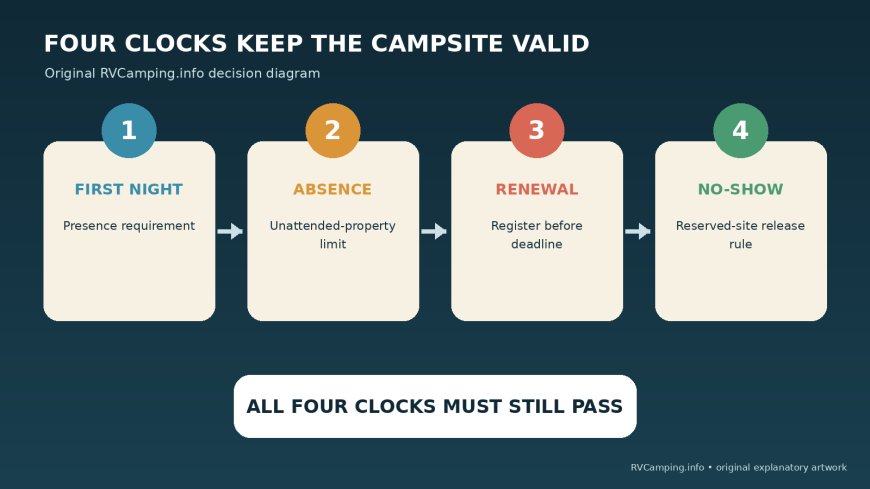
For RV campers planning a long hike, boat trip, family visit or day in town, the right question is not simply "Did we pay?" It is "Which clocks keep this site valid while we are gone?"
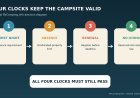
Check four clocks before leaving
Put four entries in the trip notes:
| Clock | Question | Evidence to save |
|---|---|---|
| First-night presence | Must someone physically occupy the campsite on the first night? | Arrival and no-show language for the exact campground |
| Unattended-property limit | How long may the RV, tent or other property remain without a person present? | Local rule and any written exception |
| Checkout or renewal | When does the current paid period end, and when must another night be registered? | Receipt, checkout time and renewal deadline |
| Reservation no-show | When may staff release a reserved site because check-in did not occur? | Reservation terms and campground-specific deadline |
These clocks solve different problems. A two-night reservation may fail a first-night presence rule before the general unattended-property limit matters. A legal daytime absence may turn into an overstay at checkout. A receipt on the post may identify the payer but cannot extend the paid dates.
A site tag is evidence of occupancy, not a substitute for it
The NPS describes the common frontcountry practice: a card or paper at the site shows the occupant's checkout date. It also warns campers not to take a site by removing or replacing the tag.[1]
At Glacier National Park's first-come campgrounds, the mechanics are more specific. Campers attach a receipt tab to the post after paying. At Cut Bank, the page describes using a paper plate with the camper's name and date to show the site is taken. Campers must remove their markers and belongings when they leave for good.[2]
That gives the tag two narrow jobs:
- identify a claimed site to arriving campers and staff; and
- show the paid period or intended checkout.
It does not authorize an extra night, reserve for a friend or defeat an abandonment rule. Do not add unofficial signs, cones or chairs to manufacture a stronger claim. Use the method the campground specifies, fill it out legibly, and photograph it in place before leaving.
The 24-hour rule is common in these parks, but not universal
Several NPS campgrounds use a 24-hour threshold, though the wording and consequence differ.
Glacier's first-come campground page says sites may not be left unattended for more than 24 hours.[2] Sequoia and Kings Canyon says sites not occupied for 24 hours are considered abandoned and property will be impounded.[3] Big Bend says property left unattended for more than 24 hours will be impounded and the campsite forfeited, whether the site is reservable or non-reservable.[4]
Those examples support one careful conclusion: a daytime outing shorter than 24 hours is not automatically abandonment under those quoted provisions. They do not create a nationwide 24-hour entitlement. Another campground can use a shorter limit, require first-night presence, restrict the type of property that may remain, or add terms during emergencies and closures.
Do not round the clock in your favor. If everyone leaves at 7 a.m. Monday and returns after 8 a.m. Tuesday, that is more than 24 hours. Travel delay, a missed ferry or a closed trailhead road does not stop the campground clock unless staff grants an exception.
The first night can fail before the absence clock starts
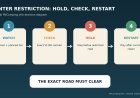
A reservation confirmation is not always enough to hold an unoccupied site through the first night. Sequoia and Kings Canyon says a reserved site may be considered unoccupied and opened to new campers when the party has not checked in by noon on the second reservation day.[3]
That rule concerns arrival, not a mid-stay day trip. Mixing them up creates two bad plans:
- booking Thursday but planning to arrive Friday evening without checking the no-show deadline; or
- checking in properly, then assuming the same no-show language governs every later absence.
Read the exact campground's arrival terms. If plans require skipping the first night, contact the reservation service and campground. Ask whether the reservation can be modified, whether staff can note the delayed arrival, and whether that note changes the release deadline. Get the answer in writing when possible. A voicemail left after the office closes is not confirmation.
Renewal has its own deadline
At Glacier's first-come campgrounds, campers staying another night must re-register by 11 a.m.; checkout is noon.[2] That one-hour gap matters. Returning from a day trip at 4 p.m. with the RV still on site is not timely renewal.
Before leaving on the final paid morning, choose one of three plans:
- Renew by the stated deadline, update the site marker as instructed, then take the day trip.
- Pack and move the RV to a legal day-parking location before checkout.
- Shorten the outing so the complete departure can happen before checkout.
Do not treat the parked RV as a placeholder while deciding later. If the registration expires, the camper is occupying past the paid period, not taking an ordinary day trip from an active site.
Leave a campsite that can safely be left
Passing the occupancy clocks does not make every campsite condition acceptable while nobody is there. Before departure:
- retract the awning and secure loose outdoor items;
- close and lock exterior compartments, doors and accessible windows;
- disconnect or arrange utilities according to the RV manual, campground rule and weather plan;
- put chairs, grills and other gear where wind or wildlife cannot move them;
- take valuables and reservation records or lock them out of sight;
- confirm that no pet or dependent person is being left contrary to campground rules.
Food storage is a separate local rule. Big Bend, for example, says food should be in a vehicle or animal-proof container and specifically says not to leave coolers or food boxes on the ground when the campsite is unattended.[4] The absence limit does not provide permission to leave an outdoor kitchen exposed for 23 hours.
Take a few timestamped photos of the secured site, the occupancy marker, the RV exterior and the utility connections. The goal is not to argue with staff later. It is to catch the easy mistake while you are still standing beside it.
Give staff a usable contact plan
For a long outing, tell the campground office or host when local procedure encourages it, especially if the site will look empty because the motorhome itself is the day-trip vehicle. A trailer left on the pad looks occupied; an empty motorhome site may not.
Keep the message short:
- camper name and site number;
- mobile number;
- departure and expected return times;
- whether the RV remains or leaves;
- backup contact;
- request for the correct after-hours number if plans change.
This notice does not override a rule. It reduces ambiguity and gives staff a way to reach the permit holder. Ask whether an empty pad with only a site tag still counts as occupied. Some campgrounds require equipment to remain; others focus on the registered party or property. Only the local rule can answer.
Build a delay trigger before the outing
A day trip can become an overnight absence after a mechanical problem, injury, weather closure or missed connection. Decide in advance when to call.
A practical trigger is the earliest of:
- four hours before the unattended-property limit;
- two hours before the campground office closes;
- the moment the group knows it cannot return before checkout or renewal;
- the moment an evacuation, closure or emergency order changes access.
When the trigger fires, contact the campground. Explain where the RV or trailer is, when the site was last attended and the best estimated return. Ask what staff authorizes: return by a new time, arrange for removal, end the stay, or another documented option. Do not assume paying remotely cures an absence violation.
If the campground cannot be reached, follow the written rule. A friend should not enter, move the RV or occupy the site unless the campground authorizes that person and the insurance, key and vehicle arrangements are lawful and safe.
A two-minute site-validity note
Before walking away, finish this sentence:
"Site [number] is paid through [date and time], marked by [approved tag or receipt], was occupied as required on [first-night date], may be unattended until [time under the local rule], and must be renewed or vacated by [deadline]."
Then add the source of each answer: campground page, reservation terms, posted notice or staff member with date and time. If the unattended deadline is unknown, the day trip is not ready. If the return plan lands too close to the deadline, shorten the outing or move the RV.
A campsite claim is a bundle of conditions, not a chair on gravel. Keep the tag, presence, payment and clock aligned, and a day away from camp stays what it was supposed to be: a day trip, not an accidental forfeiture.
Editorial note: Campground occupancy and unattended-property rules vary and can change. The official NPS pages below were reviewed October 20, 2026. Confirm the rule for the exact campground and dates; this article does not claim firsthand inspection or provide legal advice.
Sources
What's Your Reaction?