




Autumn RV trip planning: build a water-and-freeze itinerary
A per-night method for separating campground availability from water-service status, timing forecast rechecks, and placing verified fills before dry autumn stays.


Autumn RV trip planning: build a water-and-freeze itinerary
By Romana
Category: RV Camping
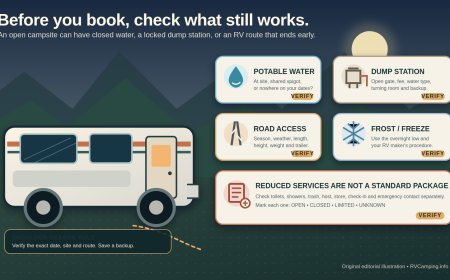
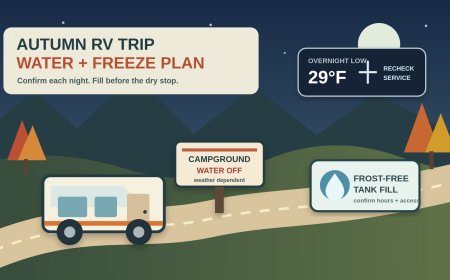
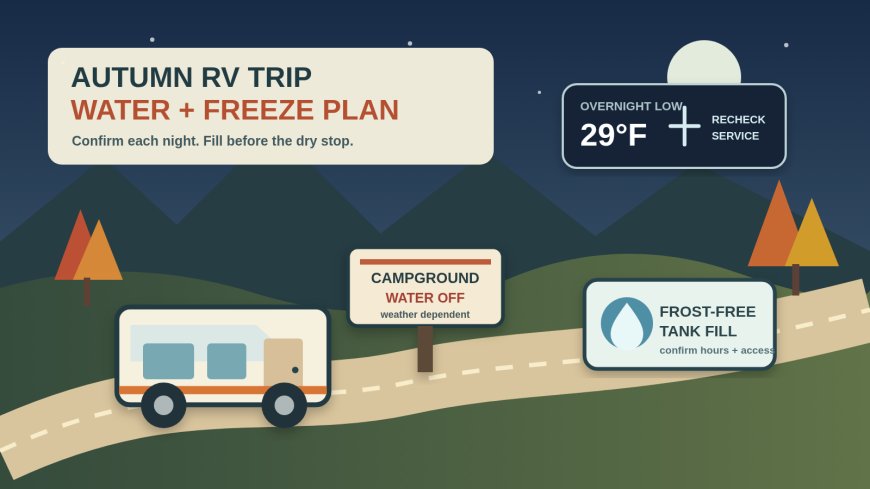
A campground can be open, reservable, and dry. That combination catches autumn RV travelers because the booking screen may still show the amenities the property offers in summer. The useful question is not simply, "Is the campground open?" It is, "Which water services will operate on each night of my stay, and what is my next workable fill if they do not?"
This is a trip-planning problem. Your RV still needs a separate, model-specific freeze-protection plan. Here, the job is to keep a cold night or early water shutoff from breaking the itinerary.
Treat the reservation and the water service as separate bookings
The National Park Service warns that campgrounds may have fewer sites and limited facilities during winter and shoulder seasons. It tells travelers to check campground and facility dates with the individual park.[1] In practice, "open" can mean a legal campsite, a vault toilet, and little else.
Make two confirmations for every overnight stop:
- The space: Is the exact site open, reachable, and suitable for the RV's length, height, weight, and deployed equipment?
- The service set: Will the site hydrant, shared potable fill, dump station, rinse water, showers, and flush restrooms operate on the arrival and departure dates?
Do not let one answer stand in for the other. A year-round campground may winterize its hookups. A dump station may remain physically accessible while its rinse water is off. A frost-free fill may operate after individual site water closes. Those are three different arrangements, and they lead to three different water plans.
Build one row for every night
Create a small trip table before paying nonrefundable fees. One row per overnight is enough:
| Night | Campground and site | Forecast low | Site water | Shared potable fill | Dump and rinse water | Shutoff rule | Backup fill |
|---|---|---|---|---|---|---|---|
| 1 | Exact reservation | Recheck later | Confirm | Confirm location and hours | Confirm separately | Date, weather trigger, or both | Named town or facility |
Add the source URL, the date you checked it, and the phone number you called. If a staff member provides information not shown online, record the employee's name and the time of the call. This is not bureaucracy for its own sake. It lets you spot a stale answer when the forecast changes.
The table also exposes bad sequencing. If Night 2 has no water and Night 1's campground closes its fill before you arrive, the shortage begins a day earlier than expected. Move the fill to a verified stop on the travel day rather than hoping to solve it after parking.
Read shutdown language literally
Official campground pages use several kinds of wording, and they are not interchangeable.
At LaPine State Park in Oregon, the south loop remains open year-round, but the page lists water at its full-hookup sites as off from October 1 through May 1. The dump station's water is listed with the same shutoff period.[3] An October reservation there should therefore be planned as a winterized-service stay unless the park confirms otherwise.
Washington's Wenatchee Confluence State Park posted a more specific 2026 notice. It says domestic water is tentatively scheduled to shut off beginning October 26, while park restrooms remain open and campers may fill tanks at frost-free valves near the dump station.[4] The word "tentatively" matters. It gives you a planning date, not a guarantee that weather or operations cannot move it.
Ponderosa Group Campground at Bandelier National Monument shows a third pattern: the campground is open year-round, but water is normally available only from mid-May to mid-October and is subject to delays or early shutoff. The listing also ties water availability to months without freezing temperatures.[5] For an autumn itinerary, "mid-October" is a review window. It is not a promise that the tap will work through a particular checkout morning.
When you see phrases such as weather permitting, subject to early shutoff, tentatively, or seasonal, put the service in the "unconfirmed" column until you check again close to arrival.
Use the forecast to time the second check
A monthly climate average cannot answer whether a campground will winterize before your stay. Use the National Weather Service point forecast for the campground's location, then open the hourly graph. NWS says its graph provides an hour-by-hour forecast for the next seven days.[2]
Run the first service check when you choose the route. Run the second when the campground enters that seven-day forecast window. Run a final check on departure day if any overnight hour is near or below freezing, the campground uses weather-dependent wording, or staff have posted a new operations alert.
The forecast does not tell you how a particular RV's plumbing will perform. It tells you when a weather-dependent campground answer deserves another call. Keep those jobs separate.
Ask for the service that solves the problem
"Will water be on?" is too broad. Use a short script:
We are arriving in an RV on [date] and leaving on [date]. Please confirm whether water will be operating at our exact site, whether a separate potable tank-fill is available, its hours and access route, whether the dump station is open, and whether rinse water is operating. Does the current forecast change any of those answers?
Then ask where the alternative fill is located. "Near the dump station" may be clear to staff but ambiguous after dark. Ask whether an RV can reach it without unhitching, whether a hose is supplied, and whether filling a tank is permitted rather than merely filling small containers.
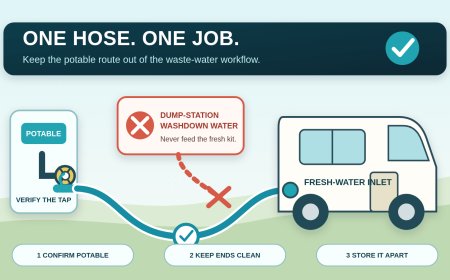
Never treat a sink, cleaning tap, irrigation spigot, or unmarked hydrant as potable. If the operator cannot identify a drinking-water source, bring water from a confirmed source or change the stop.
Put the water stops before the dry nights
Route order matters more than a clever campsite workaround. Place a confirmed fill before the first campground with reduced water service. If the RV is carrying more water than usual, keep the added load within the RV's weight ratings and actual payload margin. The fresh tank's capacity does not prove that the loaded RV can safely carry it.
Use your own measured consumption to decide how much water the itinerary needs. Before the trip, run an ordinary evening and morning from the fresh tank. Record the starting and ending tank readings, note the number of travelers, and include toilets, cooking, pets, and handwashing. Tank gauges can be imprecise, so keep a reserve rather than planning to arrive at the next fill with a theoretical zero.
Carry separate drinking water as a backup. That reserve does not replace water needed for sanitation, nor does it make an unknown source safe. It simply prevents one failed pump, closed fill, or delayed arrival from immediately consuming the drinking supply.
Plan for three different outcomes
For each stop, write a branch before leaving home.
Water remains available
Fill during posted hours, follow campground rules, and confirm whether the site connection must be disconnected overnight. Do not assume that a working afternoon tap will remain available the next morning.
Site water is off, but a shared potable fill is open
Arrive early enough to use it, fill within the RV's safe carrying limit, and store the hose before the coldest hours. Confirm the dump station and rinse-water status separately.
All campground water is off
Arrive self-contained from a verified source, use the measured water budget, and identify the next legal dump and potable fill before committing to the stay. If the required water load, tank capacity, wastewater capacity, or road conditions make that plan unrealistic, change campgrounds. An open site is not automatically a usable site.
Set a route-change trigger
Decide what will make you shorten, move, or cancel the stop. Useful triggers include:
- the campground cannot confirm a potable source for the stay dates;
- a weather-dependent shutoff moves ahead of the planned arrival;
- the only alternative fill is closed before the RV can reach it;
- the required water load would exceed the rig's safe payload plan;
- the dump station remains open but rinse water is unavailable and the planned procedure depends on it;
- the next refill requires a road, grade, or turnaround the rig cannot use; or
- freezing weather also threatens the route, making a late move less safe than an early change.
Make the decision while offices are open and roads are still routine. Waiting until the tank is low turns a scheduling problem into a campsite emergency.
The 48-hour autumn departure check
Before rolling out, confirm:
- every overnight has a dated service-status record;
- the NWS point and hourly forecasts cover the actual campground locations;
- site water and shared potable fill are recorded separately;
- dump access and dump-station water are recorded separately;
- weather-dependent or tentative shutdown language has been rechecked;
- a verified fill comes before the first reduced-service night;
- the planned water load fits the RV's payload calculation;
- drinking-water reserve and wastewater capacity cover a delay;
- office hours, after-hours access, and the fill route are known; and
- the group knows the route-change trigger.
An autumn itinerary works when each night has a confirmed service set, a weather recheck, and a named fallback. The campsite may stay open after the pipes are winterized. Your plan should still work when it does.
Editorial note: This guide addresses itinerary and campground-service planning, not RV plumbing protection. Official service facts were checked September 21, 2026. No firsthand stay or equipment test is claimed.
Sources
- [1] National Park Service: When Can I Camp? (accessed September 21, 2026).
- [2] National Weather Service: Get Your Hourly Weather Forecast (accessed September 21, 2026).
- [3] Oregon State Parks: LaPine State Park (accessed September 21, 2026).
- [4] Washington State Parks: Wenatchee Confluence State Park (accessed September 21, 2026).
- [5] Recreation.gov: Ponderosa Group Campground (accessed September 21, 2026).
What's Your Reaction?